Laboratory of Immune Regulation in Department of Biomedical Sciences, Seoul National University College of Medicine, Seoul, Korea.
Department of Pathology, Seoul National University College of Medicine, Seoul, Korea.
Sci Adv. 2024 Mar 29;10(13):eadj9600. doi: 10.1126/sciadv.adj9600. Epub 2024 Mar 27.
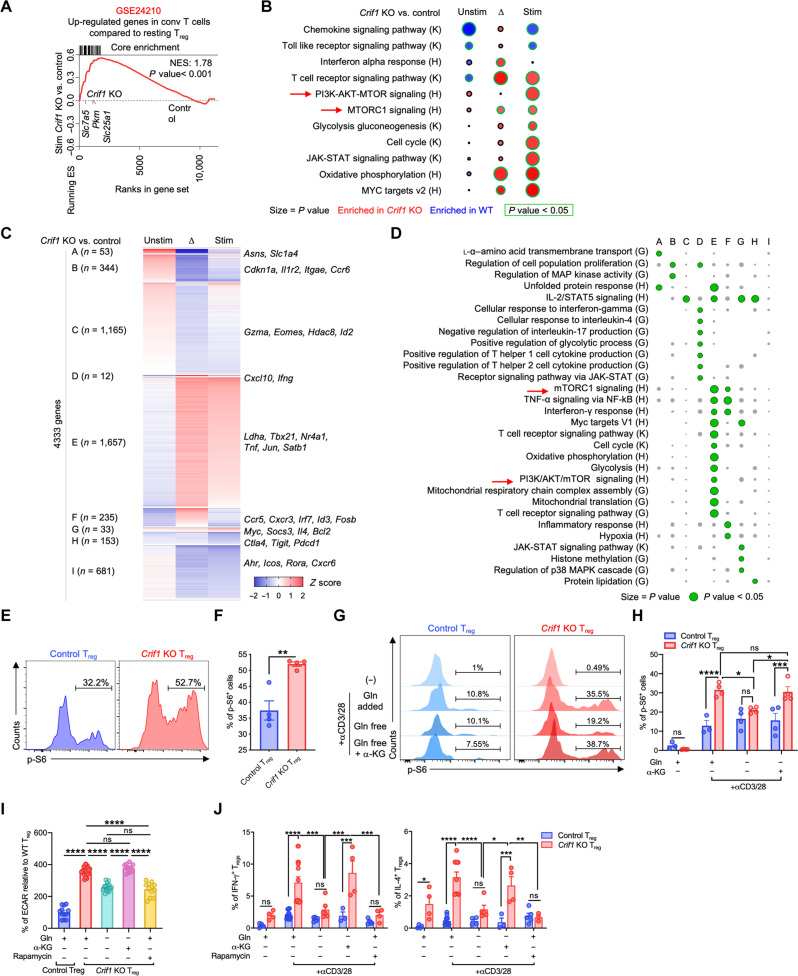
Recently identified human FOXP3CD45RA inflammatory non-suppressive (INS) cells produce proinflammatory cytokines, exhibit reduced suppressiveness, and promote antitumor immunity unlike conventional regulatory T cells (T). In spite of their implication in tumors, the mechanism for generation of FOXP3CD45RA INS cells in vivo is unclear. We showed that the FOXP3CD45RA cells in human tumors demonstrate attenuated expression of CRIF1, a vital mitochondrial regulator. Mice with CRIF1 deficiency in T bore Foxp3INS-T with mitochondrial dysfunction and metabolic reprograming. The enhanced glutaminolysis activated α-ketoglutarate-mTORC1 axis, which promoted proinflammatory cytokine expression by inducing EOMES and SATB1 expression. Moreover, chromatin openness of the regulatory regions of the and genes was increased, which facilitated EOMES/SATB1 binding. The increased α-ketoglutarate-derived 2-hydroxyglutarate down-regulated Foxp3 expression by methylating the gene regulatory regions. Furthermore, CRIF1 deficiency-induced Foxp3INS-T suppressed tumor growth in an IFN-γ-dependent manner. Thus, CRIF1 deficiency-mediated mitochondrial dysfunction results in the induction of Foxp3INS-T including FOXP3CD45RA cells that promote antitumor immunity.
最近发现的人类 FOXP3CD45RA 炎性非抑制性(INS)细胞产生促炎细胞因子,表现出降低的抑制性,并促进抗肿瘤免疫,与传统的调节性 T 细胞(T)不同。尽管它们与肿瘤有关,但体内产生 FOXP3CD45RA INS 细胞的机制尚不清楚。我们表明,人类肿瘤中的 FOXP3CD45RA 细胞表现出 CRIF1 的表达减弱,CRIF1 是一种重要的线粒体调节剂。在 T 细胞中缺乏 CRIF1 的小鼠中,Foxp3INS-T 具有线粒体功能障碍和代谢重编程。增强的谷氨酰胺分解激活了 α-酮戊二酸-mTORC1 轴,通过诱导 EOMES 和 SATB1 表达促进促炎细胞因子的表达。此外,调控区的染色质开放性增加,这促进了 EOMES/SATB1 结合。增加的 α-酮戊二酸衍生的 2-羟基戊二酸通过甲基化基因调控区来下调 Foxp3 的表达。此外,CRIF1 缺陷诱导的 Foxp3INS-T 以 IFN-γ 依赖的方式抑制肿瘤生长。因此,CRIF1 缺陷介导的线粒体功能障碍导致包括 FOXP3CD45RA 细胞在内的 Foxp3INS-T 的诱导,从而促进抗肿瘤免疫。