Department of Cardiology, Aalborg University Hospital, Hobrovej 18-22, DK-9000 Aalborg, Denmark.
Cardiovascular Department, King's College Hospital NHS Foundation Trust London, London, UK.
Eur Heart J. 2024 Mar 27;45(12):987-997. doi: 10.1093/eurheartj/ehae054.
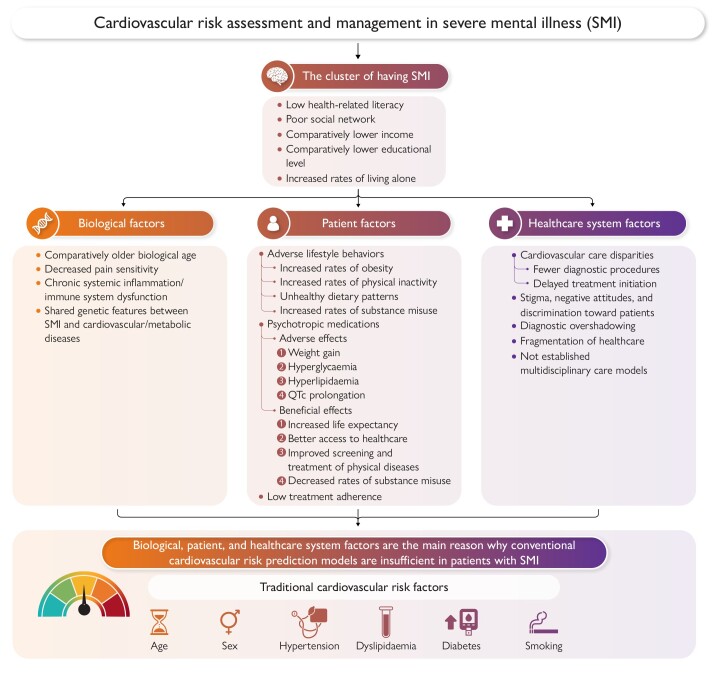
Patients with severe mental illness (SMI) including schizophrenia and bipolar disorder die on average 15-20 years earlier than the general population often due to sudden death that, in most cases, is caused by cardiovascular disease. This state-of-the-art review aims to address the complex association between SMI and cardiovascular risk, explore disparities in cardiovascular care pathways, describe how to adequately predict cardiovascular outcomes, and propose targeted interventions to improve cardiovascular health in patients with SMI. These patients have an adverse cardiovascular risk factor profile due to an interplay between biological factors such as chronic inflammation, patient factors such as excessive smoking, and healthcare system factors such as stigma and discrimination. Several disparities in cardiovascular care pathways have been demonstrated in patients with SMI, resulting in a 47% lower likelihood of undergoing invasive coronary procedures and substantially lower rates of prescribed standard secondary prevention medications compared with the general population. Although early cardiovascular risk prediction is important, conventional risk prediction models do not accurately predict long-term cardiovascular outcomes as cardiovascular disease and mortality are only partly driven by traditional risk factors in this patient group. As such, SMI-specific risk prediction models and clinical tools such as the electrocardiogram and echocardiogram are necessary when assessing and managing cardiovascular risk associated with SMI. In conclusion, there is a necessity for differentiated cardiovascular care in patients with SMI. By addressing factors involved in the excess cardiovascular risk, reconsidering risk stratification approaches, and implementing multidisciplinary care models, clinicians can take steps towards improving cardiovascular health and long-term outcomes in patients with SMI.
患有严重精神疾病(SMI)的患者,包括精神分裂症和双相情感障碍,其平均寿命比一般人群早 15-20 年,这主要是由于心血管疾病导致的猝死。本篇综述旨在探讨 SMI 与心血管风险之间的复杂关联,探索心血管护理途径中的差异,描述如何充分预测心血管结局,并提出针对性的干预措施来改善 SMI 患者的心血管健康。由于生物因素(如慢性炎症)、患者因素(如过度吸烟)和医疗保健系统因素(如污名和歧视)之间的相互作用,这些患者的心血管风险因素状况不佳。在 SMI 患者中已经发现了心血管护理途径中的多种差异,导致接受侵入性冠状动脉程序的可能性降低了 47%,与一般人群相比,开具标准二级预防药物的比率也大大降低。尽管早期心血管风险预测很重要,但传统的风险预测模型并不能准确预测长期心血管结局,因为在该患者群体中,心血管疾病和死亡率仅部分由传统危险因素驱动。因此,在评估和管理与 SMI 相关的心血管风险时,需要使用特定于 SMI 的风险预测模型和临床工具,如心电图和超声心动图。总之,SMI 患者需要差异化的心血管护理。通过解决与心血管风险增加相关的因素、重新考虑风险分层方法以及实施多学科护理模式,临床医生可以采取措施改善 SMI 患者的心血管健康和长期结局。