Department of Health and Rehabilitation Sciences, College of Applied Medical Sciences, Prince Sattam Bin Abdulaziz University, Al-Kharj, 11942, Kingdom of Saudi Arabia.
Department of Health and Rehabilitation Sciences, Prince Sattam Bin Abdulaziz University, Al-Kharj, 11942, Kingdom of Saudi Arabia.
BMC Cardiovasc Disord. 2024 Mar 27;24(1):184. doi: 10.1186/s12872-024-03845-8.
Cardiovascular diseases (CVDs) are common chronic conditions that lead to morbidity and mortality worldwide. However, there are no recent national or regional reports about CVDs in Saudi Arabia. Therefore, this study aimed to estimate the national and regional prevalence rates of CVDs among the Saudi population.
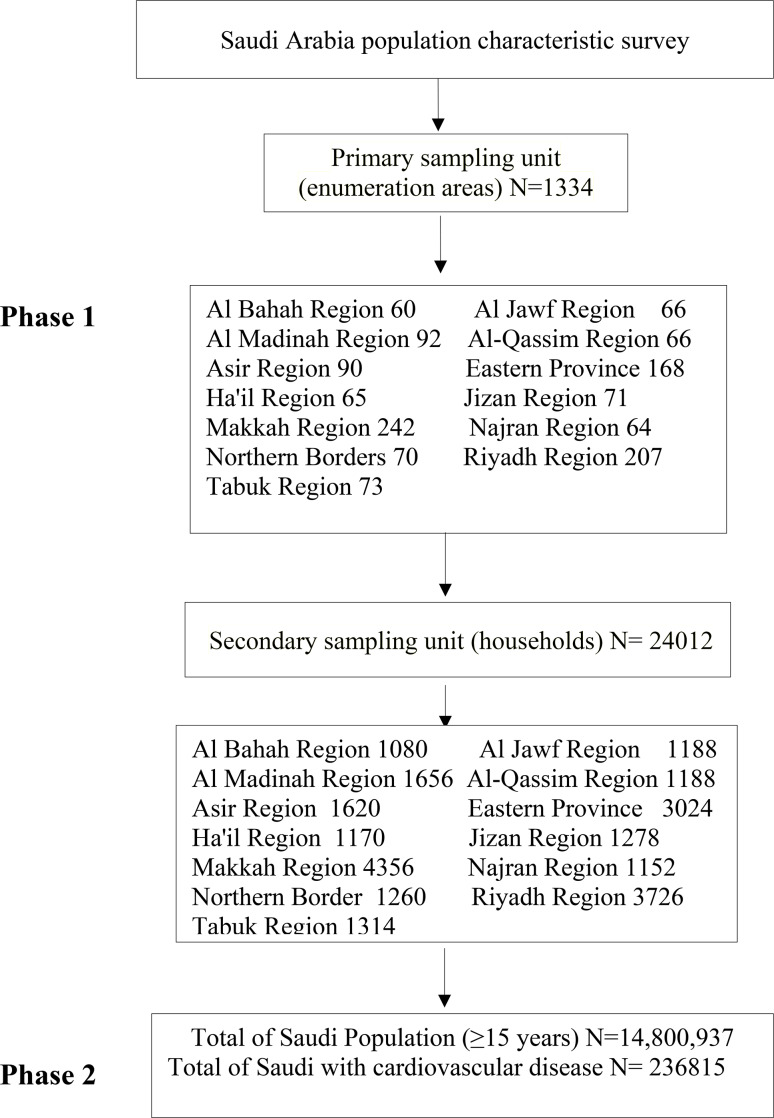
This study used data from an ongoing household health survey conducted by the General Authority for Statistics in 2017. The survey sample comprised 24,012 homes that were determined to be a representative sample of the population and dispersed throughout the 13 administrative areas. A self-reported diagnosis of CVD was collected by asking subjects if they had been diagnosed by a physician.
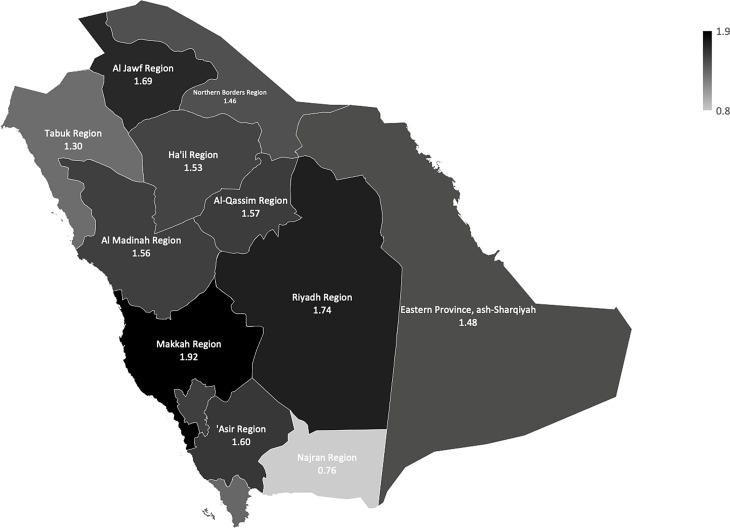
The prevalence of CVDs among the Saudi population aged 15 years and older was 1.6% (n = 236,815). The prevalence is higher in males at 1.9% compared to females at 1.4%. Age is a significant factor, with a gradual increase in CVD prevalence until the age of 50, followed by a sharp rise. The prevalence among the age group (≥ 65 years) was the highest, recording 11% (n = 93,971), followed by the age group (60-64 years) which reached 6.5% (n = 31156.71), and the lowest prevalence was found in the age group (< 40 years) as 1.2% (n = 108,226). When considering regional differences, Makkah has the highest prevalence at 1.9% (n = 85,814), followed by Riyadh at 1.7% (n = 79,191). Conversely, Najran has the lowest prevalence at 0.76% (n = 332), with the Northern Border Region having the second lowest rate at 1,46% ( n = 4218) These findings underscore the importance of considering both demographic and regional factors in addressing and managing cardiovascular health in Saudi Arabia.
This study provides the most recent estimates of the national and regional prevalence rates of CVDs in Saudi Arabia. The findings suggest that CVDs are more common among older adults, males, and residents of the Makkah region. This information can be used to inform public health policies and interventions to reduce the burden of CVDs in Saudi Arabia.
心血管疾病(CVDs)是全球常见的慢性病,可导致发病率和死亡率。然而,沙特阿拉伯目前尚无关于 CVDs 的最新国家或地区报告。因此,本研究旨在估计沙特人口中 CVDs 的全国和地区流行率。
本研究使用了 2017 年由沙特统计总局进行的一项正在进行的家庭健康调查的数据。该调查样本包括 24012 户家庭,这些家庭被确定为人口的代表性样本,并分布在 13 个行政区。通过询问受试者是否被医生诊断过来收集 CVD 的自我报告诊断。
15 岁及以上沙特人口 CVD 的患病率为 1.6%(n=236815)。男性患病率为 1.9%,高于女性的 1.4%。年龄是一个重要因素,CVD 患病率随着年龄的增长逐渐增加,直到 50 岁,然后急剧上升。年龄组(≥65 岁)的患病率最高,为 11%(n=93971),其次是年龄组(60-64 岁),达到 6.5%(n=31156.71),患病率最低的是年龄组(<40 岁),为 1.2%(n=108226)。考虑到地区差异,麦加的患病率最高,为 1.9%(n=85814),其次是利雅得,为 1.7%(n=79191)。相比之下,纳季兰的患病率最低,为 0.76%(n=332),而北部边境地区的患病率第二低,为 1.46%(n=4218)。这些发现强调了在沙特阿拉伯,在解决和管理心血管健康问题时,既要考虑人口统计学因素,又要考虑地区因素。
本研究提供了沙特阿拉伯最新的 CVD 全国和地区流行率估计。研究结果表明,CVD 在老年人、男性和麦加地区居民中更为常见。这些信息可用于为沙特阿拉伯制定公共卫生政策和干预措施提供信息,以减轻 CVD 的负担。