Zheng Zitian, Luo Huanhuan, Xue Qingyun
Department of Orthopedics, Beijing Hospital, National Center of Gerontology, Institute of Geriatric Medicine, Chinese Academy of Medical Sciences, NO.1 Da Hua Road, 100730, DongDan, Beijing, P.R. China.
Department of Sports Medicine, Beijing Key Laboratory of Sports Injuries, Peking University Third Hospital, Institute of Sports Medicine of Peking University, Beijing, P.R. China.
Arch Public Health. 2024 Mar 27;82(1):44. doi: 10.1186/s13690-024-01275-8.
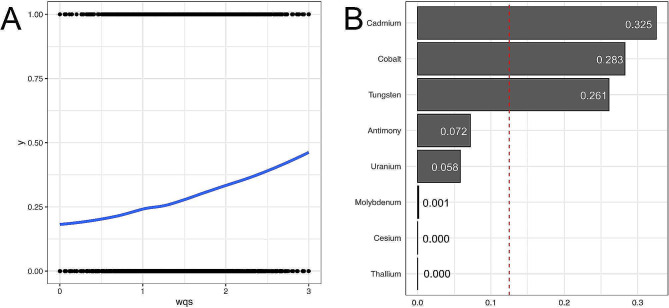
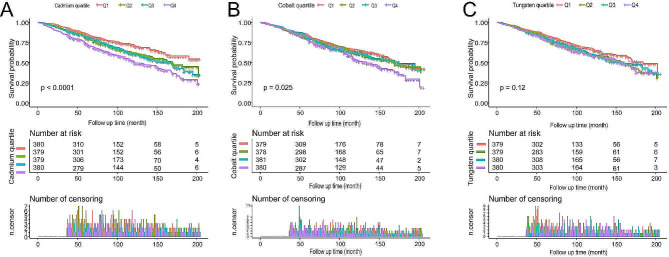
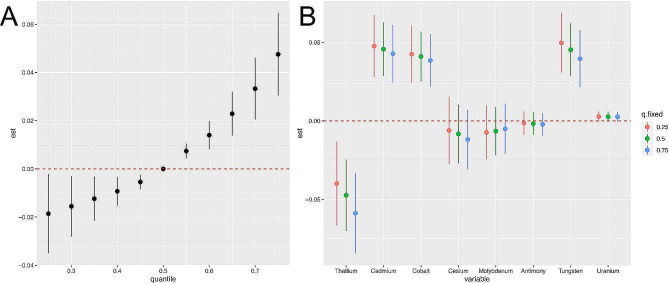
Heavy metals' presence as environmental pollutants has a close link to adverse health effects. Frailty, a clinical syndrome hallmarked by elevated vulnerability to stressors, presents a substantial challenge in healthcare. However, the association between exposure to heavy metals and frailty largely remains unexplored. Utilizing data from the National Health and Nutrition Examination Survey (NHANES) spanning 2003-2018 and correlated with the U.S. National Death Index (NDI) from 2019, we investigated mortality outcomes. Logistic regression, Cox regression, Kaplan-Meier survival curves, weighted quantile-sum (WQS) regression, and Bayesian kernel machine regression (BKMR) were employed to assess the association between heavy metal exposure and frailty incidence and mortality in the frail population. Eight metals were measured in urine using inductively coupled plasma mass spectrometry with values adjusted for urinary creatinine, which was used to reflect heavy metal exposure. The cohort incorporated 5370 female participants aged 45 and above, with 1518 diagnosed with frailty. The findings indicated a substantial correlation between exposure to specific heavy metals, namely tungsten (odds ratio [OR]: 1.94, 95% confidence interval [CI]: 1.31-2.89), cobalt (OR: 1.64, 95% CI: 1.40-1.93), cadmium (OR: 1.93, 95% CI: 1.52-2.43), and uranium (OR: 7.36, 95% CI: 1.53-35.28), and an elevated risk of frailty. WQS and BKMR regression models identified cadmium, cobalt, and tungsten as main contributors to frailty. Cox regression analysis, after adjustment for covariates, suggested that the higher the exposure levels to cadmium and lead, the higher the risk of death in frail patients, with associated hazard ratios (HR) of 95% CI: 1.96 (1.53, 2.52) and 1.30 (1.13, 1.49), respectively. Our study revealed a significant positive correlation between exposure to heavy metal mixtures and frailty onset in middle-aged and older adults, along with increased mortality in frail patients. Cobalt, cadmium, and tungsten emerged as prominent contributors to frailty, with cobalt and cadmium directly impacting the long-term life expectancy of frail patients.
重金属作为环境污染物的存在与不良健康影响密切相关。衰弱是一种临床综合征,其特征是对压力源的易感性增加,这给医疗保健带来了重大挑战。然而,重金属暴露与衰弱之间的关联在很大程度上仍未得到探索。利用2003年至2018年美国国家健康和营养检查调查(NHANES)的数据,并与2019年的美国国家死亡指数(NDI)相关联,我们调查了死亡率结果。采用逻辑回归、Cox回归、Kaplan-Meier生存曲线、加权分位数和(WQS)回归以及贝叶斯核机器回归(BKMR)来评估重金属暴露与衰弱人群中衰弱发生率和死亡率之间的关联。使用电感耦合等离子体质谱法测量尿液中的八种金属,并根据尿肌酐对数值进行调整,以反映重金属暴露情况。该队列纳入了5370名45岁及以上的女性参与者,其中1518人被诊断为衰弱。研究结果表明,特定重金属暴露之间存在显著相关性,即钨(优势比[OR]:1.94,95%置信区间[CI]:1.31-2.89)、钴(OR:1.64,95%CI:1.40-1.93)、镉(OR:1.93,95%CI:1.52-2.43)和铀(OR:7.36,95%CI:1.53-35.28),以及衰弱风险增加。WQS和BKMR回归模型确定镉、钴和钨是衰弱的主要促成因素。在对协变量进行调整后,Cox回归分析表明,衰弱患者中镉和铅的暴露水平越高,死亡风险越高,相关风险比(HR)的95%CI分别为1.96(1.53,2.52)和1.30(1.13,1.49)。我们的研究揭示了重金属混合物暴露与中老年人群衰弱发病之间存在显著正相关,以及衰弱患者死亡率增加。钴、镉和钨是衰弱的主要促成因素,钴和镉直接影响衰弱患者的长期预期寿命。