Gong Hongyang, Gao Ming, Huang Shaoqun
Department of Oncology Surgery, Fuzhou Hospital of Traditional Chinese Medicine Affiliated to Fujian University of Traditional Chinese Medicine, No.102 Gudong Road, Gulou District, Fuzhou City, 350001, Fujian Province, China.
Department of Physiology, College of Medicine, Chosun University, Gwangju, Korea.
BMC Public Health. 2025 Apr 22;25(1):1491. doi: 10.1186/s12889-025-22706-3.
Rheumatoid arthritis (RA) imposes a significant burden on healthcare systems. This study investigates the impact of social determinants of health (SDoH) on the prognosis of RA patients, aiming to inform interventions that improve health outcomes.
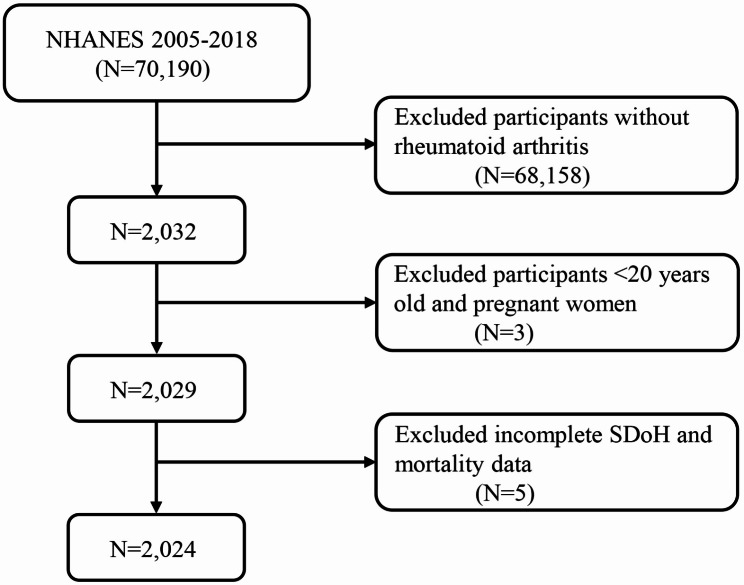
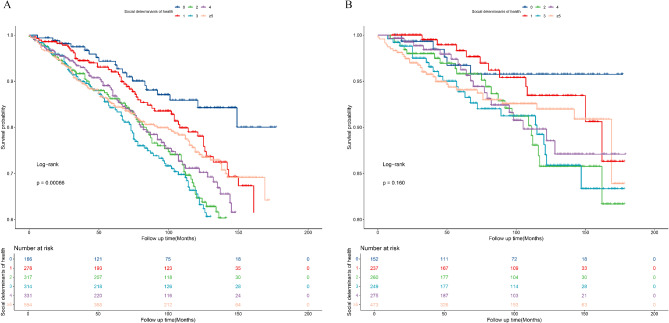
The National Health and Nutrition Examination Survey (NHANES) 2005-2018 included 2,024 RA participants. SDoH was assessed based on the five domains outlined in the Healthy People 2030 framework, with the cumulative number of adverse SDoH calculated. Cox regression analysis, subgroup analysis, and Kaplan-Meier survival analysis were employed to evaluate the associations between SDoH and all-cause mortality as well as cardiovascular mortality among RA patients, adjusting for potential confounding factors.
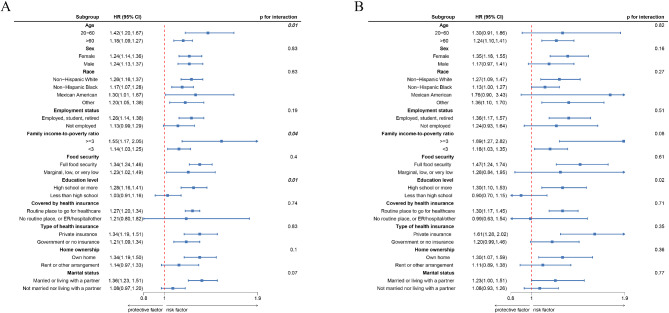
Over a median follow-up of 79 months, 449 deaths (19%) occurred, including 120 cardiovascular deaths. Each 1-point increase in cumulative SDoH score was linked to a 24% higher risk of all-cause mortality (HR: 1.24; 95% CI: 1.16-1.32; p < 0.001) and a 25% higher risk of cardiovascular mortality (HR: 1.25; 95% CI: 1.13-1.39; p < 0.001). Exposure to five or more adverse SDoH was associated with a higher risk of all-cause mortality (HR: 3.94; 95% CI: 2.20-7.06; p < 0.001) as well as cardiovascular mortality (HR: 3.98; 95% CI: 1.22-12.97; p = 0.020). Significant interactions were found between SDoH and age, income, and education level.
Adverse SDoH, particularly when accumulated, are associated with increased mortality risks in RA patients, emphasizing the need for targeted interventions to mitigate these effects.
类风湿性关节炎(RA)给医疗系统带来了沉重负担。本研究调查健康的社会决定因素(SDoH)对RA患者预后的影响,旨在为改善健康结局的干预措施提供依据。
2005 - 2018年国家健康与营养检查调查(NHANES)纳入了2024名RA参与者。根据《健康人民2030》框架中概述的五个领域对SDoH进行评估,并计算不良SDoH的累积数量。采用Cox回归分析、亚组分析和Kaplan - Meier生存分析来评估SDoH与RA患者全因死亡率以及心血管死亡率之间的关联,并对潜在混杂因素进行调整。
在中位随访79个月期间,发生了449例死亡(19%),其中包括120例心血管死亡。累积SDoH评分每增加1分,全因死亡率风险升高24%(风险比:1.24;95%置信区间:1.16 - 1.32;p < 0.001),心血管死亡率风险升高25%(风险比:1.25;95%置信区间:1.13 - 1.39;p < 0.001)。暴露于五个或更多不良SDoH与全因死亡率较高(风险比:3.94;95%置信区间:2.20 - 7.06;p < 0.001)以及心血管死亡率较高(风险比:3.98;95%置信区间:1.22 - 12.97;p = 0.020)相关。在SDoH与年龄、收入和教育水平之间发现了显著的交互作用。
不良SDoH,尤其是累积时,与RA患者的死亡风险增加相关,强调需要采取针对性干预措施来减轻这些影响。