
NHANES(2005-2018 年)中单纯吸食大麻者的血液和尿液金属水平。
Blood and Urinary Metal Levels among Exclusive Marijuana Users in NHANES (2005-2018).
机构信息
Department of Environmental Health Science, Columbia University Mailman School of Public Health, New York, New York, USA.
Department of Medicine, Columbia University Irving Medical Center, New York, New York, USA.
出版信息
Environ Health Perspect. 2023 Aug;131(8):87019. doi: 10.1289/EHP12074. Epub 2023 Aug 30.
BACKGROUND
Marijuana is the third most used drug in the world.
OBJECTIVES
Because the cannabis plant is a known scavenger of metals, we hypothesized that individuals who use marijuana will have higher metal biomarker levels compared with those who do not use.
METHODS
We combined data from the National Health and Nutrition Examination Survey (2005-2018) for participants, classified by use: non-marijuana/non-tobacco, exclusive marijuana, exclusive tobacco, and dual marijuana and tobacco use. Five metals were measured in blood and 16 in urine using inductively coupled plasma mass spectrometry; urinary metals were adjusted for urinary creatinine.
RESULTS
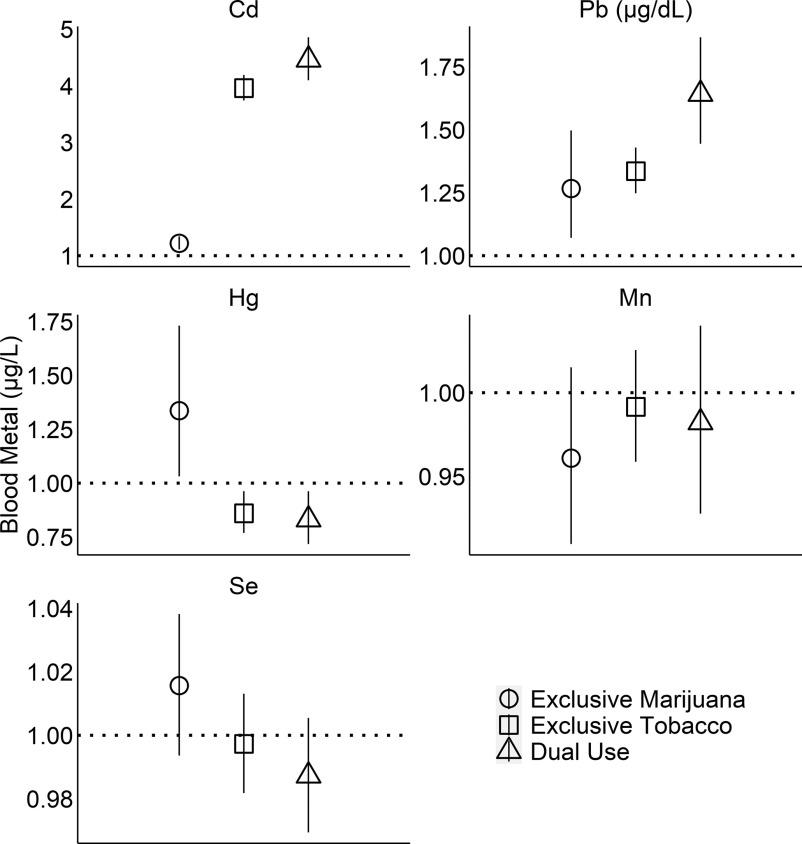
Participants reporting exclusive marijuana use compared with non-marijuana/non-tobacco use had statistically significantly higher mean cadmium levels in blood [ (95% CI: 1.11, 1.34); ] and urine [ (95% CI: 1.0, 1.31); ] and statistically significantly higher mean lead levels in blood [ (95% CI: 1.07, 1.50); ] and urine [ (95% CI: , 1.50); ].
DISCUSSION
Our results suggest marijuana is a source of cadmium and lead exposure. Research regarding cannabis use and cannabis contaminants, particularly metals, should be conducted to address public health concerns related to the growing number of cannabis users. https://doi.org/10.1289/EHP12074.
背景
大麻是世界上使用第三多的毒品。
目的
由于大麻植物是金属的已知清除剂,我们假设与不使用大麻的人相比,使用大麻的个体的金属生物标志物水平会更高。
方法
我们结合了 2005-2018 年全国健康和营养检查调查(National Health and Nutrition Examination Survey)的数据,参与者分为使用组:非大麻/非烟草、单一使用大麻、单一使用烟草以及大麻和烟草同时使用。使用电感耦合等离子体质谱法(inductively coupled plasma mass spectrometry)在血液中测量了 5 种金属,在尿液中测量了 16 种金属;尿液中的金属用尿肌酐进行了调整。
结果
与非大麻/非烟草使用者相比,报告单一使用大麻的参与者血液中的镉水平[(95%置信区间:1.11,1.34)]和尿液中的镉水平[(95%置信区间:1.0,1.31)]显著更高,血液中的铅水平[(95%置信区间:1.07,1.50)]和尿液中的铅水平[(95%置信区间:1.07,1.50)]也显著更高。
讨论
我们的结果表明大麻是镉和铅暴露的来源。应该开展关于大麻使用和大麻污染物的研究,特别是金属方面的研究,以解决与越来越多的大麻使用者相关的公共卫生问题。https://doi.org/10.1289/EHP12074。



 Zotero 插件