Tinterri Corrado, Barbieri Erika, Sagona Andrea, Bottini Alberto, Canavese Giuseppe, Gentile Damiano
Breast Unit, IRCCS Humanitas Research Hospital, Via Manzoni 56, 20089 Milan, Italy.
Department of Biomedical Sciences, Humanitas University, Via Rita Levi Montalcini 4, 20090 Milan, Italy.
Cancers (Basel). 2024 Mar 16;16(6):1169. doi: 10.3390/cancers16061169.
Neoadjuvant therapy (NAT) has become increasingly employed for the treatment of cT3-4 breast cancer (BC), enabling breast-conserving surgery (BCS) in cases traditionally considered for mastectomy. This study aims to identify predictors for breast conservation post-NAT and to evaluate whether BCS influences long-term oncological outcomes.
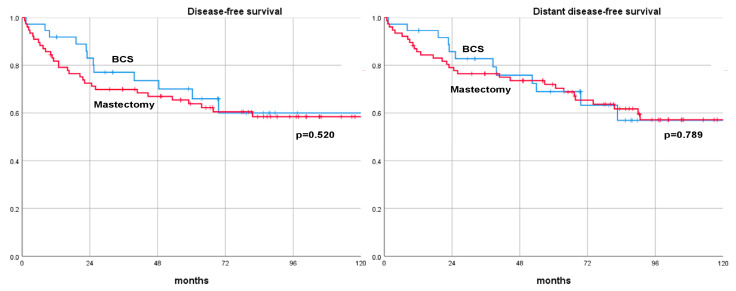
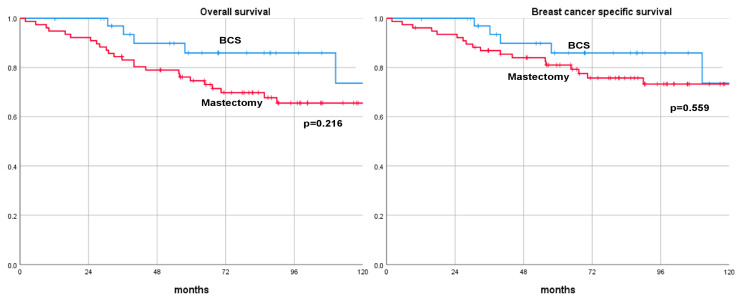
We retrospectively analyzed data from patients with cT3-4 BC who received NAT at the Breast Unit of IRCCS Humanitas Research Hospital, Milan, Italy, from October 2009 to April 2020. Surgical outcomes and long-term oncological results, such as disease-free survival (DFS), distant DFS (DDFS), overall survival (OS), and BC-specific survival (BCSS), were compared between the BCS and mastectomy groups.
Among 114 patients analyzed, 37 (32.5%) underwent BCS, and 77 (67.5%) had a mastectomy. The key predictors for opting for BCS included absence of vascular invasion, reduced tumor size post-NAT, and achieving ypT0 status. No significant differences in DFS, DDFS, OS, and BCSS were observed between the two surgical groups (log-ranks, = 0.520, = 0.789, = 0.216, = 0.559, respectively).
BCS after NAT is a feasible and safe option for patients with cT3-4 BC, without adversely affecting long-term oncological outcomes. Identifying predictors of breast conservation can guide surgical decision-making, ensuring that patients receive optimal treatment.
新辅助治疗(NAT)已越来越多地用于治疗cT3-4期乳腺癌(BC),使得在传统上考虑行乳房切除术的病例中能够进行保乳手术(BCS)。本研究旨在确定NAT后保乳的预测因素,并评估BCS是否会影响长期肿瘤学结局。
我们回顾性分析了2009年10月至2020年4月在意大利米兰IRCCS胡马纳塔斯研究医院乳腺科接受NAT的cT3-4期BC患者的数据。比较了BCS组和乳房切除术组的手术结局以及长期肿瘤学结果,如无病生存(DFS)、远处无病生存(DDFS)、总生存(OS)和BC特异性生存(BCSS)。
在分析的114例患者中,37例(32.5%)接受了BCS,77例(67.5%)进行了乳房切除术。选择BCS的关键预测因素包括无血管侵犯、NAT后肿瘤大小减小以及达到ypT0状态。两组手术患者的DFS、DDFS、OS和BCSS均未观察到显著差异(对数秩检验,P值分别为0.520、0.789、0.216、0.559)。
对于cT3-4期BC患者,NAT后的BCS是一种可行且安全的选择,不会对长期肿瘤学结局产生不利影响。识别保乳的预测因素可以指导手术决策,确保患者接受最佳治疗。