Kurilin Vasily, Alshevskaya Alina, Sennikov Sergey
Laboratory of Molecular Immunology, Federal State Budgetary Scientific Institution "Research Institute of Fundamental and Clinical Immunology" (RIFCI), 630099 Novosibirsk, Russia.
Laboratory of Immuno Engineering, Federal State Autonomous Educational Institution of Higher Education I.M. Sechenov First Moscow State Medical University of the Ministry of Health of the Russian Federation (Sechenov University), 119048 Moscow, Russia.
Biomedicines. 2024 Mar 21;12(3):699. doi: 10.3390/biomedicines12030699.
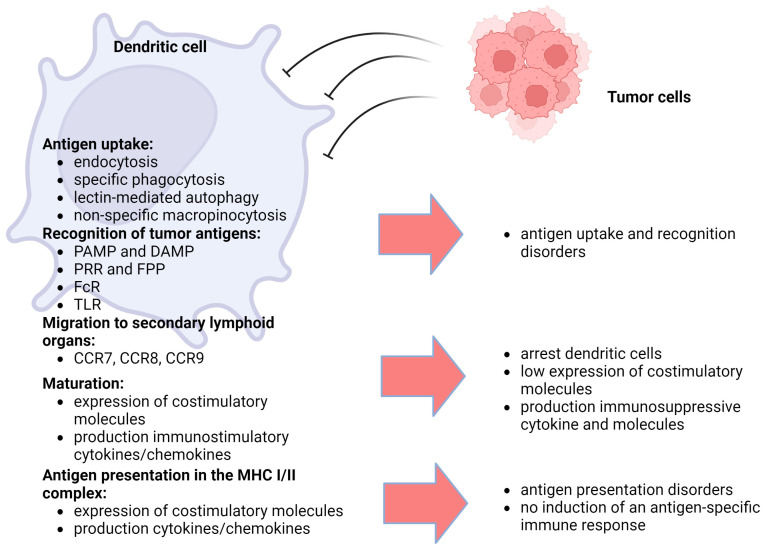
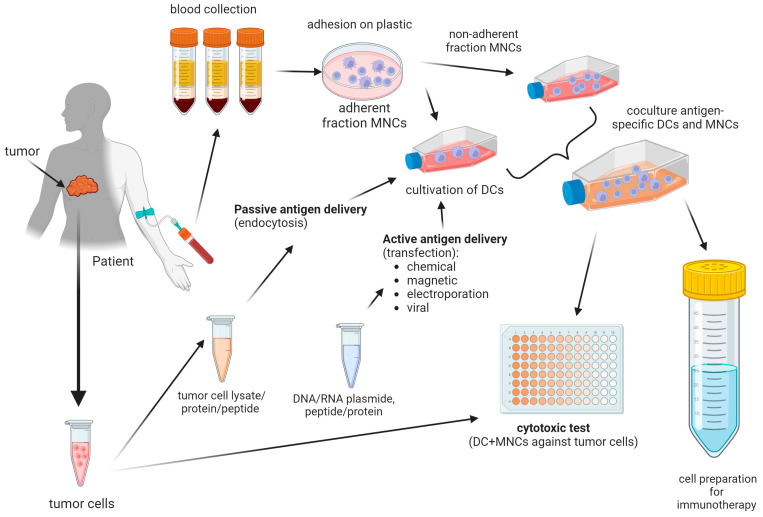
Immunotherapy using dendritic cell-based vaccination is a natural approach using the capabilities and functions inherent in the patient's immune system to eliminate tumor cells. The development of dendritic cell-based cell technologies evolved as the disorders of dendritic cell differentiation and function in cancer were studied; some of these functions are antigen presentation, priming of cytotoxic T-lymphocytes and induction of antigen-specific immune responses. At the initial stage of technology development, it was necessary to develop protocols for the in vitro generation of functionally mature dendritic cells that were capable of capturing tumor antigens and processing and presenting them in complex with MHC to T-lymphocytes. To achieve this, various forms of tumor-associated antigen delivery systems were tested, including lysates, tumor cell proteins (peptides), and DNA and RNA constructs, and it was shown that the use of DNA and RNA constructs was the most effective method, as it made it possible not only to deliver the most immunogenic epitopes of tumor-associated antigens to dendritic cells, but also to enhance their ability to induce antigen-specific cytotoxic T-lymphocytes. Currently, cell therapy based on dendritic cells is a modern basis for antigen-specific immunotherapy of cancer due to the simplicity of creating DNA and RNA constructs encoding information about both target tumor antigens and regulatory molecules. The potential development of cell technologies based on dendritic cells aims to obtain antigen-specific cytotoxic T-lymphocytes induced by dendritic cells, study their functional activity and develop cell-based therapy.
使用基于树突状细胞的疫苗接种进行免疫治疗是一种利用患者免疫系统固有能力和功能来消除肿瘤细胞的自然方法。随着对癌症中树突状细胞分化和功能紊乱的研究,基于树突状细胞的细胞技术不断发展;其中一些功能包括抗原呈递、细胞毒性T淋巴细胞的启动以及抗原特异性免疫反应的诱导。在技术发展的初始阶段,有必要制定体外生成功能成熟树突状细胞的方案,这些细胞能够捕获肿瘤抗原,并与主要组织相容性复合体(MHC)结合后加工并呈递给T淋巴细胞。为实现这一目标,测试了各种形式的肿瘤相关抗原递送系统,包括裂解物、肿瘤细胞蛋白(肽)以及DNA和RNA构建体,结果表明使用DNA和RNA构建体是最有效的方法,因为它不仅能够将肿瘤相关抗原的最具免疫原性的表位递送至树突状细胞,还能增强其诱导抗原特异性细胞毒性T淋巴细胞的能力。目前,基于树突状细胞的细胞疗法是癌症抗原特异性免疫治疗的现代基础,这是由于创建编码靶标肿瘤抗原和调节分子信息的DNA和RNA构建体较为简便。基于树突状细胞的细胞技术的潜在发展旨在获得由树突状细胞诱导的抗原特异性细胞毒性T淋巴细胞,研究它们的功能活性并开发基于细胞的疗法。