Elgendy Hossam, Shalaby Reham, Agyapong Belinda, Lesage Deanna, Paulsen Lacey, Delday Amy, Duiker Sherianna, Surood Shireen, Wei Yifeng, Nkire Nnamdi, Agyapong Vincent Israel Opoku
Department of Psychiatry, Faculty of Medicine and Dentistry, University of Alberta, Edmonton, AB T6G 2R3, Canada.
Addiction and Mental Health, Alberta Health Services, Edmonton, AB T5J 0G5, Canada.
Behav Sci (Basel). 2024 Mar 8;14(3):219. doi: 10.3390/bs14030219.
Depression is highly prevalent and a significant cause of mortality and morbidity across the globe. Although antidepressants and/or psychotherapy are often used to treat depression, some recent studies indicate that exercise may play an important role in lowering depression symptoms among patients meeting the clinical criteria of a depressive episode.
This study aimed to evaluate the mental health and wellbeing of adult participants diagnosed with major depressive disorder (MDD) after fourteen weeks of receiving a supervised physical exercise program.
In a pre-post design, the assessments were performed at baseline, seven weeks and fourteen weeks following the exercise intervention program using facilitated self-reported psychometric scales. The Beck Depression Inventory (BDI-2) and Clinical Outcomes in Routine Evaluation-Outcome Measure (CORE-OM) were used to assess depression. The short form of the International Physical Activity Questionnaire (IPAQ) was used for the self-reporting of participants' physical activity.
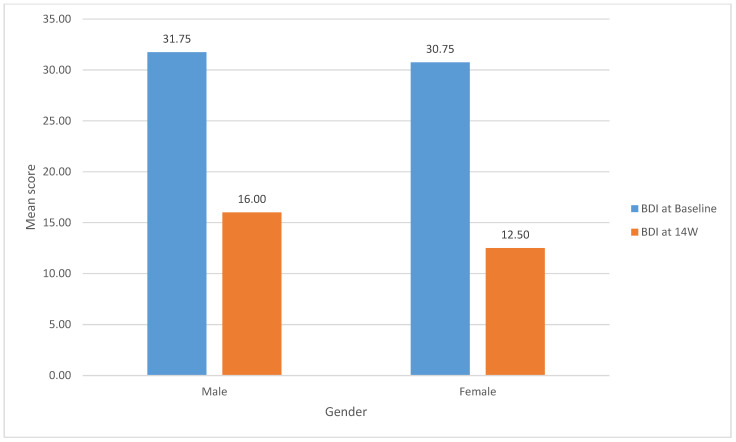
At the beginning of the study, the baseline total mean scores and standard deviations for the BDI-2, CORE-OM, and IPAQ in both genders did not differ significantly (-value > 0.05). Patients showed significant improvement in all assessment scales after completing fourteen weeks of the physical exercise program. Based on the BDI-2, the baseline score dropped from 31.25 (indicating moderate to severe depression) to 14.25 (indicating mild to minimal depression), with a -value of <0.001. The CORE-OM total mean score was reduced from 1.91 to 0.98 with a significant -value < 0.005 indicating effective clinical improvement in depression symptoms. The IPAQ total MET-minutes/week mean score increased from 1713.22 to 4367.62, indicating an improvement in the participants' weekly P.E. intake; however, the change was not statistically significant = 0.07).
Exercise treatment is linked with considerable therapeutic improvement in patients with MDD, particularly when exercise is sustained over time. The BDI-2 and CORE-OM total scores significantly decreased after the fourteen-week P.E. programme, indicating a change from moderate and severe depression to minimal and mild depression. Our findings offer insightful information to primary care doctors and psychiatrists, indicating that prescribing exercise to depressed patients may be a helpful adjunctive therapy.
抑郁症在全球范围内高度流行,是导致死亡和发病的重要原因。尽管抗抑郁药和/或心理治疗常用于治疗抑郁症,但最近的一些研究表明,运动可能在减轻符合抑郁发作临床标准的患者的抑郁症状方面发挥重要作用。
本研究旨在评估成年参与者在接受为期十四周的有监督体育锻炼计划后被诊断为重度抑郁症(MDD)的心理健康状况。
在前后设计中,使用简易自我报告心理测量量表在运动干预计划开始时、七周和十四周后进行评估。使用贝克抑郁量表(BDI-2)和常规评估临床结果-结果测量量表(CORE-OM)评估抑郁情况。国际体力活动问卷简表(IPAQ)用于参与者自我报告体力活动情况。
在研究开始时,男女BDI-2、CORE-OM和IPAQ的基线总平均分及标准差无显著差异(p值>0.05)。在完成十四周的体育锻炼计划后,患者在所有评估量表上均有显著改善。基于BDI-2,基线分数从31.25(表明中度至重度抑郁)降至14.25(表明轻度至极轻度抑郁),p值<0.001。CORE-OM总平均分从1.91降至0.98,显著p值<0.005,表明抑郁症状有有效的临床改善。IPAQ每周总代谢当量分钟平均分从1713.22增加到4367.62,表明参与者每周体育锻炼量有所改善;然而,变化无统计学意义(p = 0.07)。
运动治疗与MDD患者的显著治疗改善相关,尤其是当运动长期持续时。在为期十四周的体育锻炼计划后,BDI-2和CORE-OM总分显著下降,表明从中度和重度抑郁转变为极轻度和轻度抑郁。我们的研究结果为初级保健医生和精神科医生提供了有见地的信息,表明为抑郁症患者开运动处方可能是一种有益的辅助治疗方法。