Xue Peng, Du Xingbin, Kong Jianda
College of General Education, Shandong Huayu University of Technology, Dezhou, China.
College of Sports Science, Qufu Normal University, Qufu, China.
Front Psychol. 2025 Apr 17;16:1562434. doi: 10.3389/fpsyg.2025.1562434. eCollection 2025.
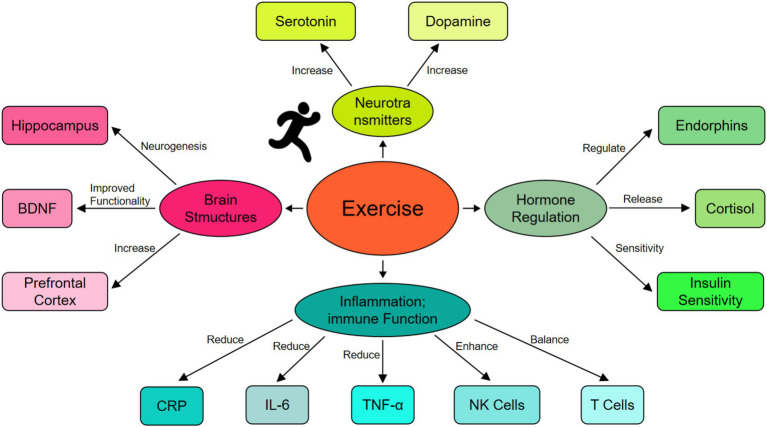
Depression has become one of the most common mental disorders in the world. The rising incidence rate and disability rate pose a serious challenge to public health and socio-economic development. Traditional medication and psychotherapy are positive, but they often come with limitations such as side effects, poor compliance, and resource constraints, which highlights the urgent need for more proactive and sustainable non pharmacological interventions. We mainly explored the physiological and psychological mechanisms of exercise in alleviating depression in different age groups. In particular, we evaluated the characteristics and influencing factors of depression in each age group and compared the pathways through which exercise works, aiming to provide scientific basis for clinical practice and public health policies, and strengthen the application of non pharmacological treatment in depression management. It is worth noting that, in the context of a comprehensive search and analysis of recent literature, we have covered the epidemiology of depression, the impact of exercise on mental health, the characteristics of depression in different age groups, and the specific ways in which exercise alleviates depression through physiological and psychological mechanisms. Exercise alleviates symptoms of depression by regulating neurotransmitters, enhancing neuroplasticity, regulating hormone levels, reducing inflammatory responses through physiological pathways, as well as enhancing cognitive function, strengthening emotional regulation, triggering social interactions, and improving self-efficacy through psychological pathways. The differences in physiological and psychological mechanisms among different age groups determine the age dependent characteristics of exercise in mitigating depression. Teenagers, middle-aged people, and elderly people can improve depressive symptoms by enhancing neural progression, regulating stress responses, and strengthening social support, respectively.
抑郁症已成为全球最常见的精神障碍之一。发病率和致残率的不断上升对公众健康和社会经济发展构成了严峻挑战。传统药物治疗和心理治疗虽有积极作用,但往往存在副作用、依从性差和资源限制等局限性,这凸显了对更积极、可持续的非药物干预措施的迫切需求。我们主要探讨了运动缓解不同年龄组抑郁症的生理和心理机制。具体而言,我们评估了各年龄组抑郁症的特征和影响因素,并比较了运动起作用的途径,旨在为临床实践和公共卫生政策提供科学依据,并加强非药物治疗在抑郁症管理中的应用。值得注意的是,在全面检索和分析近期文献的背景下,我们涵盖了抑郁症的流行病学、运动对心理健康的影响、不同年龄组抑郁症的特征,以及运动通过生理和心理机制缓解抑郁症的具体方式。运动通过调节神经递质、增强神经可塑性、调节激素水平、通过生理途径减轻炎症反应,以及通过心理途径增强认知功能、加强情绪调节、引发社交互动和提高自我效能感来缓解抑郁症状。不同年龄组在生理和心理机制上的差异决定了运动缓解抑郁症的年龄依赖性特征。青少年、中年人和老年人可分别通过增强神经进展、调节应激反应和加强社会支持来改善抑郁症状。