Ningbo No. 2 Hospital, Ningbo 315099, China.
Ningbo Institute of Life and Health Industry, University of Chinese Academy of Sciences, Ningbo 315000, China.
Biomolecules. 2024 Mar 6;14(3):312. doi: 10.3390/biom14030312.
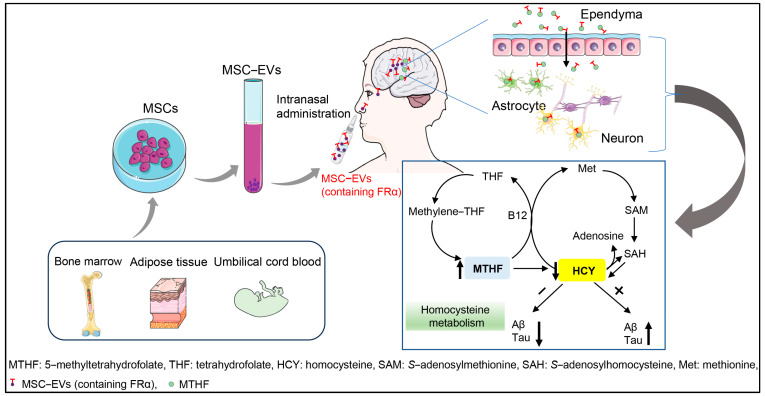
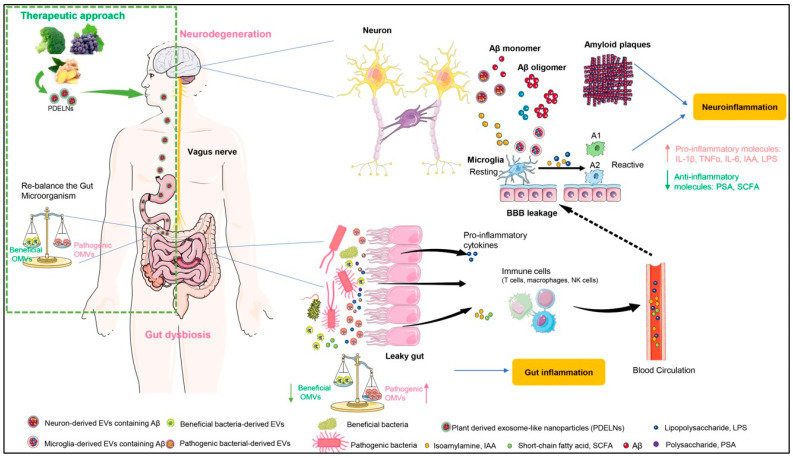
A growing number of studies have indicated that extracellular vesicles (EVs), such as exosomes, are involved in the development of neurodegenerative diseases. Components of EVs with biological effects like proteins, nucleic acids, or other molecules can be delivered to recipient cells to mediate physio-/pathological processes. For instance, some aggregate-prone proteins, such as β-amyloid and α-synuclein, had been found to propagate through exosomes. Therefore, either an increase of detrimental molecules or a decrease of beneficial molecules enwrapped in EVs may fully or partly indicate disease progression. Numerous studies have demonstrated that dysbiosis of the gut microbiota and neurodegeneration are tightly correlated, well-known as the "gut-brain axis". Accumulating evidence has revealed that the gut bacteria-derived EVs play a pivotal role in mediating microbe-host interactions and affect the function of the "gut-brain axis", which subsequently contributes to the pathogenesis of neurodegenerative diseases. In this review, we first briefly discuss the role of EVs from mammalian cells and microbes in mediating the progression of neurodegenerative diseases, and then propose a novel strategy that employs EVs of plants (plant cell-derived exosome-like nanoparticles) for treating neurodegeneration.
越来越多的研究表明,细胞外囊泡(EVs),如外泌体,参与了神经退行性疾病的发展。具有生物效应的 EV 成分,如蛋白质、核酸或其他分子,可以被递送到受体细胞中,从而介导生理/病理过程。例如,一些易于聚集的蛋白质,如β-淀粉样蛋白和α-突触核蛋白,已经被发现通过外泌体传播。因此,EV 中包裹的有害分子的增加或有益分子的减少可能完全或部分表明疾病的进展。许多研究表明,肠道微生物组的失调与神经退行性变密切相关,这被称为“肠脑轴”。越来越多的证据表明,肠道细菌衍生的 EV 在介导微生物-宿主相互作用中起着关键作用,并影响“肠脑轴”的功能,从而导致神经退行性疾病的发病机制。在这篇综述中,我们首先简要讨论了哺乳动物细胞和微生物来源的 EV 在介导神经退行性疾病进展中的作用,然后提出了一种利用植物 EVs(植物细胞衍生的类外泌体纳米颗粒)治疗神经退行性变的新策略。