Dipartimento di Scienze Clinico-Chirurgiche, Diagnostiche e Pediatriche, University of Pavia, 27100 Pavia, Italy.
SC Chirurgia Pediatrica, Fondazione IRCCS Policlinico San Matteo, 27100 Pavia, Italy.
Int J Mol Sci. 2024 Mar 12;25(6):3225. doi: 10.3390/ijms25063225.
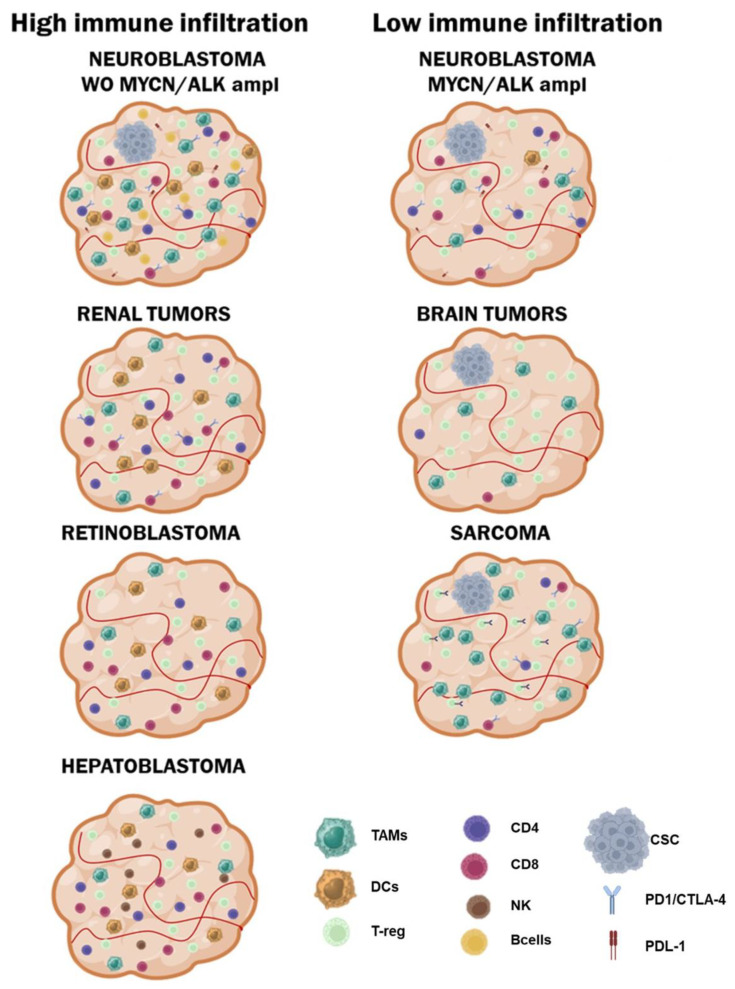
Despite advances in their diagnosis and treatment, pediatric cancers remain among the leading causes of death in childhood. The development of immunotherapies and other forms of targeted therapies has significantly changed the prognosis of some previously incurable cancers in the adult population. However, so far, the results in pediatric cohorts are disappointing, which is mainly due to differences in tumor biology, including extreme heterogeneity and a generally low tumor mutational burden. A central role in the limited efficacy of immunotherapeutic approaches is played by the peculiar characteristics of the tumor microenvironment (TME) in pediatric cancer, with the scarcity of tumor infiltration by T cells and the abundance of stromal cells endowed with lymphocyte suppressor and tumor-growth-promoting activity. Thus, progress in the treatment of pediatric solid tumors will likely be influenced by the ability to modify the TME while delivering novel, more effective therapeutic agents. In this review, we will describe the TME composition in pediatric solid tumors and illustrate recent advances in treatment for the modulation of immune cells belonging to the TME.
尽管在儿科癌症的诊断和治疗方面取得了进展,但它们仍然是儿童死亡的主要原因之一。免疫疗法和其他形式的靶向治疗的发展显著改变了一些以前在成年人群中无法治愈的癌症的预后。然而,到目前为止,儿科患者的结果令人失望,这主要是由于肿瘤生物学的差异,包括极端异质性和普遍较低的肿瘤突变负担。在免疫治疗方法的有限疗效中起着核心作用的是儿科癌症中肿瘤微环境(TME)的特殊特征,T 细胞浸润肿瘤的稀缺性和具有淋巴细胞抑制和肿瘤生长促进活性的基质细胞的丰富性。因此,治疗儿科实体瘤的进展可能会受到在输送新型、更有效的治疗剂的同时改变 TME 的能力的影响。在这篇综述中,我们将描述儿科实体瘤的 TME 组成,并说明最近在调节属于 TME 的免疫细胞方面的治疗进展。