
八角嫁接林根际土壤生物学性质及微生物群落结构特征
The Characteristics of the Root-Zone Soil's Biological Properties and Microbial Community Structure in Grafted Star Anise Plantations.
作者信息
Xiao Jian, Liu Junxian, Wu Siyu, Liang Wenhui, Yang Shangdong
机构信息
Guangxi Key Laboratory of Agro-Environment and Agro-Products Safety, National Demonstration Center for Experimental Plant Science Education, Agricultural College, Guangxi University, Nanning 530004, China.
Agricultural Resources and Environmental Research Institute, Guangxi Academy of Agricultural Sciences/Guangxi Key Laboratory of Arable Land Conservation, Nanning 530007, China.
出版信息
Microorganisms. 2024 Feb 20;12(3):431. doi: 10.3390/microorganisms12030431.
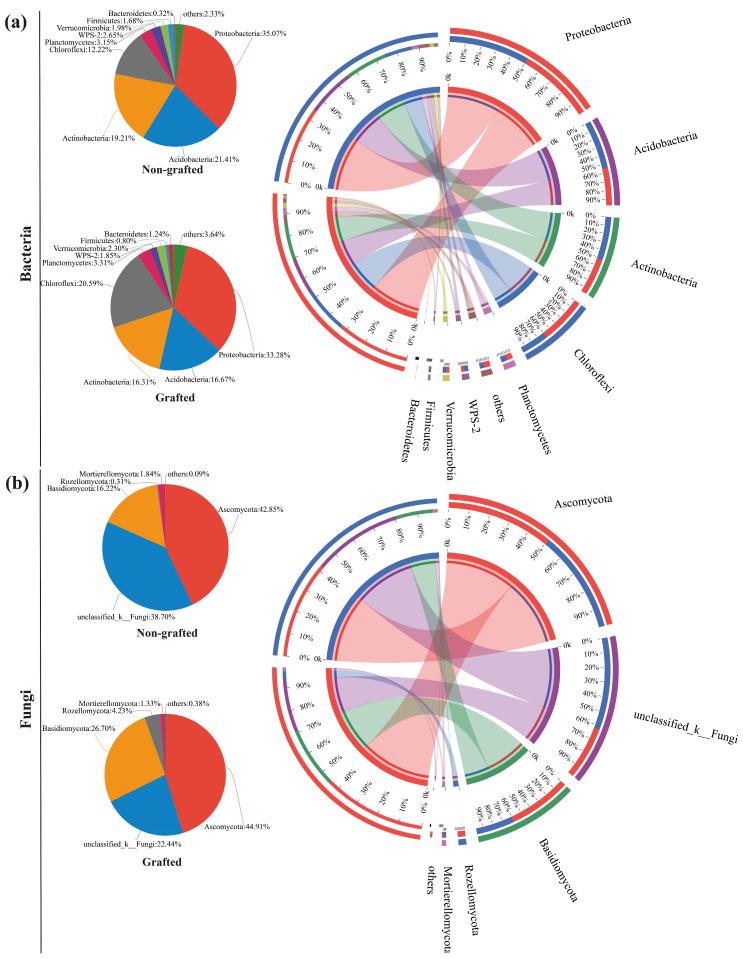
Extensive management seriously affects the output, quality, and sustainable development of star anise, and grafting is commonly used to improve its production and quality. Although many studies have explored the effects of grafting on soil microorganisms for other plants, there is a lack of research on aromatic plants, especially on the soil ecosystems of star anise plantations. The effect of grafting star anise on the soil's biological characteristics and microbial composition remains unclear. The soil's enzyme activities, soil microbial biomass, and microbial community composition in grafted and non-grafted star anise plantations in Guangxi, China were studied using high-throughput sequencing technology. The results showed that the microbial biomass carbon and phosphorus contents in the soils of grafted star anise were significantly lower and the phosphatase activity was significantly higher than in the soils of non-grafted star anise. In comparison with the soils of non-grafted star anise plantations, the proportions of Proteobacteria, Acidobacteria, Actinobacteria, and WPS-2 decreased and the proportions of Chloroflexi, Planctomycetes, and Verrucomicrobia increased in the grafted star anise plantations. Meanwhile, Bacteroidetes was a dominant bacterial phylum unique to the soil of the grafted star anise plantations. Moreover, the proportions of Ascomycota and Basidiomycota increased and the proportions of Mortierellomycota and unclassified_k_Fungi decreased in the soils of the grafted star anise plantations. Furthermore, Basidiomycota and Rozellomycota had significant dominance in the grafted star anise plantations. In general, grafting can improve soil fertility and maintain soil health by promoting soil nutrient cycling and increasing the soil's microbial diversity.
粗放式管理严重影响八角的产量、品质及可持续发展,嫁接是提高其产量和品质常用的方法。尽管许多研究探讨了嫁接对其他植物土壤微生物的影响,但缺乏对芳香植物的研究,尤其是对八角种植园土壤生态系统的研究。八角嫁接对土壤生物学特性和微生物组成的影响尚不清楚。本研究利用高通量测序技术,对中国广西嫁接和未嫁接八角种植园土壤的酶活性、土壤微生物生物量及微生物群落组成进行了研究。结果表明,嫁接八角土壤中微生物生物量碳和磷的含量显著低于未嫁接八角土壤,而磷酸酶活性显著高于未嫁接八角土壤。与未嫁接八角种植园土壤相比,嫁接八角种植园土壤中变形菌门、酸杆菌门、放线菌门和WPS-2的比例降低,绿弯菌门、浮霉菌门和疣微菌门的比例增加。同时,拟杆菌门是嫁接八角种植园土壤特有的优势细菌门。此外,嫁接八角种植园土壤中子囊菌门和担子菌门的比例增加,被孢霉门和未分类_k_真菌的比例降低。此外,担子菌门和罗兹菌门在嫁接八角种植园中具有显著优势。总体而言,嫁接可通过促进土壤养分循环和增加土壤微生物多样性来提高土壤肥力并维持土壤健康。




 Zotero 插件