Valladares-Garrido Danai, Dominguez-Troncos Helena, Picón-Reátegui Cinthia Karina, Valdiviezo-Morales Christopher, Vera-Ponce Víctor J, Failoc-Rojas Virgilio E, Pereira-Victorio César Johan, León-Figueroa Darwin A, Valladares-Garrido Mario J
Facultad de Medicina, Universidad Cesar Vallejo, Trujillo, Peru.
School of Medicine, Universidad Nacional de Piura, Piura, Peru.
Front Psychiatry. 2024 Mar 7;15:1309957. doi: 10.3389/fpsyt.2024.1309957. eCollection 2024.
During the COVID-19 pandemic, the mounting workload and heightened stress may contribute to exacerbated mental health challenges, including an increased fear of COVID-19, among military personnel. Despite the potential influence of these factors, there remains a scarcity of studies addressing mental health issues, particularly the fear of COVID-19, within this specific population. We aimed to determine the prevalence and factors associated with fear of COVID-19 among military members.
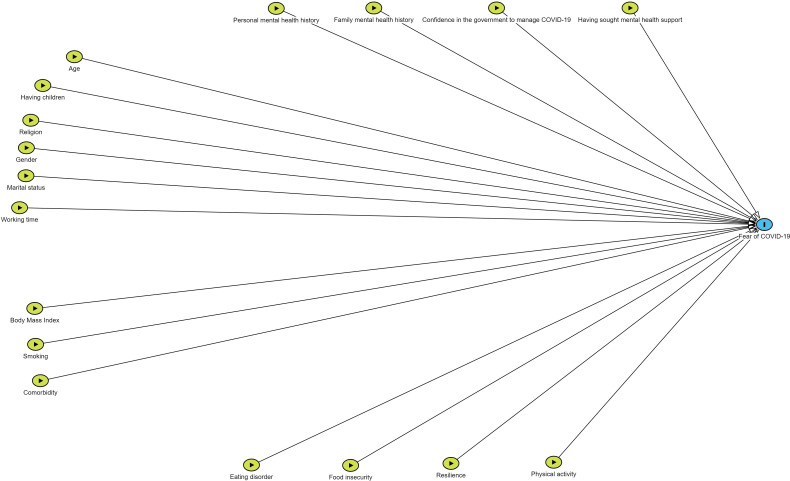
A cross-sectional study was conducted between November 2 and 9, 2021, during the second wave of the COVID-19 pandemic in the Lambayeque region, Peru. The outcome variable was fear of COVID-19, assessed using the Fear of COVID-19 Scale. The association with resilience (Connor-Davidson Resilience Scale, abbreviated as CD-RISC), food insecurity (Household Food Insecurity Access Scale, abbreviated as HFIAS), physical activity (International Physical Activity Questionnaire-Short Form, abbreviated as IPAQ-S), eating disorder (Eating Attitudes Test-26, abbreviated as EAT-26), and other socio- demographic variables was assessed.
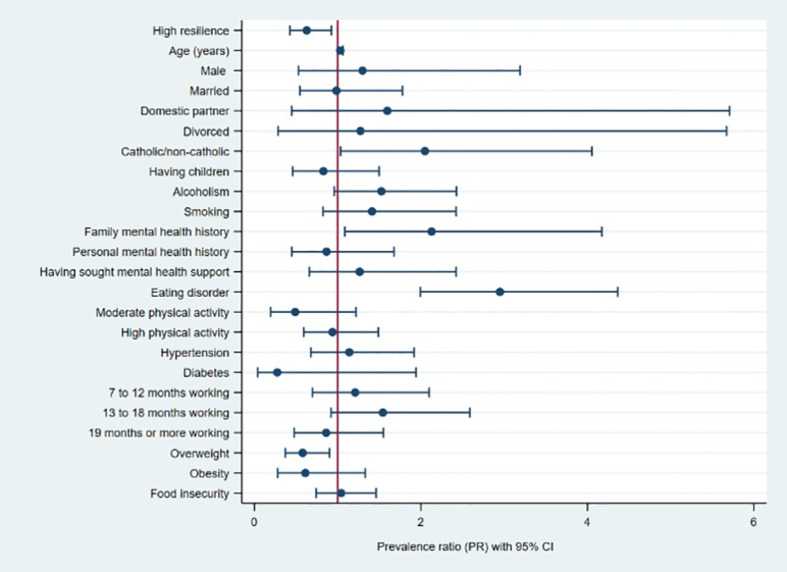
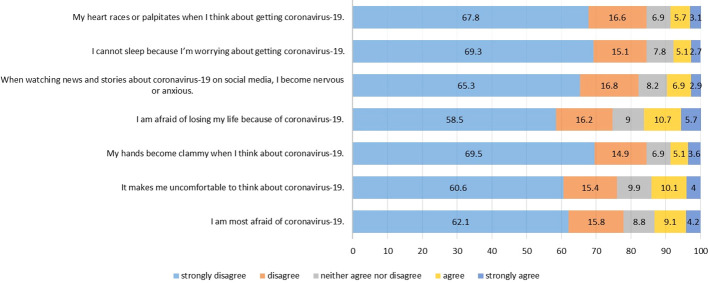
Among the 525 participants, the median age was 22, 95.8% were male, and 19.2% experienced fear of COVID-19. A higher prevalence of fear of COVID-19 was associated with age (PR=1.03; 95% CI: 1.01-1.06), religion (PR=2.05; 95% CI: 1.04-4.05), eating disorder (PR=2.95; 95% CI: 1.99-4.36), and having a relative with mental disorder (PR=2.13; 95% CI: 1.09-4.17). Overweight (PR=0.58; 95% CI: 0.37-0.90) and a high level of resilience (PR=0.63; 95% CI: 0.43-0.93) were associated with a lower prevalence of fear of COVID-19.
Two out of ten military personnel were afraid of COVID-19. Our results highlight the need for targeted interventions addressing the factors contributing to fear of COVID-19 among military personnel, emphasizing the significance of mental health support and preventive measures within this specific population.
在新冠疫情期间,工作量的增加和压力的增大可能会导致军人面临更严峻的心理健康挑战,包括对新冠病毒的恐惧加剧。尽管存在这些因素的潜在影响,但针对这一特定人群心理健康问题,尤其是对新冠病毒的恐惧的研究仍然匮乏。我们旨在确定军人中对新冠病毒恐惧的患病率及其相关因素。
于2021年11月2日至9日在秘鲁兰巴耶克地区新冠疫情第二波期间进行了一项横断面研究。结果变量为对新冠病毒的恐惧,使用新冠病毒恐惧量表进行评估。评估了其与心理韧性(Connor-Davidson心理韧性量表,简称为CD-RISC)、粮食不安全(家庭粮食不安全获取量表,简称为HFIAS)、身体活动(国际身体活动问卷简表,简称为IPAQ-S)、饮食失调(饮食态度测试-26,简称为EAT-26)以及其他社会人口统计学变量之间的关联。
在525名参与者中,年龄中位数为22岁,95.8%为男性,19.2%的人对新冠病毒感到恐惧。对新冠病毒恐惧的较高患病率与年龄(PR=1.03;95%置信区间:1.01-1.06)、宗教信仰(PR=2.05;95%置信区间:1.04-4.05)、饮食失调(PR=2.95;95%置信区间:1.99-4.36)以及有亲属患有精神疾病(PR=2.13;95%置信区间:1.09-4.17)有关。超重(PR=0.58;95%置信区间:0.37-0.90)和较高的心理韧性水平(PR=0.63;95%置信区间:0.43-0.93)与对新冠病毒恐惧的较低患病率有关。
十分之二的军人害怕新冠病毒。我们的研究结果凸显了针对导致军人对新冠病毒恐惧的因素进行有针对性干预的必要性,强调了在这一特定人群中提供心理健康支持和预防措施的重要性。