School of Medicine, Universidad de San Martín de Porres, Chiclayo 14012, Peru.
South American Center for Education and Research in Public Health, Universidad Norbert Wiener, Lima 15046, Peru.
Int J Environ Res Public Health. 2022 Jul 30;19(15):9343. doi: 10.3390/ijerph19159343.
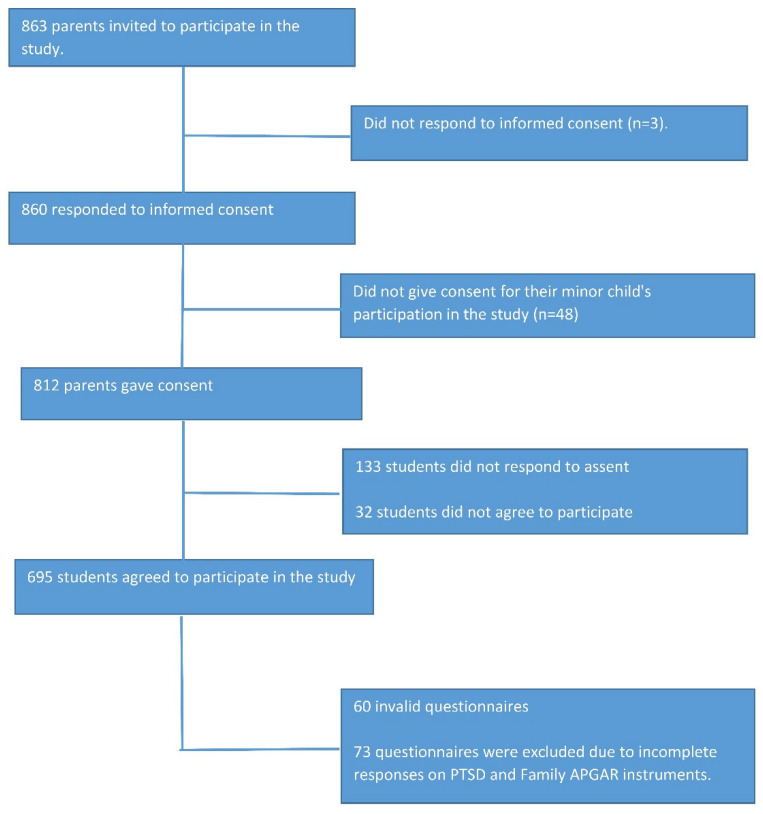
Although the effect of the COVID-19 pandemic on children and adolescents' mental health has been studied, there is still scarce evidence of the influence of nuclear family on the development of post-traumatic stress disorder (PTSD). This study aimed to determine the association between family dysfunction and PTSD in Peruvian high-school students during the COVID-19 pandemic. A cross-sectional study was conducted using a virtual survey administered to 562 high-school students in three schools in Chiclayo, Peru. The dependent variable was PTSD, which was measured with the Child PTSD Symptom Scale. Family dysfunction was the main independent variable, measured with the Family APGAR Questionnaire. Prevalence ratios (PR) and 95% confidence intervals (95% CI) were estimated with generalized linear models. Most of the students were female (88.3%) and the average age was 14.4 years. We found that 21.4% showed severe family dysfunction and 60.3% had PTSD. Students with mild and moderate family dysfunction had 37% (PR: 1.37; 95% CI: 1.14-1.65) and 26% (PR: 1.26; 95% CI: 1.04-1.54) higher PTSD prevalence, respectively. In conclusion, family dysfunction may influence the development of PTSD in adolescents. This study suggests the importance to develop a healthy family environment to help adolescents face critical situations experienced during the pandemic.
尽管已经研究了 COVID-19 大流行对儿童和青少年心理健康的影响,但关于核心家庭对创伤后应激障碍(PTSD)发展影响的证据仍然很少。本研究旨在确定 COVID-19 大流行期间秘鲁高中生家庭功能障碍与 PTSD 之间的关系。采用横断面研究,对秘鲁奇克拉约的三所学校的 562 名高中生进行了虚拟调查。因变量为 PTSD,采用儿童 PTSD 症状量表进行测量。家庭功能障碍是主要的独立变量,采用家庭 APGAR 问卷进行测量。使用广义线性模型估计患病率比(PR)和 95%置信区间(95%CI)。大多数学生为女性(88.3%),平均年龄为 14.4 岁。我们发现,21.4%的学生表现出严重的家庭功能障碍,60.3%的学生患有 PTSD。轻度和中度家庭功能障碍的学生 PTSD 患病率分别高出 37%(PR:1.37;95%CI:1.14-1.65)和 26%(PR:1.26;95%CI:1.04-1.54)。总之,家庭功能障碍可能会影响青少年 PTSD 的发展。这项研究表明,培养健康的家庭环境对于帮助青少年应对大流行期间经历的危机情况非常重要。