Chabbey Isaline, Cudalbu Cristina, Barras Eugénie, Hanquinet Sylviane, Maréchal Bénédicte, Rougemont Anne-Laure, Wacker Julie, Zangas-Gheri Florence, McLin Valérie A
Department of Pediatrics, Gynecology and Obstetrics, Swiss Pediatric Liver Center, Division of Pediatric Surgery University of Geneva Geneva Switzerland.
CIBM Center for Biomedical Imaging Vaud Switzerland.
JPGN Rep. 2023 Dec 28;5(1):35-42. doi: 10.1002/jpr3.12035. eCollection 2024 Feb.
Chronic hepatic encephalopathy (CHE) has been reported both in patients with congenital porto-systemic shunts (CPSS) and chronic liver disease. CHE is difficult to recognize in children as there is no clear definition and its manifestations are highly variable. CHE is associated with variations in brain volumes and metabolites that have already been demonstrated using 1.5-3T MRI systems. However, the in-depth study of brain metabolism requires the high spectral resolution of high magnetic fields.
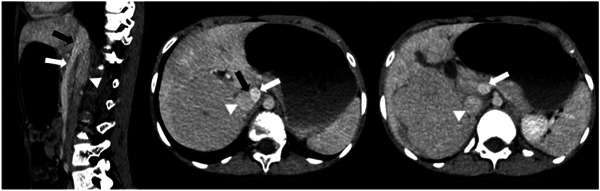
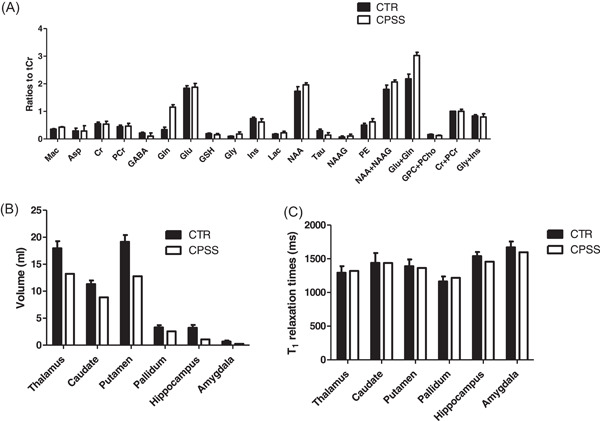
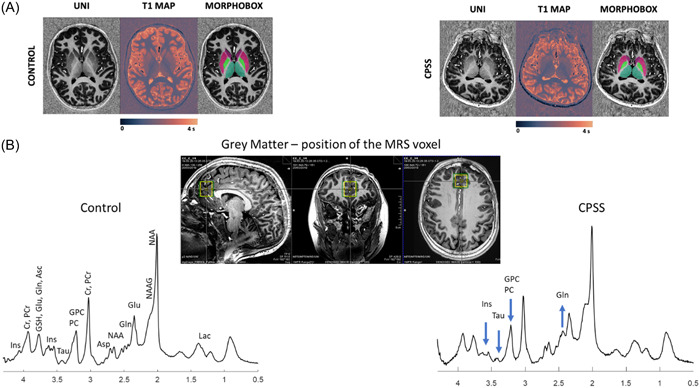
We analyzed the neurometabolic profile, brain volumes and T relaxation times of a child with a CPSS using high field proton magnetic resonance spectroscopy (H MRS, 7T) combined with MRI and compared it to an age-matched control group. We also evaluated the impact of shunt closure on neurocognitive symptoms using adapted neuropsychological tests.
7T MRS revealed a significant increase in glutamine compared to controls, a decrease in brain osmolytes, and a slight elevation in NAA concentrations. 7T MRI scans showed morphological abnormalities but no changes in the signal intensity of the globus pallidus. Neurocognitive testing revealed attention deficit disorder, language difficulties, and mild intellectual disability. Most of these areas improved after shunt closure.
In this paediatric case of type B HE with normal fasting ammonia, neurometabolic profile was compatible with what has been previously shown in chronic liver disease, while also demonstrating an isolated glutamine peak. In addition, neurocognitive function partially improved after shunt closure, arguing strongly for shunt closure in both presymptomatic and symptomatic patients.
先天性门体分流(CPSS)患者和慢性肝病患者均有慢性肝性脑病(CHE)的报道。CHE在儿童中难以识别,因为没有明确的定义且其表现高度可变。CHE与脑容量和代谢物的变化有关,这已通过1.5 - 3T MRI系统得到证实。然而,对脑代谢的深入研究需要高磁场的高光谱分辨率。
我们使用高场质子磁共振波谱(H MRS,7T)结合MRI分析了一名CPSS患儿的神经代谢谱、脑容量和T2弛豫时间,并将其与年龄匹配的对照组进行比较。我们还使用适应性神经心理测试评估了分流关闭对神经认知症状的影响。
与对照组相比,7T MRS显示谷氨酰胺显著增加,脑渗透压物质减少,NAA浓度略有升高。7T MRI扫描显示形态学异常,但苍白球信号强度无变化。神经认知测试显示注意力缺陷障碍、语言困难和轻度智力残疾。分流关闭后,这些方面大多有所改善。
在这例空腹血氨正常的B型肝性脑病儿科病例中,神经代谢谱与先前在慢性肝病中显示的情况相符,同时还显示出孤立的谷氨酰胺峰。此外,分流关闭后神经认知功能部分改善,强烈支持对无症状和有症状患者均进行分流关闭。