Jafar Abbas, Bibi Nabila, Naqvi Rizwan Ali, Sadeghi-Niaraki Abolghasem, Jeong Daesik
HPC Laboratory, Department of Computer Engineering, Myongji University, Yongin, Republic of Korea.
Department of Botany, The Islamia University of Bahawalpur, Bahawalpur, Pakistan.
Front Plant Sci. 2024 Mar 13;15:1356260. doi: 10.3389/fpls.2024.1356260. eCollection 2024.
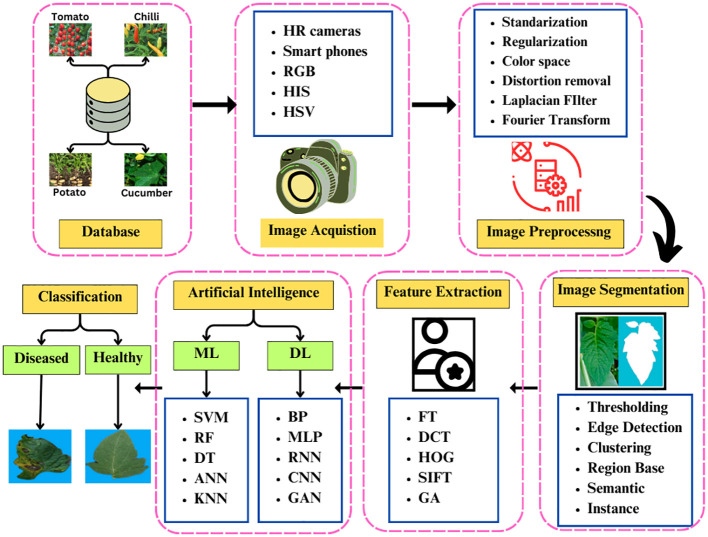
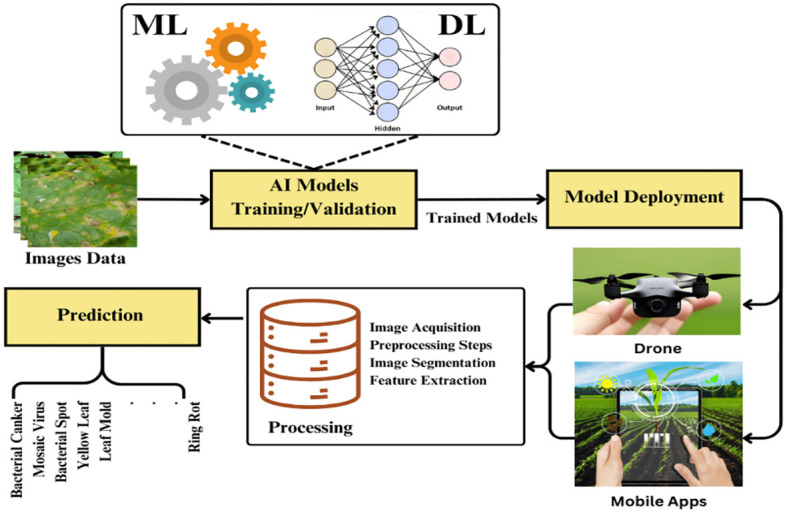
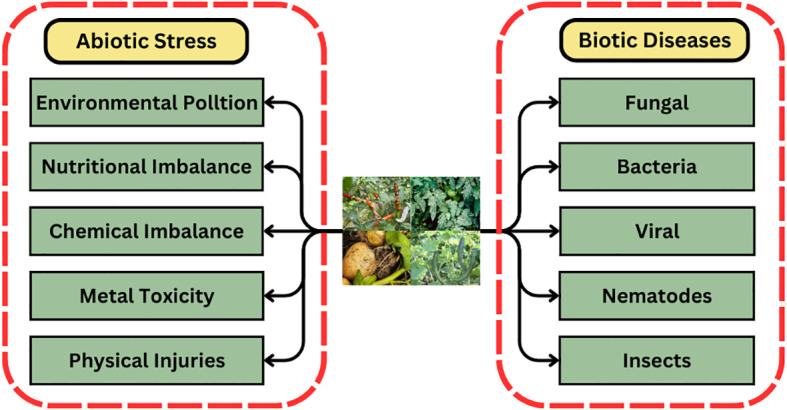
Accurate and rapid plant disease detection is critical for enhancing long-term agricultural yield. Disease infection poses the most significant challenge in crop production, potentially leading to economic losses. Viruses, fungi, bacteria, and other infectious organisms can affect numerous plant parts, including roots, stems, and leaves. Traditional techniques for plant disease detection are time-consuming, require expertise, and are resource-intensive. Therefore, automated leaf disease diagnosis using artificial intelligence (AI) with Internet of Things (IoT) sensors methodologies are considered for the analysis and detection. This research examines four crop diseases: tomato, chilli, potato, and cucumber. It also highlights the most prevalent diseases and infections in these four types of vegetables, along with their symptoms. This review provides detailed predetermined steps to predict plant diseases using AI. Predetermined steps include image acquisition, preprocessing, segmentation, feature selection, and classification. Machine learning (ML) and deep understanding (DL) detection models are discussed. A comprehensive examination of various existing ML and DL-based studies to detect the disease of the following four crops is discussed, including the datasets used to evaluate these studies. We also provided the list of plant disease detection datasets. Finally, different ML and DL application problems are identified and discussed, along with future research prospects, by combining AI with IoT platforms like smart drones for field-based disease detection and monitoring. This work will help other practitioners in surveying different plant disease detection strategies and the limits of present systems.
准确快速的植物病害检测对于提高长期农业产量至关重要。病害感染是作物生产中最严峻的挑战,可能导致经济损失。病毒、真菌、细菌和其他传染性生物可影响包括根、茎和叶在内的许多植物部位。传统的植物病害检测技术耗时、需要专业知识且资源密集。因此,考虑使用人工智能(AI)与物联网(IoT)传感器方法进行自动叶片病害诊断以进行分析和检测。本研究考察了四种作物病害:番茄、辣椒、马铃薯和黄瓜。它还突出了这四种蔬菜中最常见的病害和感染情况及其症状。本综述提供了使用人工智能预测植物病害的详细预定步骤。预定步骤包括图像采集、预处理、分割、特征选择和分类。讨论了机器学习(ML)和深度学习(DL)检测模型。对各种现有的基于ML和DL的研究进行了全面考察,以检测以下四种作物的病害,包括用于评估这些研究的数据集。我们还提供了植物病害检测数据集列表。最后,通过将人工智能与物联网平台(如用于田间病害检测和监测的智能无人机)相结合,识别并讨论了不同的ML和DL应用问题以及未来的研究前景。这项工作将帮助其他从业者审视不同的植物病害检测策略以及现有系统的局限性。