Jafar Abbas, Hameed Muhammad Talha, Akram Nadeem, Waqas Umer, Kim Hyung Seok, Naqvi Rizwan Ali
Department of Computer Engineering, Myongji University, Yongin 03674, Korea.
Department of Primary and Secondary Healthcare, Lahore 54000, Pakistan.
J Pers Med. 2022 Jun 17;12(6):988. doi: 10.3390/jpm12060988.
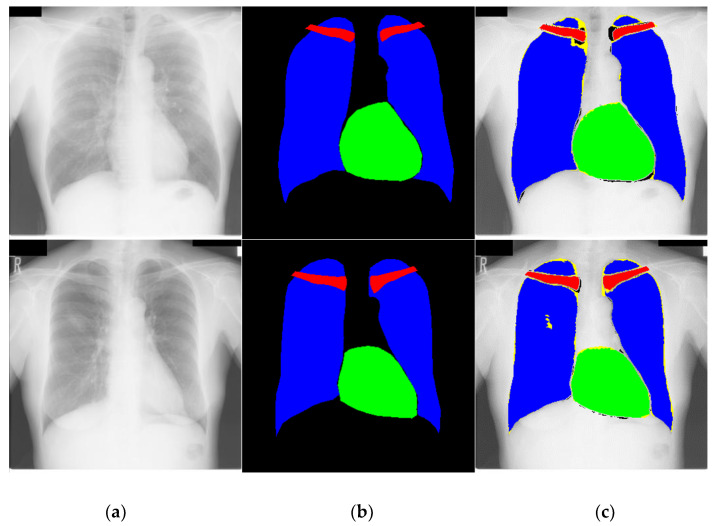
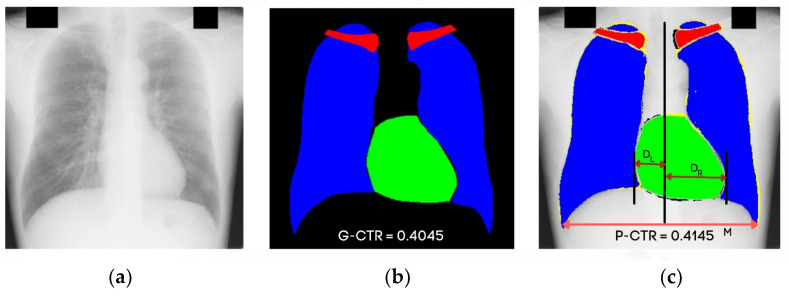
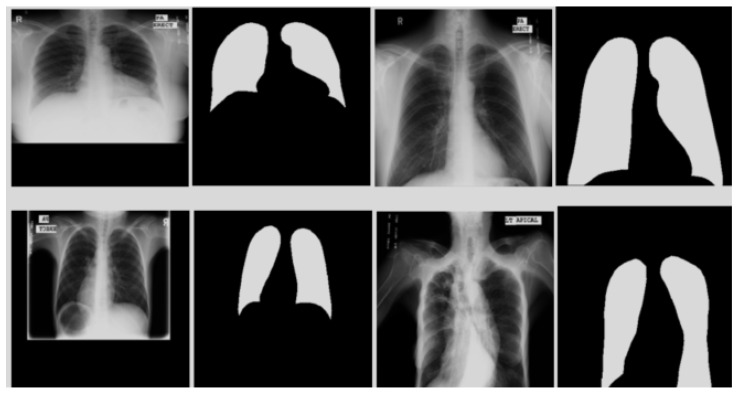
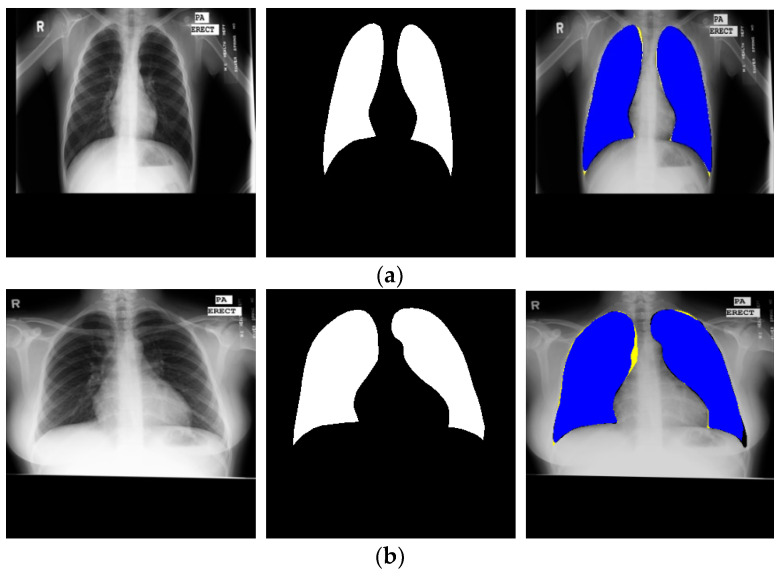
Semantic segmentation for diagnosing chest-related diseases like cardiomegaly, emphysema, pleural effusions, and pneumothorax is a critical yet understudied tool for identifying the chest anatomy. A dangerous disease among these is cardiomegaly, in which sudden death is a high risk. An expert medical practitioner can diagnose cardiomegaly early using a chest radiograph (CXR). Cardiomegaly is a heart enlargement disease that can be analyzed by calculating the transverse cardiac diameter (TCD) and the cardiothoracic ratio (CTR). However, the manual estimation of CTR and other chest-related diseases requires much time from medical experts. Based on their anatomical semantics, artificial intelligence estimates cardiomegaly and related diseases by segmenting CXRs. Unfortunately, due to poor-quality images and variations in intensity, the automatic segmentation of the lungs and heart with CXRs is challenging. Deep learning-based methods are being used to identify the chest anatomy segmentation, but most of them only consider the lung segmentation, requiring a great deal of training. This work is based on a multiclass concatenation-based automatic semantic segmentation network, CardioNet, that was explicitly designed to perform fine segmentation using fewer parameters than a conventional deep learning scheme. Furthermore, the semantic segmentation of other chest-related diseases is diagnosed using CardioNet. CardioNet is evaluated using the JSRT dataset (Japanese Society of Radiological Technology). The JSRT dataset is publicly available and contains multiclass segmentation of the heart, lungs, and clavicle bones. In addition, our study examined lung segmentation using another publicly available dataset, Montgomery County (MC). The experimental results of the proposed CardioNet model achieved acceptable accuracy and competitive results across all datasets.
用于诊断诸如心脏肥大、肺气肿、胸腔积液和气胸等胸部相关疾病的语义分割,是识别胸部解剖结构的一种关键但研究不足的工具。其中一种危险疾病是心脏肥大,猝死风险很高。专业医生可以通过胸部X光片(CXR)早期诊断心脏肥大。心脏肥大是一种心脏扩大疾病,可以通过计算心脏横径(TCD)和心胸比率(CTR)来分析。然而,人工估算CTR和其他胸部相关疾病需要医学专家花费大量时间。人工智能基于其解剖语义,通过对CXR进行分割来估算心脏肥大及相关疾病。不幸的是,由于图像质量差和强度变化,用CXR对肺和心脏进行自动分割具有挑战性。基于深度学习的方法正被用于识别胸部解剖结构分割,但其中大多数只考虑肺分割,需要大量训练。这项工作基于一个基于多类拼接的自动语义分割网络CardioNet,该网络经过专门设计,使用比传统深度学习方案更少的参数来进行精细分割。此外,还使用CardioNet诊断其他胸部相关疾病的语义分割。使用JSRT数据集(日本放射技术学会)对CardioNet进行评估。JSRT数据集是公开可用的,包含心脏、肺和锁骨骨骼的多类分割。此外,我们的研究使用另一个公开可用的数据集蒙哥马利县(MC)检查了肺分割。所提出的CardioNet模型的实验结果在所有数据集上都取得了可接受的准确率和有竞争力的结果。