Department of Neurology, Mayo Clinic College of Medicine and Science, Phoenix, Arizona.
Department of Neurology, Massachusetts General Hospital, Boston.
JAMA Netw Open. 2024 Mar 4;7(3):e244294. doi: 10.1001/jamanetworkopen.2024.4294.
West Nile virus (WNV) is the leading cause of human arboviral disease in the US, peaking during summer. The incidence of WNV, including its neuroinvasive form (NWNV), is increasing, largely due to the expanding distribution of its vector, the Culex mosquito, and climatic changes causing heavy monsoon rains. However, the distinct characteristics and outcomes of NWNV in individuals who are immunosuppressed (IS) and individuals who are not IS remain underexplored.
To describe and compare clinical and radiographic features, treatment responses, and outcomes of NWNV infection in individuals who are IS and those who are not IS.
DESIGN, SETTING, AND PARTICIPANTS: This retrospective cohort study used data from the Mayo Clinic Hospital system collected from July 2006 to December 2021. Participants were adult patients (age ≥18 years) with established diagnosis of NWNV infection. Data were analyzed from May 12, 2020, to July 20, 2023.
Immunosuppresion.
Outcomes of interest were clinical and radiographic features and 90-day mortality among patients with and without IS.
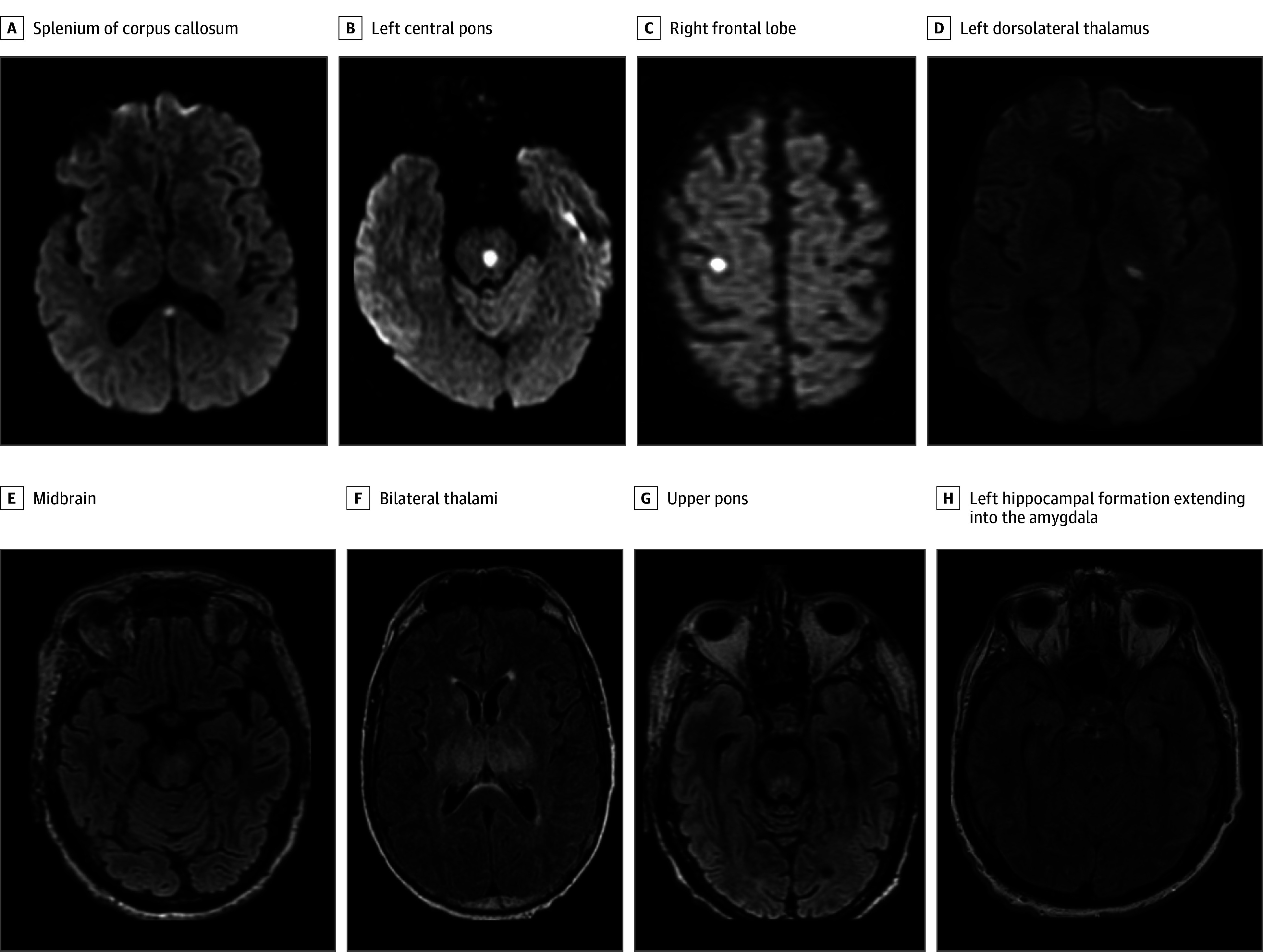
Of 115 participants with NWNV infection (mean [SD] age, 64 [16] years; 75 [66%] male) enrolled, 72 (63%) were not IS and 43 (37%) were IS. Neurologic manifestations were meningoencephalitis (98 patients [85%]), encephalitis (10 patients [9%]), and myeloradiculitis (7 patients [6%]). Patients without IS, compared with those with IS, more frequently reported headache (45 patients [63%] vs 18 patients [42%]) and myalgias (32 patients [44%] vs 9 patients [21%]). In contrast, patients with IS, compared with those without, had higher rates of altered mental status (33 patients [77%] vs 41 patients [57%]) and myoclonus (8 patients [19%] vs 8 patients [4%]). Magnetic resonance imaging revealed more frequent thalamic T2 fluid-attenuated inversion recovery hyperintensities in individuals with IS than those without (4 patients [11%] vs 0 patients). Individuals with IS had more severe disease requiring higher rates of intensive care unit admission (26 patients [61%] vs 24 patients [33%]) and mechanical ventilation (24 patients [56%] vs 22 patients [31%]). The 90-day all-cause mortality rate was higher in the patients with IS compared with patients without IS (12 patients [28%] vs 5 patients [7%]), and this difference in mortality persisted after adjusting for Glasgow Coma Scale score (adjusted hazard ratio, 2.22; 95% CI, 1.07-4.27; P = .03). Individuals with IS were more likely to receive intravenous immunoglobulin than individuals without IS (12 individuals [17%] vs 24 individuals [56%]), but its use was not associated with survival (hazard ratio, 1.24; 95% CI, 0.50-3.09; P = .64).
In this cohort study of individuals with NWNV infection, individuals with IS had a higher risk of disease complications and poor outcomes than individuals without IS, highlighting the need for innovative and effective therapies to improve outcomes in this high-risk population.
西尼罗河病毒(WNV)是美国导致人类虫媒病毒病的主要原因,在夏季达到高峰。WNV 的发病率包括其神经侵袭形式(NWNV)正在增加,这主要是由于其载体库蚊的分布扩大以及导致季风降雨量大的气候变化。然而,免疫抑制(IS)个体和非 IS 个体中 NWNV 的独特特征和结果仍未得到充分探索。
描述和比较 IS 个体和非 IS 个体中 NWNV 感染的临床和影像学特征、治疗反应和结局。
设计、设置和参与者:这项回顾性队列研究使用了 2006 年 7 月至 2021 年 12 月期间梅奥诊所医院系统的数据。参与者为确诊为 NWNV 感染的成年患者(年龄≥18 岁)。数据分析于 2020 年 5 月 12 日至 2023 年 7 月 20 日进行。
免疫抑制。
感兴趣的结局是 IS 患者和非 IS 患者的临床和影像学特征以及 90 天死亡率。
在 115 名患有 NWNV 感染的参与者中(平均[标准差]年龄,64[16]岁;75[66%]男性),72 名(63%)未接受 IS 治疗,43 名(37%)接受 IS 治疗。神经表现为脑膜脑炎(98 例[85%])、脑炎(10 例[9%])和骨髓炎(7 例[6%])。与非 IS 患者相比,无 IS 患者更常报告头痛(45 例[63%] vs 18 例[42%])和肌痛(32 例[44%] vs 9 例[21%])。相比之下,IS 患者更有可能出现精神状态改变(33 例[77%] vs 41 例[57%])和肌阵挛(8 例[19%] vs 8 例[4%])。磁共振成像显示,与非 IS 患者相比,IS 患者的丘脑 T2 液体衰减反转恢复高信号更常见(4 例[11%] vs 0 例)。IS 患者的疾病更严重,需要更高的重症监护病房入院率(26 例[61%] vs 24 例[33%])和机械通气(24 例[56%] vs 22 例[31%])。与非 IS 患者相比,IS 患者的 90 天全因死亡率更高(12 例[28%] vs 5 例[7%]),并且在调整格拉斯哥昏迷量表评分后,这种死亡率差异仍然存在(调整后的危险比,2.22;95%CI,1.07-4.27;P=0.03)。与非 IS 患者相比,IS 患者更有可能接受静脉注射免疫球蛋白(12 名[17%] vs 24 名[56%]),但它的使用与生存率无关(危险比,1.24;95%CI,0.50-3.09;P=0.64)。
在这项关于 NWNV 感染患者的队列研究中,与非 IS 患者相比,IS 患者的疾病并发症和不良结局风险更高,这突出表明需要创新和有效的治疗方法来改善这一高危人群的结局。