Emerg Infect Dis. 2019 Nov;25(11):2064-2073. doi: 10.3201/eid2511.190537.
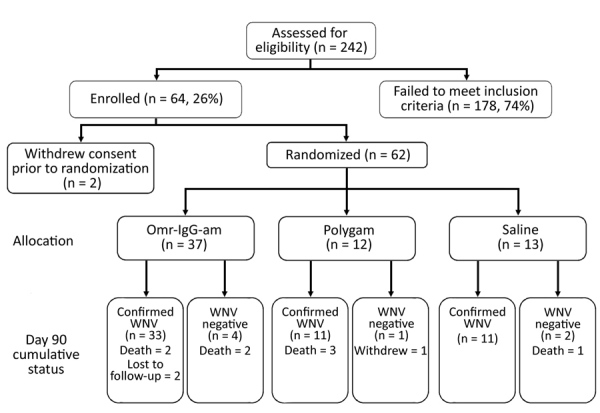
West Nile Virus (WNV) can result in clinically severe neurologic disease. There is no treatment for WNV infection, but administration of anti-WNV polyclonal human antibody has demonstrated efficacy in animal models. We compared Omr-IgG-am, an immunoglobulin product with high titers of anti-WNV antibody, with intravenous immunoglobulin (IVIG) and normal saline to assess safety and efficacy in patients with WNV neuroinvasive disease as part of a phase I/II, randomized, double-blind, multicenter study in North America. During 2003-2006, a total of 62 hospitalized patients were randomized to receive Omr-IgG-am, standard IVIG, or normal saline (3:1:1). The primary endpoint was medication safety. Secondary endpoints were morbidity and mortality, measured using 4 standardized assessments of cognitive and functional status. The death rate in the study population was 12.9%. No significant differences were found between groups receiving Omr-IgG-am compared with IVIG or saline for either the safety or efficacy endpoints.
西尼罗河病毒(WNV)可导致严重的临床神经疾病。目前尚无针对 WNV 感染的治疗方法,但抗 WNV 多克隆人抗体的给药已在动物模型中显示出疗效。我们比较了 Omr-IgG-am,一种具有高滴度抗 WNV 抗体的免疫球蛋白产品,与静脉注射免疫球蛋白(IVIG)和生理盐水,以评估其在 WNV 神经侵袭性疾病患者中的安全性和疗效,这是一项在北美进行的 I/II 期、随机、双盲、多中心研究的一部分。在 2003-2006 年期间,共有 62 名住院患者被随机分配接受 Omr-IgG-am、标准 IVIG 或生理盐水(3:1:1)。主要终点是药物安全性。次要终点是发病率和死亡率,使用 4 种标准化认知和功能状态评估进行测量。研究人群的死亡率为 12.9%。与 IVIG 或生理盐水相比,接受 Omr-IgG-am 的组在安全性或疗效终点方面均无显著差异。