
三种蜥形纲动物模型前脑的磁共振成像对比分析
Comparative MRI analysis of the forebrain of three sauropsida models.
作者信息
Jiménez S, Santos-Álvarez I, Fernández-Valle E, Castejón D, Villa-Valverde P, Rojo-Salvador C, Pérez-Llorens P, Ruiz-Fernández M J, Ariza-Pastrana S, Martín-Orti R, González-Soriano Juncal, Moreno Nerea
机构信息
Achucarro Basque Center for Neuroscience, Scientific Park of the University of the Basque Country (UPV/EHU), Leioa, Bilbao, 48940, Spain.
Departament Section of Anatomy and Embriology, Faculty of Veterinary, Complutense University, Avenida Puerta de Hierro s/n, Madrid, 28040, Spain.
出版信息
Brain Struct Funct. 2024 Jul;229(6):1349-1364. doi: 10.1007/s00429-024-02788-2. Epub 2024 Mar 28.
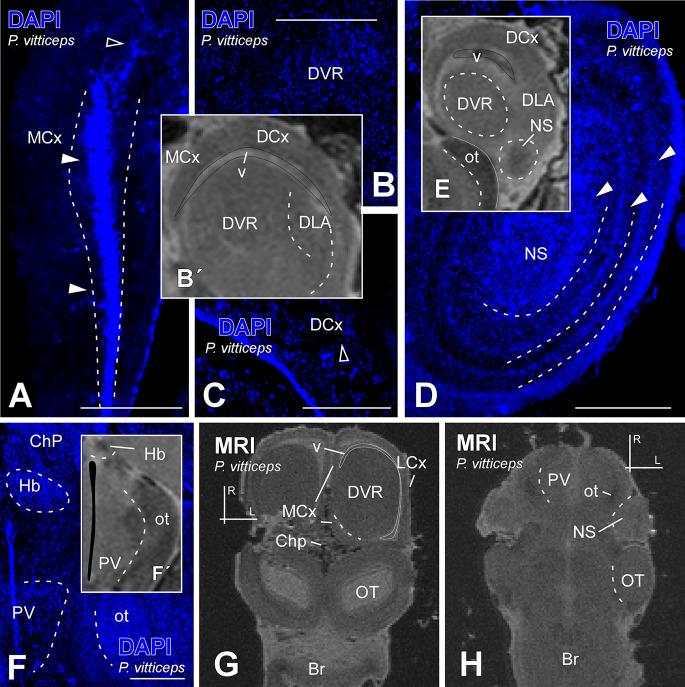
The study of the brain by magnetic resonance imaging (MRI) allows to obtain detailed anatomical images, useful to describe specific encephalic structures and to analyze possible variabilities. It is widely used in clinical practice and is becoming increasingly used in veterinary medicine, even in exotic animals; however, despite its potential, its use in comparative neuroanatomy studies is still incipient. It is a technology that in recent years has significantly improved anatomical resolution, together with the fact that it is non-invasive and allows for systematic comparative analysis. All this makes it particularly interesting and useful in evolutionary neuroscience studies, since it allows for the analysis and comparison of brains of rare or otherwise inaccessible species. In the present study, we have analyzed the prosencephalon of three representative sauropsid species, the turtle Trachemys scripta (order Testudine), the lizard Pogona vitticeps (order Squamata) and the snake Python regius (order Squamata) by MRI. In addition, we used MRI sections to analyze the total brain volume and ventricular system of these species, employing volumetric and chemometric analyses together. The raw MRI data of the sauropsida models analyzed in the present study are available for viewing and downloading and have allowed us to produce an atlas of the forebrain of each of the species analyzed, with the main brain regions. In addition, our volumetric data showed that the three groups presented clear differences in terms of total and ventricular brain volumes, particularly the turtles, which in all cases presented distinctive characteristics compared to the lizards and snakes.
通过磁共振成像(MRI)对大脑进行研究能够获取详细的解剖图像,这对于描述特定的脑结构以及分析可能存在的变异性很有用处。它在临床实践中被广泛应用,并且在兽医学中,甚至在 exotic animals 中也越来越多地被使用;然而,尽管它具有潜力,但其在比较神经解剖学研究中的应用仍处于起步阶段。这是一项近年来显著提高了解剖分辨率的技术,同时它是非侵入性的,并且允许进行系统的比较分析。所有这些使得它在进化神经科学研究中特别有趣且有用,因为它能够对稀有或难以获取的物种的大脑进行分析和比较。在本研究中,我们通过 MRI 分析了三种有代表性的蜥形纲物种的前脑,即水龟 Trachemys scripta(龟鳖目)、鬃狮蜥 Pogona vitticeps(有鳞目)和球蟒 Python regius(有鳞目)。此外,我们使用 MRI 切片,结合体积分析和化学计量分析来分析这些物种的全脑体积和脑室系统。本研究中分析的蜥形纲模型的原始 MRI 数据可供查看和下载,并且使我们能够制作出所分析的每个物种的前脑图谱,包括主要的脑区。此外,我们的体积数据表明,这三组在全脑体积和脑室体积方面存在明显差异,特别是龟类,在所有情况下,它们与蜥蜴和蛇相比都呈现出独特的特征。




 Zotero 插件