Wang Zhi-Yun, Ma Dong-Rui, Li Meng-Jie, Liang Yuan-Yuan, Hu Zheng-Wei, Li Shuang-Jie, Zuo Chun-Yan, Hao Chen-Wei, Feng Yan-Mei, Guo Meng-Nan, Hao Xiao-Yan, Guo Yuan-Li, Ma Ke-Ke, Guo Li-Na, Zhang Chan, Xu Yu-Ming, Mao Cheng-Yuan, Shi Chang-He
Department of Neurology, The First Affiliated Hospital of Zhengzhou University, Zhengzhou University, Zhengzhou, Henan, China.
Henan Key Laboratory of Cerebrovascular Diseases, The First Affiliated Hospital of Zhengzhou University, Zhengzhou University, Zhengzhou, Henan, China.
NPJ Parkinsons Dis. 2024 Mar 28;10(1):70. doi: 10.1038/s41531-024-00691-5.
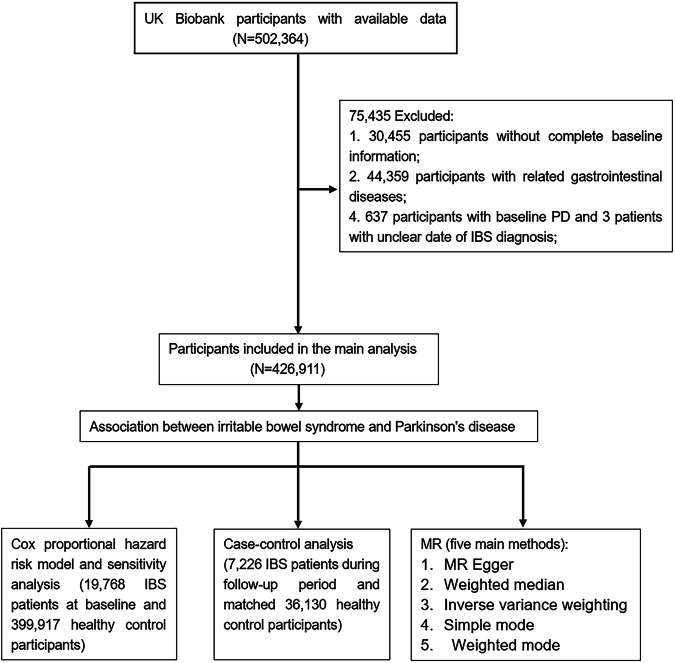
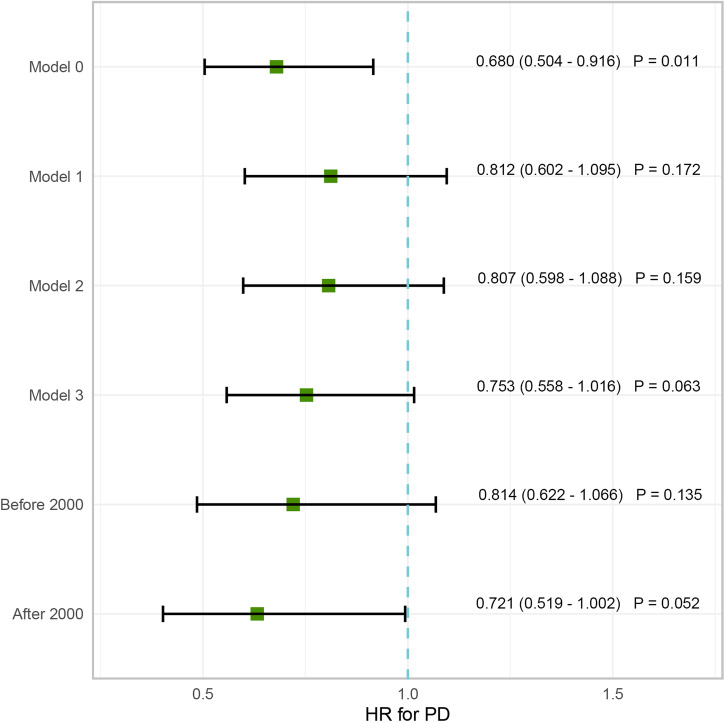
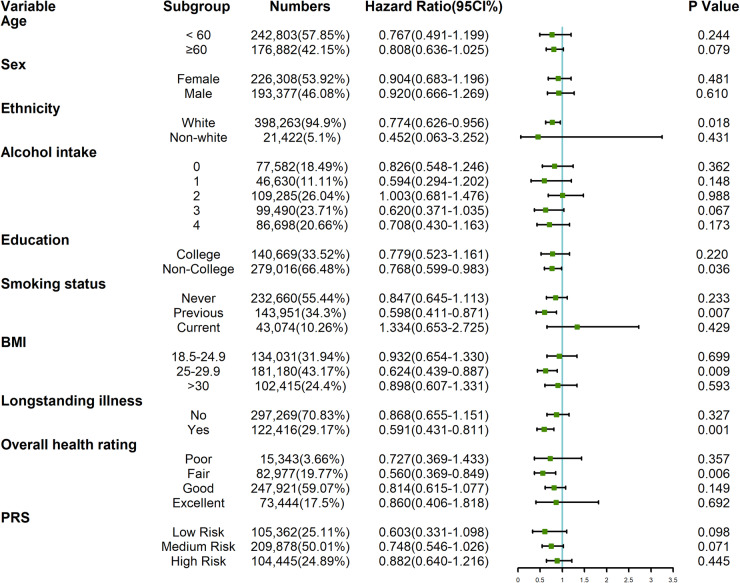
This study aimed to investigate the association between irritable bowel syndrome (IBS) and Parkinson's disease (PD) utilizing prospective cohort study and Mendelian randomization. The dataset contained a substantial cohort of 426,911 participants from the UK Biobank, discussing the association between IBS and PD with Cox proportional hazards models and case-control analysis while adjusting for covariates such as age, gender, ethnicity and education level. In univariate Cox regression model, the risk of PD was reduced in IBS patients (HR: 0.774, 95%CI: 0.625-0.956, P = 0.017), but the statistical significance diminished in the three models after adjusting for other variables. In a few subgroup analyses, IBS patients are less likely to develop into PD, and patients diagnosed with IBS after 2000 also had a lower risk (HR: 0.633, 95%CI: 0.403-0.994, P = 0.047) of subsequently developing PD. In addition, we matched five healthy control participants based on gender and age at the end of the study for each IBS patient diagnosed during the follow-up period, and logistic regression results (OR:1.239, 95%CI: 0.896-1.680, P = 0.181) showed that IBS was not associated with the risk of PD. Mendelian randomization did not find significant evidence of the causal relationship between IBS and Parkinson's disease (OR: 0.801, 95%CI: 0.570-1.278, P = 0.204). Overall, we suggest that IBS status is not associated with the risk of developing PD, and that these findings provide valuable insights into the clinical management and resource allocation of patients with IBS.
本研究旨在利用前瞻性队列研究和孟德尔随机化方法,调查肠易激综合征(IBS)与帕金森病(PD)之间的关联。该数据集包含来自英国生物银行的426,911名参与者的大量队列,使用Cox比例风险模型和病例对照分析探讨IBS与PD之间的关联,同时对年龄、性别、种族和教育水平等协变量进行调整。在单变量Cox回归模型中,IBS患者患PD的风险降低(HR:0.774,95%CI:0.625 - 0.956,P = 0.017),但在调整其他变量后的三个模型中,统计学意义减弱。在一些亚组分析中,IBS患者发展为PD的可能性较小,2000年后被诊断为IBS的患者随后患PD的风险也较低(HR:0.633,95%CI:0.403 - 0.994,P = 0.047)。此外,在研究结束时,我们为随访期间诊断出的每例IBS患者按性别和年龄匹配了5名健康对照参与者,逻辑回归结果(OR:1.239,95%CI:0.896 - 1.680,P = 0.181)表明IBS与PD风险无关。孟德尔随机化未发现IBS与帕金森病之间存在因果关系的显著证据(OR:0.801,95%CI:0.570 - 1.278,P = 0.204)。总体而言,我们认为IBS状态与患PD的风险无关,这些发现为IBS患者的临床管理和资源分配提供了有价值的见解。