
从 CT 中半自动且无需监督的股骨分割方法的开发与验证。
Development and validation of a semi-automated and unsupervised method for femur segmentation from CT.
机构信息
PolitoBIOMedLab, Department of Mechanical and Aerospace Engineering, Politecnico di Torino, Turin, Italy.
Medical Technology Lab, IRCCS Istituto Ortopedico Rizzoli, Bologna, Italy.
出版信息
Sci Rep. 2024 Mar 28;14(1):7403. doi: 10.1038/s41598-024-57618-6.
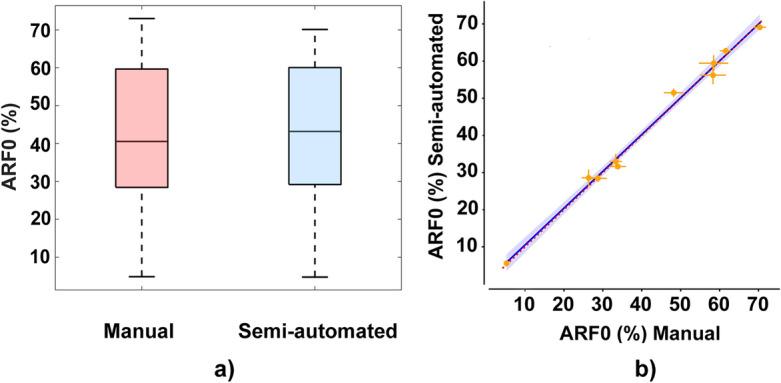
Quantitative computed tomography (QCT)-based in silico models have demonstrated improved accuracy in predicting hip fractures with respect to the current gold standard, the areal bone mineral density. These models require that the femur bone is segmented as a first step. This task can be challenging, and in fact, it is often almost fully manual, which is time-consuming, operator-dependent, and hard to reproduce. This work proposes a semi-automated procedure for femur bone segmentation from CT images. The proposed procedure is based on the bone and joint enhancement filter and graph-cut algorithms. The semi-automated procedure performances were assessed on 10 subjects through comparison with the standard manual segmentation. Metrics based on the femur geometries and the risk of fracture assessed in silico resulting from the two segmentation procedures were considered. The average Hausdorff distance (0.03 ± 0.01 mm) and the difference union ratio (0.06 ± 0.02) metrics computed between the manual and semi-automated segmentations were significantly higher than those computed within the manual segmentations (0.01 ± 0.01 mm and 0.03 ± 0.02). Besides, a blind qualitative evaluation revealed that the semi-automated procedure was significantly superior (p < 0.001) to the manual one in terms of fidelity to the CT. As for the hip fracture risk assessed in silico starting from both segmentations, no significant difference emerged between the two (R = 0.99). The proposed semi-automated segmentation procedure overcomes the manual one, shortening the segmentation time and providing a better segmentation. The method could be employed within CT-based in silico methodologies and to segment large volumes of images to train and test fully automated and supervised segmentation methods.
基于定量计算机断层扫描(QCT)的计算机模型在预测髋部骨折方面的准确性相对于当前的金标准——面积骨密度有了显著提高。这些模型要求首先对股骨进行分割。这一任务具有挑战性,实际上,它通常几乎完全是手动的,既耗时、依赖操作人员,又难以复制。本研究提出了一种从 CT 图像半自动分割股骨的方法。所提出的方法基于骨骼和关节增强滤波器和图割算法。通过与标准手动分割进行比较,评估了该半自动分割程序在 10 个受试者中的性能。所考虑的指标包括基于股骨几何形状的指标和两种分割方法在计算机模拟中评估的骨折风险。手动和半自动分割之间计算出的平均 Hausdorff 距离(0.03±0.01mm)和差异联合比(0.06±0.02)明显高于手动分割(0.01±0.01mm 和 0.03±0.02)。此外,盲法定性评估表明,半自动分割在与 CT 的拟合度方面明显优于手动分割(p<0.001)。对于从两种分割开始在计算机模拟中评估的髋部骨折风险,两种分割之间没有出现显著差异(R=0.99)。所提出的半自动分割程序优于手动分割,缩短了分割时间,并提供了更好的分割效果。该方法可用于基于 CT 的计算机模拟方法中,也可用于分割大量图像,以训练和测试全自动和有监督的分割方法。


 Zotero 插件