Ruland Florian, Meltl Andreas A, Neugebauer Muriel S, Jeschke Jonathan M
Leibniz Institute of Freshwater Ecology and Inland Fisheries (IGB), Müggelseedamm 310, 12587 Berlin, Germany.
Department of Biology, Chemistry, Pharmacy, Institute of Biology, Freie Universität Berlin, Königin-Luise-Str. 1-3, 14195 Berlin, Germany.
iScience. 2024 Mar 8;27(4):109462. doi: 10.1016/j.isci.2024.109462. eCollection 2024 Apr 19.
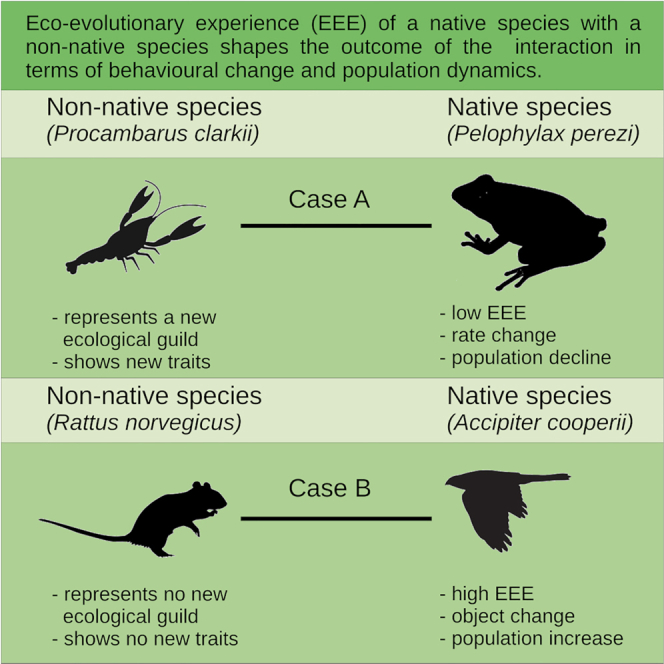
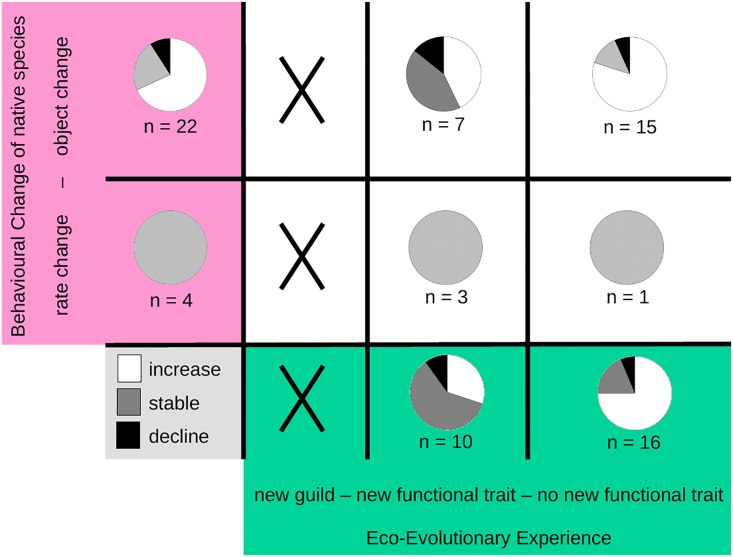
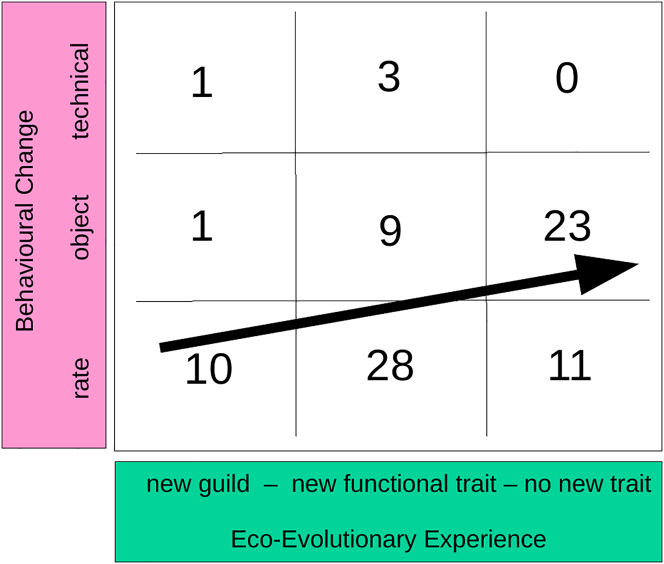
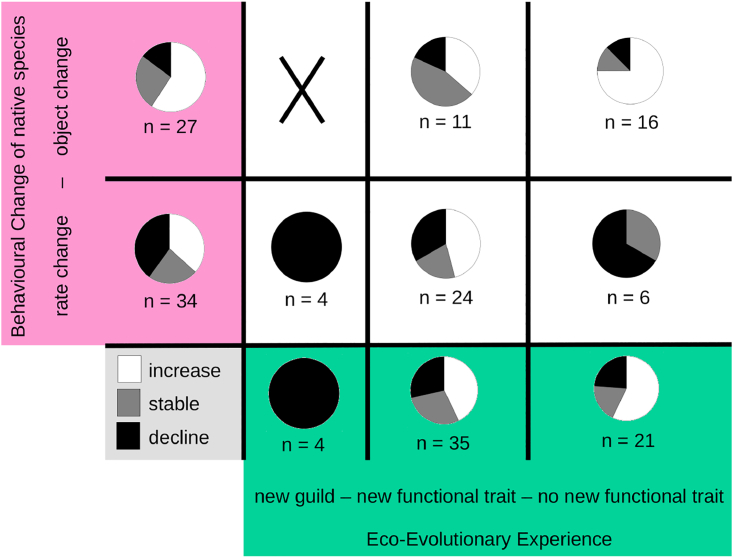
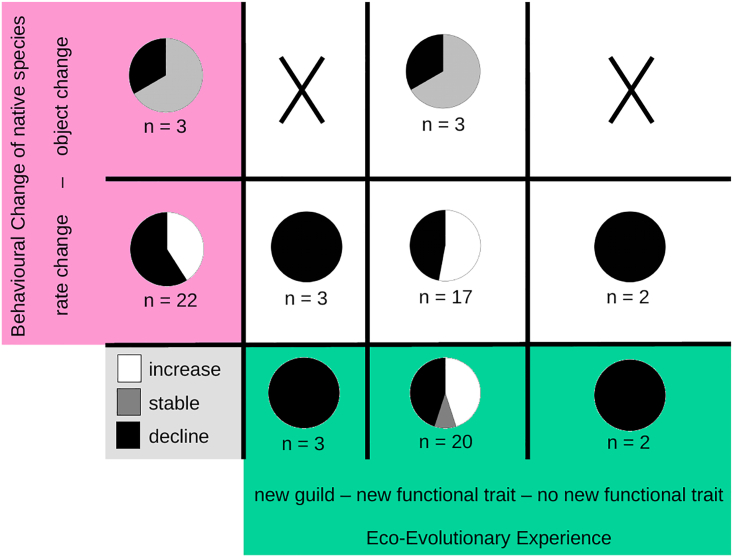
Behavioral changes play an important role for animals to cope with human-induced rapid environmental change such as biological invasions. The concept of eco-evolutionary experience (EEE) postulates that native species are more strongly impacted by non-native species the more these differ from species they have coevolved with. Also, EEE could influence the degree of innovation in new behaviors shown by native species. We conceived categorization schemes to assess both EEE and innovation and applied them to 86 records of behavioral change in native birds (n = 50), mammals (n = 19), and amphibians (n = 17). The results of this proof-of-concept study suggest an interconnectedness of EEE, innovation, and resulting population dynamics of native species. However, quantitative analyses were limited by the small size of our dataset. We encourage the use of the categorization schemes proposed here to close important knowledge gaps, so that our findings can be revisited with larger datasets in the future.
行为变化对于动物应对人类引起的快速环境变化(如生物入侵)起着重要作用。生态进化经验(EEE)的概念假定,本地物种受到非本地物种的影响越大,这些非本地物种与它们共同进化的物种差异就越大。此外,EEE可能会影响本地物种表现出的新行为的创新程度。我们构思了分类方案来评估EEE和创新,并将其应用于86条本地鸟类(n = 50)、哺乳动物(n = 19)和两栖动物(n = 17)行为变化的记录。这项概念验证研究的结果表明了EEE、创新以及本地物种由此产生的种群动态之间的相互联系。然而,定量分析受到我们数据集规模较小的限制。我们鼓励使用这里提出的分类方案来填补重要的知识空白,以便未来可以用更大的数据集重新审视我们的发现。