
在膀胱癌患者中,α1-油酸和卡介苗治疗引起的免疫反应相似。
Similar immune responses to alpha1-oleate and Bacillus Calmette-Guérin treatment in patients with bladder cancer.
机构信息
Division of Microbiology, Immunology and Glycobiology, Department of Laboratory Medicine, Faculty of Medicine, Lund University, Lund, Sweden.
Department of Urology, Motol University Hospital, 2nd Faculty of Medicine, Charles University Praha, Prague, Czech Republic.
出版信息
Cancer Med. 2024 Apr;13(7):e7091. doi: 10.1002/cam4.7091.
BACKGROUND
The molecular content of urine is defined by filtration in the kidneys and by local release from tissues lining the urinary tract. Pathological processes and different therapies change the molecular composition of urine and a variety of markers have been analyzed in patients with bladder cancer. The response to BCG immunotherapy and chemotherapy has been extensively studied and elevated urine concentrations of IL-1RA, IFN-α, IFN-γ TNF-α, and IL-17 have been associated with improved outcome.
METHODS
In this study, the host response to intravesical alpha 1-oleate treatment was characterized in patients with non-muscle invasive bladder cancer by proteomic and transcriptomic analysis.
RESULTS
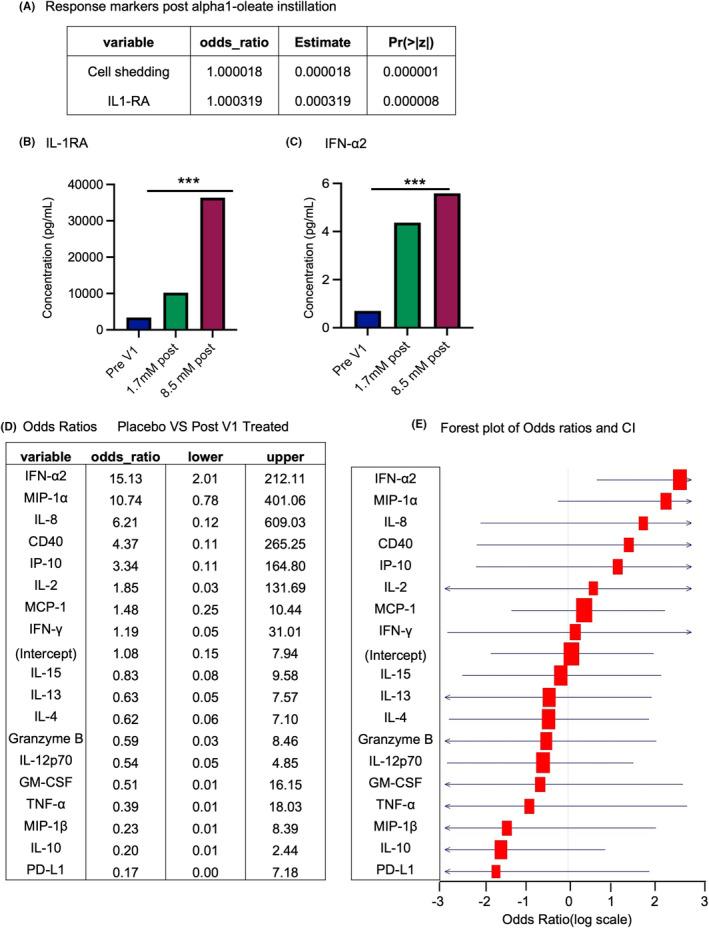
Proteomic profiling detected a significant increase in multiple cytokines in the treatment group compared to placebo. The innate immune response was strongly activated, including IL-1RA and pro-inflammatory cytokines in the IL-1 family (IL-1α, IL-1β, IL-33), chemokines (MIP-1α, IL-8), and interferons (IFN-α2, IFN-γ). Adaptive immune mediators included IL-12, Granzyme B, CD40, PD-L1, and IL-17D, suggesting broad effects of alpha 1-oleate treatment on the tumor tissues.
CONCLUSIONS
The cytokine response profile in alpha 1-oleate treated patients was similar to that reported in BCG treated patients, suggesting a significant overlap. A reduction in protein levels at the end of treatment coincided with inhibition of cancer-related gene expression in tissue biopsies, consistent with a positive treatment effect. Thus, in addition to killing tumor cells and inducing cell detachment, alpha 1-oleate is shown to activate a broad immune response with a protective potential.
背景
尿液中的分子成分是由肾脏过滤和尿路上皮组织局部释放所决定的。病理过程和不同的治疗方法会改变尿液的分子组成,目前已经有多种标志物在膀胱癌患者中进行了分析。卡介苗免疫治疗和化学治疗的反应已经得到了广泛的研究,尿液中白细胞介素-1受体拮抗剂(IL-1RA)、干扰素-α(IFN-α)、干扰素-γ(IFN-γ)、肿瘤坏死因子-α(TNF-α)和白细胞介素-17(IL-17)浓度的升高与预后改善相关。
方法
在这项研究中,通过蛋白质组学和转录组学分析,研究人员分析了非肌层浸润性膀胱癌患者经腔内α-1-油酸治疗后的宿主反应。
结果
蛋白质组学分析检测到治疗组与安慰剂组相比,多种细胞因子显著增加。先天免疫反应被强烈激活,包括白细胞介素-1受体拮抗剂(IL-1RA)和白细胞介素-1 家族中的促炎细胞因子(IL-1α、IL-1β、IL-33)、趋化因子(MIP-1α、IL-8)和干扰素(IFN-α2、IFN-γ)。适应性免疫介质包括白细胞介素-12(IL-12)、颗粒酶 B、CD40、PD-L1 和白细胞介素-17D(IL-17D),这表明α-1-油酸治疗对肿瘤组织有广泛的影响。
结论
α-1-油酸治疗患者的细胞因子反应谱与卡介苗治疗患者的反应谱相似,表明存在显著的重叠。治疗结束时蛋白质水平的降低与组织活检中与癌症相关的基因表达抑制相一致,这与积极的治疗效果一致。因此,除了杀伤肿瘤细胞和诱导细胞脱落外,α-1-油酸还能激活具有保护潜力的广泛免疫反应。


 Zotero 插件