Department of Psychology, Toronto Metropolitan University, Toronto, ON, Canada.
Department of Psychiatry, Sinai Health, Toronto, ON, Canada.
Yale J Biol Med. 2024 Mar 29;97(1):3-16. doi: 10.59249/WMGE9032. eCollection 2024 Mar.
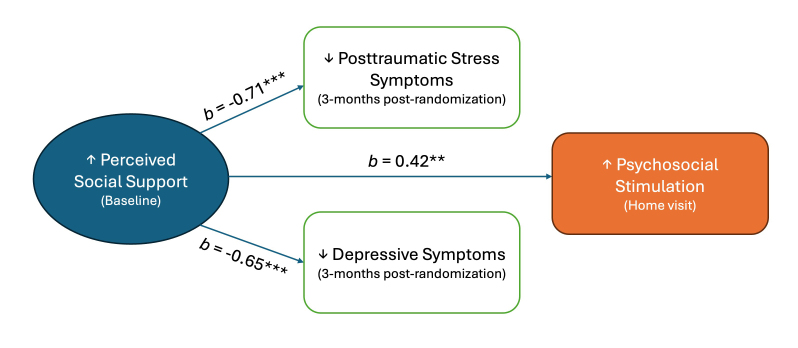
Social support refers to the help someone receives emotionally or instrumentally from their social network. Poor social support in the perinatal period has been associated with increased risk for symptoms of common mental disorders, including depression and posttraumatic stress symptoms (PTS), which may impact parenting behavior. Whether social support impacts parenting behaviors, independent of mental health symptomatology, remains unclear. Among N=309 participants of the Scaling Up Maternal Mental healthcare by Increasing access to Treatment (SUMMIT Trial), a large perinatal depression and anxiety treatment trial, we explored the relations between perceived social support, perinatal depressive and PTS symptoms, and psychosocial stimulation provided by the parent in their home environment. Social support was measured at baseline using the Multidimensional Scale of Perceived Social Support (MSPSS). Perinatal depressive symptoms were measured by the Edinburgh Postnatal Depression Scale (EPDS) and PTS symptoms were measured by the Abbreviated PTSD Checklist (PCL-6) at baseline, 3-, and 6-months post-randomization. Psychosocial stimulation was assessed by the Home Observation Measurement of the Environment (HOME) when the infant was between 6 to 24 months. Using stepwise hierarchical regressions, we found: (1) perceived social support at baseline significantly predicted both depressive and PTS symptoms at 3-months post-randomization, even when controlling for baseline depressive and PTS symptoms; and (2) while neither depressive nor PTS symptoms were significantly associated with psychosocial stimulation, perceived social support at baseline was a significant predictor. Clinical implications regarding treatment of perinatal patients are discussed.
社会支持是指个体从其社交网络中获得的情感或工具性帮助。围产期社会支持不足与常见精神障碍症状(包括抑郁和创伤后应激症状)的风险增加有关,这些症状可能会影响育儿行为。社会支持是否独立于心理健康症状对育儿行为产生影响尚不清楚。在大规模孕产妇心理健康治疗增加治疗机会试验(SUMMIT 试验)中,我们对 309 名参与者进行了研究,这是一项针对围产期抑郁和焦虑的大型治疗试验,探讨了感知社会支持、围产期抑郁和 PTS 症状与父母在家庭环境中提供的心理社会刺激之间的关系。社会支持在基线时使用多维感知社会支持量表(MSPSS)进行测量。围产期抑郁症状通过爱丁堡产后抑郁量表(EPDS)测量,创伤后应激症状通过简化创伤后应激检查表(PCL-6)在基线、3 个月和随机分组后 6 个月测量。当婴儿在 6 至 24 个月之间时,使用家庭观察测量环境量表(HOME)评估心理社会刺激。使用逐步分层回归,我们发现:(1)基线时感知到的社会支持显著预测了随机分组后 3 个月的抑郁和 PTS 症状,即使控制了基线时的抑郁和 PTS 症状;(2)虽然抑郁和 PTS 症状均与心理社会刺激无关,但基线时感知到的社会支持是一个显著的预测因素。讨论了与围产期患者治疗相关的临床意义。