Deluca Meridith, Hoffman Brett A, Serdahely Kevin, Ravi Sreeram, Sanford Christopher
Orthopedics, The University of Toledo College of Medicine and Life Sciences, Toledo, USA.
Orthopedics, Penn State Health Milton S. Hershey Medical Center, State College, USA.
Cureus. 2024 Mar 1;16(3):e55312. doi: 10.7759/cureus.55312. eCollection 2024 Mar.
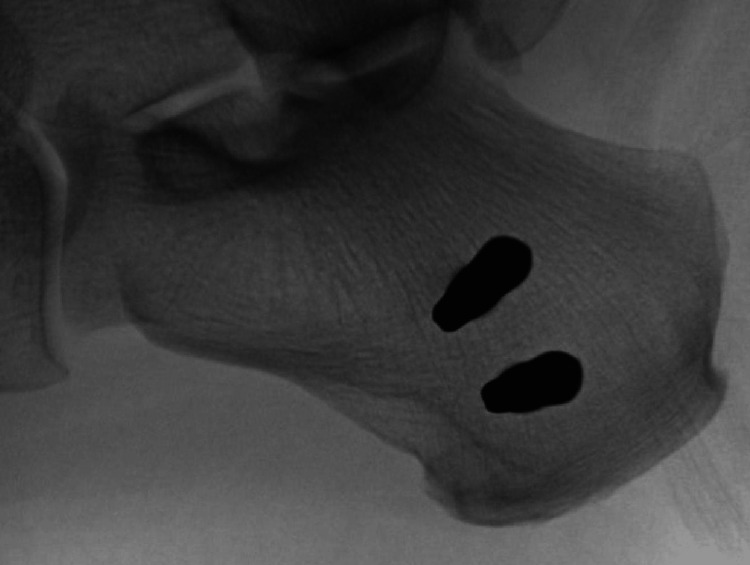
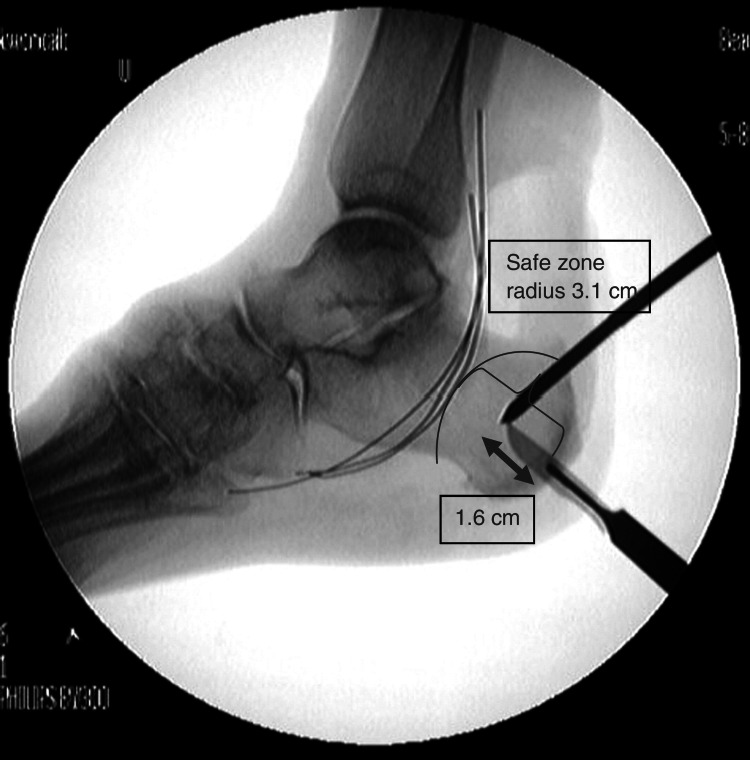
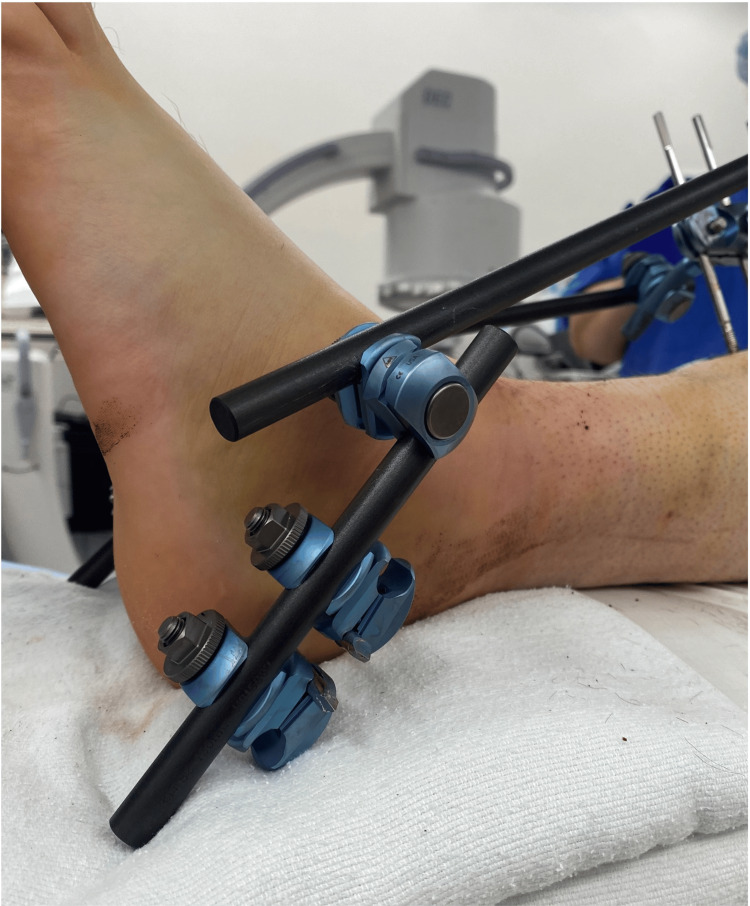
Spanning ankle external fixation is a commonly used technique for the treatment of fractures of the lower extremity. Traditionally, a single pin is placed in the safe zone of the calcaneus to provide a point of traction for fracture reduction and stabilization. Complications include infection and pin loosening with subsequent loss of fracture reduction. We aim to highlight the benefits and techniques of adding a second calcaneal pin to reduce the likelihood of infection, pin loosening, and possible loss of fracture reduction. Using the standard medial-to-lateral placement technique, two centrally threaded Schanz pins were placed within the safe zone of the calcaneus approximately 2 cm apart and were connected by clamps and a short carbon fiber rod. The remainder of the external fixation apparatus is assembled using a standard technique after obtaining fracture reduction. There is an increased incidence of infection and pin loosening with decreased bone quality and a longer duration within an external fixator. The addition of a second calcaneal pin can be used to reduce the incidence of pin loosening and associated sequela, especially in patients with decreased bone quality, thus improving outcomes for patients undergoing spanning ankle external fixation.
跨踝关节外固定是治疗下肢骨折常用的技术。传统上,在跟骨安全区置入一枚钢针,为骨折复位和固定提供牵引点。并发症包括感染和钢针松动,继而导致骨折复位丢失。我们旨在强调增加一枚跟骨钢针的益处和技术,以降低感染、钢针松动以及可能的骨折复位丢失的可能性。采用标准的从内侧到外侧的置入技术,在跟骨安全区内相距约2厘米处置入两枚中心螺纹斯氏针,并用夹具和短碳纤维棒连接。在获得骨折复位后,使用标准技术组装外固定装置的其余部分。随着骨质下降和外固定器使用时间延长,感染和钢针松动的发生率会增加。增加一枚跟骨钢针可用于降低钢针松动及相关后遗症的发生率,尤其是在骨质下降的患者中,从而改善接受跨踝关节外固定患者的治疗效果。