Usman Muhammad, Cheng Shuo, Boonyubol Sasipa, Cross Jeffrey S
Department of Transdisciplinary Science and Engineering, School of Environment and Society, Tokyo Institute of Technology, 2-12-1, Ookayama, Meguro-ku, Tokyo 152-8550, Japan.
ACS Omega. 2024 Mar 15;9(12):14530-14538. doi: 10.1021/acsomega.4c00455. eCollection 2024 Mar 26.
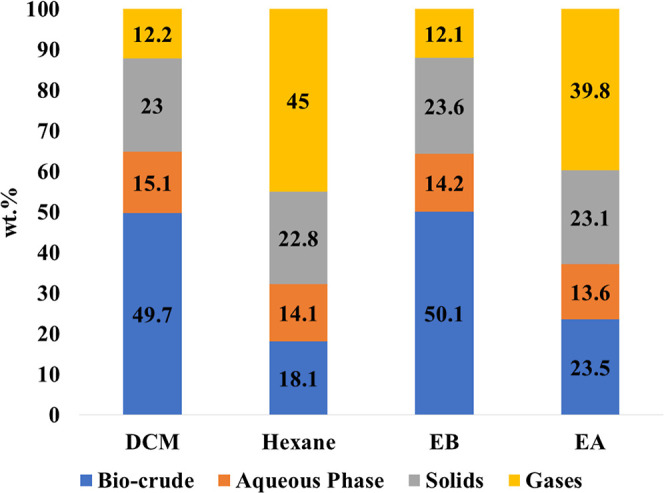
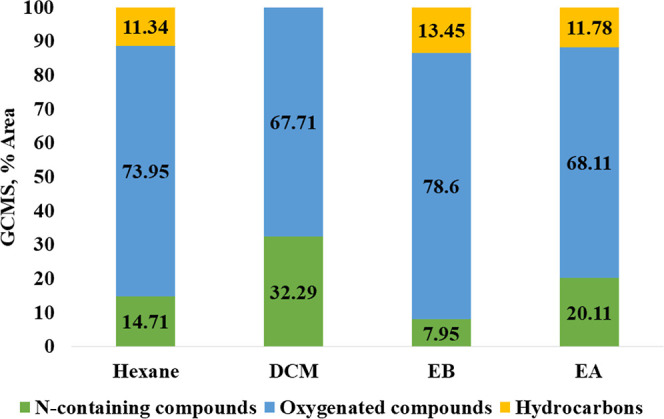
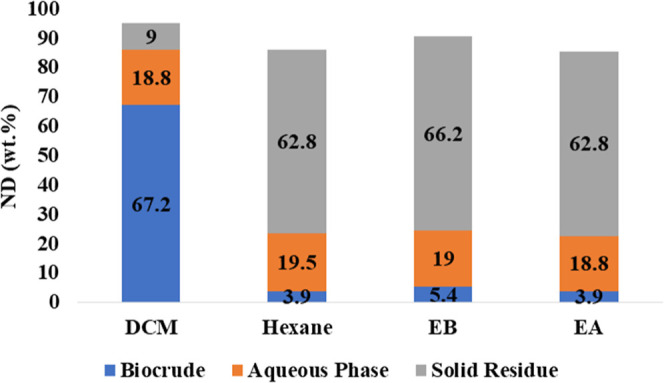
This study explored the effectiveness of hydrothermal liquefaction (HTL) in converting sewage sludge (SS) into high-quality biocrude. It scrutinized the influence of various solvents, including conventional choices like dichloromethane (DCM) and hexane, alongside environmentally friendly alternatives, such as ethyl butyrate (EB) and ethyl acetate (EA). HTL experiments, conducted at 350 °C for 60 min in a 20 mL batch reactor, include solvent-based biocrude extraction. Notably, EB showed the highest extraction yield (50.1 wt %), the lowest nitrogen distribution (5.4% with 0.32 wt %), and a remarkable 74% energy recovery (ER), setting a noteworthy benchmark in nitrogen reduction. GCMS analysis reveals EB-derived biocrude's superiority in having the least heteroatoms and nitrogenous compounds compared to hexane, EA, and DCM. Solid residues from hexane, EB, and EA displayed the highest nitrogen distribution range (62-68%), hinting at potential applications in further processes. These findings significantly inform solvent selection for efficient and sustainable waste-to-energy conversion. While promising, the study emphasizes the need to explore solvent-solute interactions further to optimize biocrude quality, highlighting the pivotal role of solvent choice in advancing clean, cost-effective waste-to-energy technologies.
本研究探讨了水热液化(HTL)将污水污泥(SS)转化为高质量生物原油的有效性。研究考察了各种溶剂的影响,包括二氯甲烷(DCM)和己烷等传统溶剂,以及丁酸乙酯(EB)和乙酸乙酯(EA)等环境友好型替代溶剂。在20 mL间歇式反应器中于350℃下进行60分钟的HTL实验,包括基于溶剂的生物原油提取。值得注意的是,EB的提取产率最高(50.1 wt%),氮分布最低(5.4%,含0.32 wt%),能量回收率(ER)高达74%,在氮减排方面树立了显著的标杆。气相色谱-质谱联用(GCMS)分析表明,与己烷、EA和DCM相比,EB衍生的生物原油中杂原子和含氮化合物最少,具有优越性。己烷、EB和EA产生的固体残渣显示出最高的氮分布范围(62 - 68%),这暗示了其在后续工艺中的潜在应用。这些发现为高效、可持续的废物转化为能源过程中的溶剂选择提供了重要参考。尽管前景乐观,但该研究强调需要进一步探索溶剂 - 溶质相互作用以优化生物原油质量,突出了溶剂选择在推进清洁、经济高效的废物转化为能源技术中的关键作用。