Mellen Center for Multiple Sclerosis, Cleveland Clinic, Cleveland, OH, USA.
Bristol Myers Squibb, Princeton, NJ, USA.
BMC Neurol. 2022 Jun 7;22(1):211. doi: 10.1186/s12883-022-02738-7.
Over a dozen disease-modifying therapies (DMTs) have been approved for treatment of multiple sclerosis (MS). Treatment guidelines focus on when to initiate, change, and discontinue treatment but provide little guidance on how to select or sequence DMTs. This study assessed sequencing patterns of DMTs in patients with newly diagnosed MS.
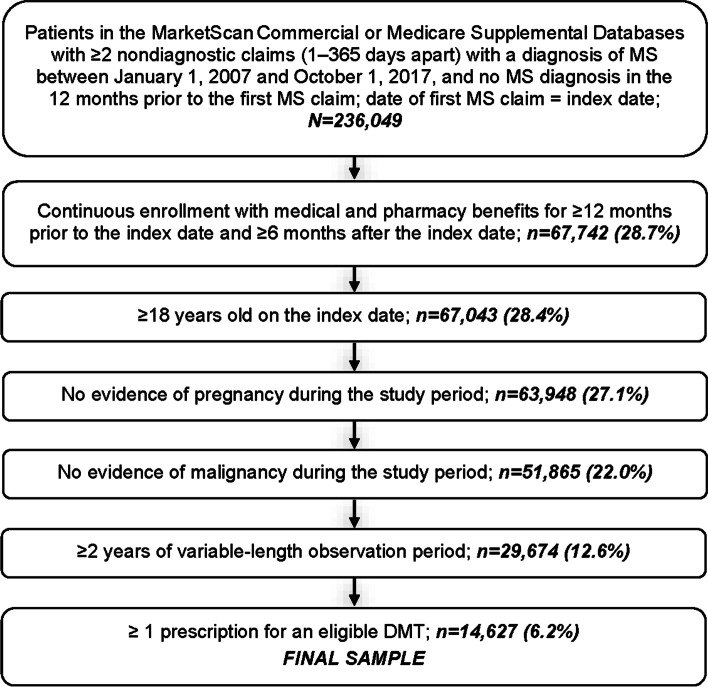
Adults newly diagnosed with MS in the United States were identified from January 2007 to October 2017 using IBM MarketScan database. Patients had ≥12 months of continuous enrollment prior to diagnosis and ≥ 2 years of follow-up. Treatment pathways consisting of up to 3 DMT courses were reported, and each treatment course ended with discontinuation, switch, or end of follow-up.
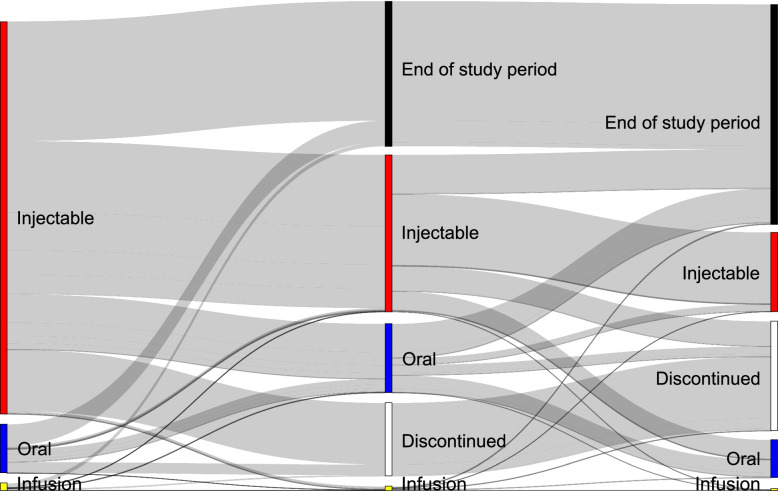
In total, 14,627 MS patients were treated with DMTs and had ≥2 years of follow-up. More than 400 DMT treatment pathways were observed. Glatiramer acetate was the most common DMT; 40% of patients initiated this treatment. Among these, 51.3% had 2 DMT courses during follow-up and 26.5% had 3 DMT courses. Approximately 70% of patients switched or discontinued their initial DMT, and rates of switch and discontinuation differed by initial DMT. Injectable DMTs were used most commonly over the study period (87.5% as first course to 66.6% as third course). Oral DMTs were more common as second or third treatment courses (29.9% and 31.8%, respectively).
A wide variety in treatment patterns were observed among patients newly diagnosed with MS. Further examination of DMT prescribing practices is needed to understand the reasons behind treatment discontinuation and treatment cycling.
已有十多种疾病修正疗法(DMT)获批用于治疗多发性硬化症(MS)。治疗指南侧重于何时开始、改变和停止治疗,但对如何选择或序贯 DMT 提供的指导很少。本研究评估了新诊断 MS 患者 DMT 的序贯模式。
使用 IBM MarketScan 数据库,从 2007 年 1 月至 2017 年 10 月期间在美国识别出新诊断为 MS 的成年人。患者在诊断前至少有 12 个月的连续参保,并且随访时间至少有 2 年。报告了由最多 3 种 DMT 疗程组成的治疗途径,并且每个治疗疗程以停药、换药或随访结束而告终。
总共有 14627 名 MS 患者接受 DMT 治疗且随访时间至少 2 年。观察到超过 400 种 DMT 治疗途径。醋酸格拉替雷是最常用的 DMT;40%的患者使用这种治疗。其中,51.3%的患者在随访期间有 2 个 DMT 疗程,26.5%的患者有 3 个 DMT 疗程。大约 70%的患者换用或停止了初始 DMT,并且初始 DMT 的换药和停药率不同。在研究期间,注射用 DMT 最常用于一线治疗(首次作为一线治疗的占 87.5%,第三次作为一线治疗的占 66.6%)。口服 DMT 更常用于二线或三线治疗(分别为 29.9%和 31.8%)。
新诊断为 MS 的患者的治疗模式多种多样。需要进一步检查 DMT 处方实践,以了解停药和治疗循环的原因。