Clinical and Experimental Neuropsychology Laboratory, Faculty of Psychology, University of Geneva, Switzerland.
Faculty of Medicine, University of Geneva, Switzerland.
Arch Clin Neuropsychol. 2023 Jul 25;38(5):657-666. doi: 10.1093/arclin/acad010.
As personality changes and personality disorders are frequently observed in multiple sclerosis (MS), personality may be a prognostic factor for this disease. The present study investigated the influence of personality on disability, progression, and treatment adherence in MS.
Personality was assessed in 41 patients with Relapsing-Remitting MS (30 females; mean age = 42.63 years) using the NEO Personality Inventory-3rd edition. Disability was measured with the Expanded Disability Status Scale, and treatment adherence information was collected from the Swiss MS Cohort. Correlation, multiple linear and partial least square regressions were performed to examine relations between personality, disability, and treatment adherence in MS.
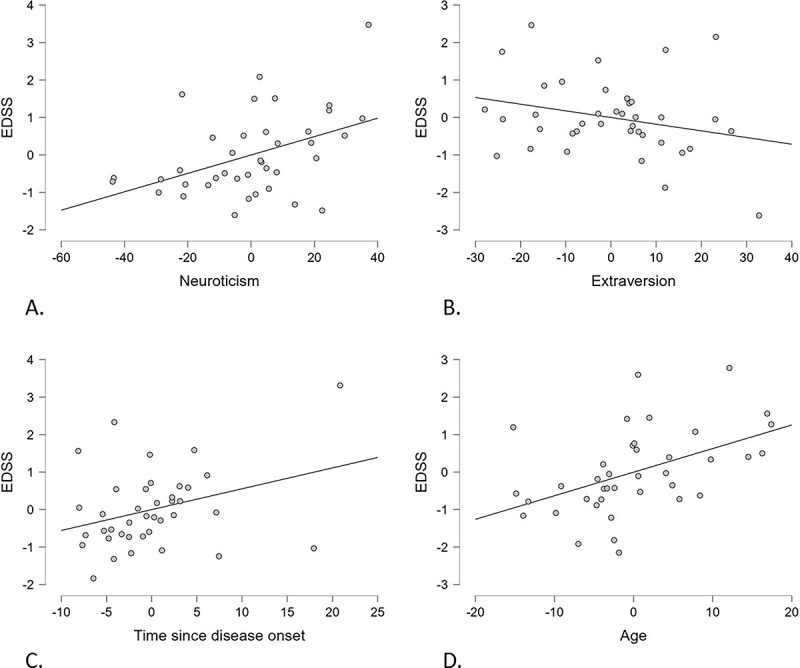
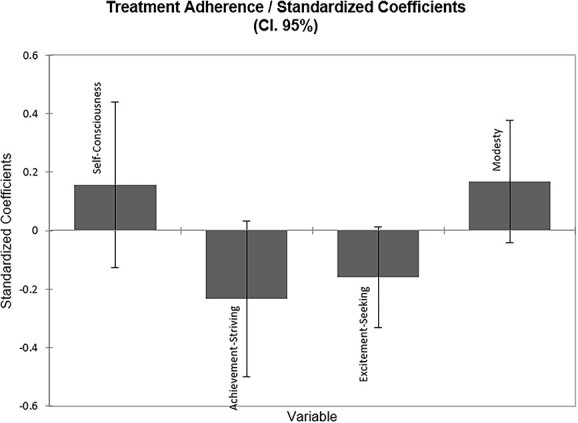
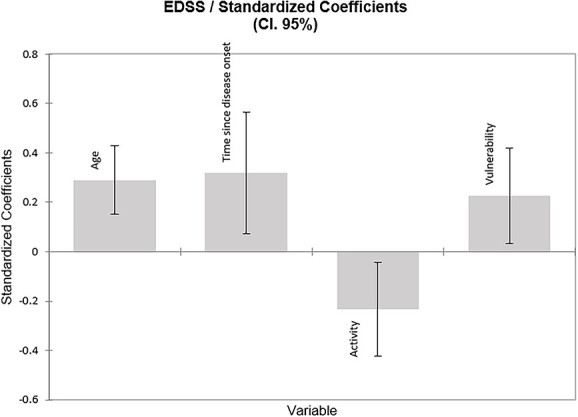
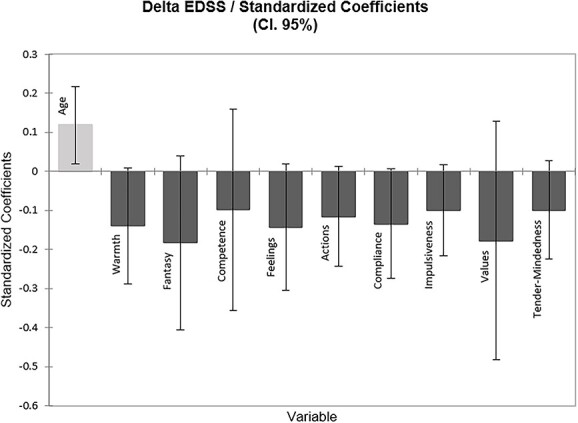
After accounting for age and time since disease onset, our analysis revealed that Neuroticism (β = 0.32, p = 0.01) and its Vulnerability facet (β = 0.28, p < 0.05) predicted greater disability, whereas Extraversion (β = -0.25, p = 0.04) and its Activity facet (β = -0.23, p < 0.05) predicted milder disability. Regarding disability progression, correlational analysis revealed that it was negatively correlated with Extraversion (r = -0.44, p = 0.02) and the Feelings facet of Openness (r = -0.41, p = 0.03), but regressions failed to highlight any predictive links. No significant results could be demonstrated for treatment adherence.
Overall, our study showed that some personality traits can impact disability in MS, indicating that these should be considered in clinical practice, as they could be used to adapt and improve patients' clinical support.
由于多发性硬化症(MS)患者经常出现人格改变和人格障碍,因此人格可能是该疾病的预后因素。本研究探讨了人格对 MS 患者残疾、进展和治疗依从性的影响。
使用 NEO 人格量表第三版对 41 例复发缓解型 MS 患者(30 名女性;平均年龄 42.63 岁)进行了人格评估。使用扩展残疾状况量表评估残疾程度,从瑞士 MS 队列中收集治疗依从性信息。采用相关分析、多元线性和偏最小二乘回归分析,探讨 MS 患者人格、残疾和治疗依从性之间的关系。
在考虑年龄和疾病发病时间后,我们的分析表明,神经质(β=0.32,p=0.01)及其脆弱性方面(β=0.28,p<0.05)预测残疾程度更严重,而外向性(β=-0.25,p=0.04)及其活动方面(β=-0.23,p<0.05)预测残疾程度较轻。关于残疾进展,相关分析表明,它与外向性呈负相关(r=-0.44,p=0.02)和开放性的感觉方面(r=-0.41,p=0.03),但回归未能突出任何预测关联。治疗依从性没有显著结果。
总体而言,我们的研究表明,一些人格特征可以影响 MS 患者的残疾程度,这表明在临床实践中应考虑这些因素,因为它们可用于适应和改善患者的临床支持。