Sulfianti Asri, Sopandi Vidhia Tiara, Isnaeni Isnaeni, Suryanggono Jodi, Pambudi Sabar, El Muttaqien Sjaikhurrizal, Ningsih Febby Nurdiya, Widayanti Tika, Mardliyati Etik, Annisa Annisa
Research Center for Vaccine and Drugs, National Research and Innovation Agency Republic of Indonesia (BRIN), LAPTIAB Building no 611-612, KST BJ Habibie, Serpong, Tangerang Selatan, Banten 15310, Indonesia.
Department of Biology, Faculty of Mathematics and Natural Sciences, Padjajaran University, Jalan Raya Bandung, Jatinangor, Sumedang, West Java 45361, Indonesia.
ADMET DMPK. 2023 Dec 6;12(1):193-208. doi: 10.5599/admet.2079. eCollection 2024.
Rapid detection test via lateral flow immunoassay (LFIA) is employed as an alternate method to detect Severe Acute Respiratory Syndrome Coronavirus 2 (SARS-CoV-2) infection. Gold nanoparticles (AuNPs), a vital component of LFIA, can be synthesized by laser ablation technique. This intense laser radiation may result in monodisperse gold nanoclusters, which are impurity-free and demonstrate innovative biocompatible surface chemistry. In this current research, laser-ablated AuNPs are produced and coupled with an anti-spike SARS-CoV-2 monoclonal antibody (mAb) generated in our prior study.
The AuNPs from 30,000 shots of laser ablation exhibited a robust red color with a maximum absorbance peak at 520 nm. The performance of AuNPs-mAb conjugates as a signal reporter was then evaluated in half-stick LFIA.
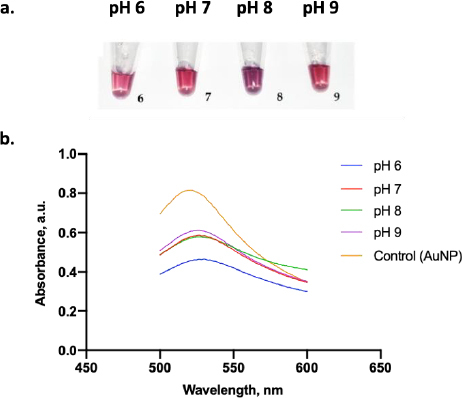
The size distribution of AuNPs shows a relatively monodisperse and unimodal distribution with average particle diameters of 44.77 nm and a surface potential of -38.5 mV. The purified anti-spike mAb SARS-CoV-2 yielded two protein bands, representing the mAb heavy chain at 55 kDa and its light chain at 25 kDa. The immobilization of anti-spike mAb onto the surface of AuNPs revealed that 25 g/ml of mAb at phosphate buffer pH 9 was required to stabilize the AuNPs. The functional test of this conjugate was performed using dipstick LFIA, and the result shows that the AuNPs-mAb conjugates could successfully detect commercial spike antigen of SARS-CoV-2 at 10 ng level.
In this study, laser-ablated AuNPs were functionalized with anti-spike mAb SARS-CoV-2 and successfully used as a signal reporter in half-stick LFIA for detecting antigen spike SARS-CoV-2.
通过侧向流动免疫分析(LFIA)进行快速检测试验被用作检测严重急性呼吸综合征冠状病毒2(SARS-CoV-2)感染的替代方法。金纳米颗粒(AuNPs)是LFIA的重要组成部分,可通过激光烧蚀技术合成。这种强激光辐射可能会产生单分散的金纳米团簇,其无杂质并展现出创新的生物相容性表面化学性质。在当前这项研究中,制备了激光烧蚀的AuNPs,并将其与我们之前研究中产生的抗SARS-CoV-2刺突单克隆抗体(mAb)偶联。
经过30000次激光烧蚀产生的AuNPs呈现出强烈的红色,在520nm处有最大吸收峰。然后在半条LFIA中评估AuNPs-mAb偶联物作为信号报告分子的性能。
AuNPs的尺寸分布呈现出相对单分散的单峰分布,平均粒径为44.77nm,表面电位为-38.5mV。纯化的抗SARS-CoV-2刺突mAb产生了两条蛋白带,分别代表55kDa的mAb重链和25kDa的轻链。将抗刺突mAb固定在AuNPs表面表明,在pH9的磷酸盐缓冲液中需要25μg/ml的mAb来稳定AuNPs。使用试纸条LFIA对该偶联物进行功能测试,结果表明AuNPs-mAb偶联物能够成功检测10ng水平的SARS-CoV-2商业刺突抗原。
在本研究中,激光烧蚀的AuNPs用抗SARS-CoV-2刺突mAb进行了功能化,并成功用作半条LFIA中检测SARS-CoV-2刺突抗原的信号报告分子。