Bono Shinji, Nakai Ryotaro, Konishi Satoshi
Research Organization of Science and Technology, Ritsumeikan University, Shiga, Japan.
Ritsumeikan Advanced Research Academy, Kyoto, Japan.
Microsyst Nanoeng. 2024 Mar 29;10:46. doi: 10.1038/s41378-024-00652-1. eCollection 2024.
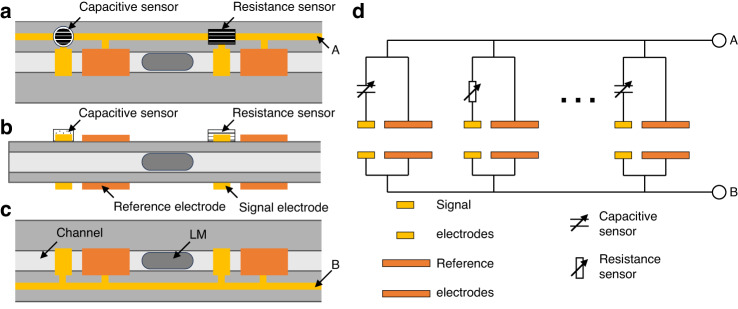
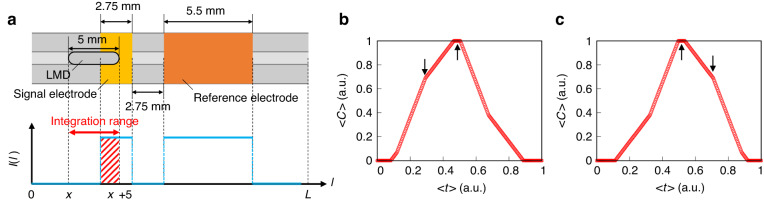
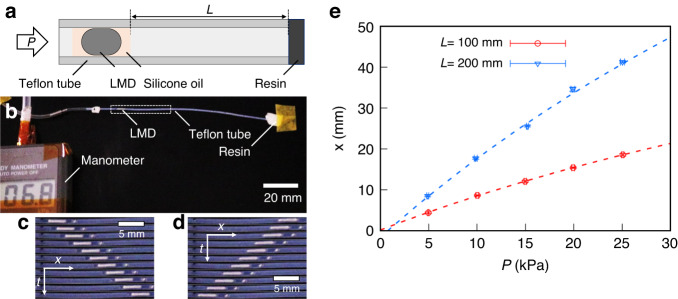
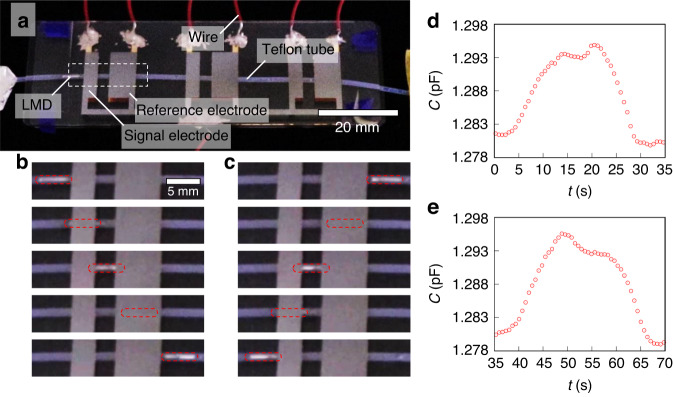
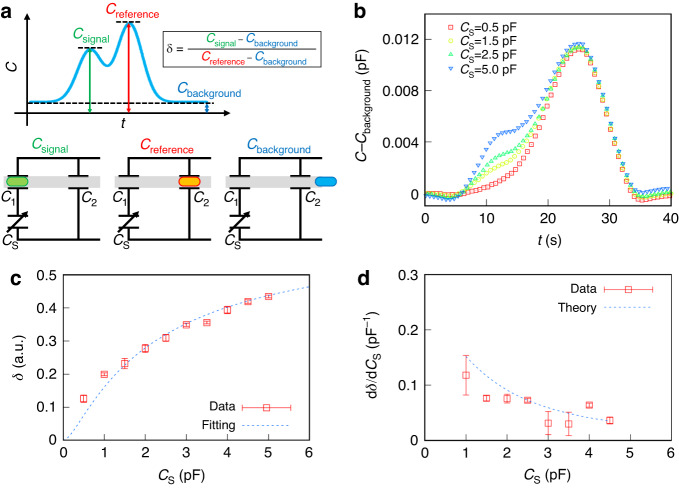
Implementing a signal-switching mechanism for the selective use of integrated sensors and actuators plays a crucial role in streamlining the functionality of miniaturized devices. Here, a liquid metal droplet (LMD)-based signal-switching mechanism is introduced to achieve such functionality. Pressure modulation with a 100-μm spatial resolution enabled precise control of the position of the LMDs within a channel. After integrating the channel with asymmetrically structured electrodes, the effect of the shuttle-like movement of LMD on the temporal changes in the overall capacitance was investigated. Consequently, analysis of the capacitive peaks revealed the directional movement of the LMDs, enabling estimation of the position of the LMDs without direct observation. In addition, we achieved successful signal extraction from the capacitive sensor that was linked to the activated electrodes, thereby enabling selective data retrieval. The proposed signal-switching mechanism method achieved a detection accuracy of ~0.1 pF. The sensor's ability to simultaneously detect the LMD position and generate a signal underscores its significant potential for multiplexing in multisensing systems, particularly in concealed environments, such as in vivo settings.
为集成传感器和执行器的选择性使用实现信号切换机制,在简化小型化设备的功能方面起着至关重要的作用。在此,引入了一种基于液态金属微滴(LMD)的信号切换机制来实现这种功能。具有100μm空间分辨率的压力调制能够精确控制通道内LMD的位置。在将通道与不对称结构电极集成后,研究了LMD的穿梭状移动对总电容随时间变化的影响。因此,对电容峰值的分析揭示了LMD的定向移动,无需直接观察就能估计LMD的位置。此外,我们成功地从与激活电极相连的电容式传感器中提取了信号,从而实现了选择性数据检索。所提出的信号切换机制方法实现了约0.1 pF的检测精度。该传感器同时检测LMD位置并生成信号的能力突出了其在多传感系统中进行多路复用的巨大潜力,特别是在诸如体内环境等隐蔽环境中。