
基于机器学习的腮腺黏液表皮样癌术后生存预测列线图。
Machine learning-based survival prediction nomogram for postoperative parotid mucoepidermoid carcinoma.
机构信息
Fujian Medical University Cancer Hospital, Fujian Cancer Hospital, Fuzhou, China.
Radiation Oncology Department, Clinical Oncology School, Fujian Cancer Hospital, Fujian Medical University, Fuzhou, Fujian, China.
出版信息
Sci Rep. 2024 Apr 1;14(1):7686. doi: 10.1038/s41598-024-58329-8.
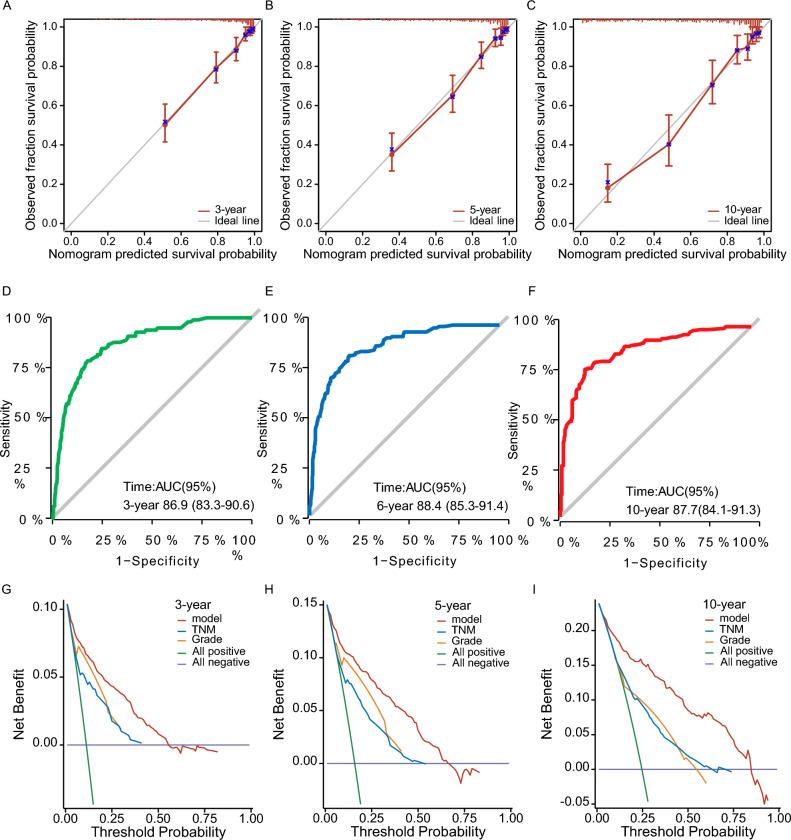
Parotid mucoepidermoid carcinoma (P-MEC) is a significant histopathological subtype of salivary gland cancer with inherent heterogeneity and complexity. Existing clinical models inadequately offer personalized treatment options for patients. In response, we assessed the efficacy of four machine learning algorithms vis-à-vis traditional analysis in forecasting the overall survival (OS) of P-MEC patients. Using the SEER database, we analyzed data from 882 postoperative P-MEC patients (stages I-IVA). Single-factor Cox regression and four machine learning techniques (random forest, LASSO, XGBoost, best subset regression) were employed for variable selection. The optimal model was derived via stepwise backward regression, Akaike Information Criterion (AIC), and Area Under the Curve (AUC). Bootstrap resampling facilitated internal validation, while prediction accuracy was gauged through C-index, time-dependent ROC curve, and calibration curve. The model's clinical relevance was ascertained using decision curve analysis (DCA). The study found 3-, 5-, and 10-year OS rates of 0.887, 0.841, and 0.753, respectively. XGBoost, BSR, and LASSO stood out in predictive efficacy, identifying seven key prognostic factors including age, pathological grade, T stage, N stage, radiation therapy, chemotherapy, and marital status. A subsequent nomogram revealed a C-index of 0.8499 (3-year), 0.8557 (5-year), and 0.8375 (10-year) and AUC values of 0.8670, 0.8879, and 0.8767, respectively. The model also highlighted the clinical significance of postoperative radiotherapy across varying risk levels. Our prognostic model, grounded in machine learning, surpasses traditional models in prediction and offer superior visualization of variable importance.
腮腺黏液表皮样癌(P-MEC)是一种具有固有异质性和复杂性的重要涎腺癌组织病理学亚型。现有的临床模型不能为患者提供个性化的治疗选择。有鉴于此,我们评估了四种机器学习算法相对于传统分析预测 P-MEC 患者总生存期(OS)的效果。我们使用 SEER 数据库分析了 882 例术后 P-MEC 患者(I-IVA 期)的数据。单因素 Cox 回归和四种机器学习技术(随机森林、LASSO、XGBoost、最佳子集回归)用于变量选择。通过逐步向后回归、Akaike 信息准则(AIC)和曲线下面积(AUC)得出最优模型。Bootstrap 重采样促进了内部验证,而通过 C 指数、时间依赖性 ROC 曲线和校准曲线来衡量预测准确性。使用决策曲线分析(DCA)确定模型的临床相关性。研究发现 3、5 和 10 年 OS 率分别为 0.887、0.841 和 0.753。XGBoost、BSR 和 LASSO 在预测效果方面表现出色,确定了年龄、病理分级、T 分期、N 分期、放疗、化疗和婚姻状况等 7 个关键预后因素。随后的列线图显示 C 指数为 0.8499(3 年)、0.8557(5 年)和 0.8375(10 年),AUC 值分别为 0.8670、0.8879 和 0.8767。该模型还强调了术后放疗在不同风险水平下的临床意义。我们的预后模型基于机器学习,在预测方面优于传统模型,并提供了变量重要性的更好可视化。


 Zotero 插件