Fletcher Charles, Ripple William J, Newsome Thomas, Barnard Phoebe, Beamer Kamanamaikalani, Behl Aishwarya, Bowen Jay, Cooney Michael, Crist Eileen, Field Christopher, Hiser Krista, Karl David M, King David A, Mann Michael E, McGregor Davianna P, Mora Camilo, Oreskes Naomi, Wilson Michael
School of Ocean and Earth Science and Technology, University of Hawai'i at Mānoa, Honolulu, HI 96822, USA.
Department of Forest Ecosystems and Society, Oregon State University, Corvallis, OR 97331, USA.
PNAS Nexus. 2024 Apr 2;3(4):pgae106. doi: 10.1093/pnasnexus/pgae106. eCollection 2024 Apr.
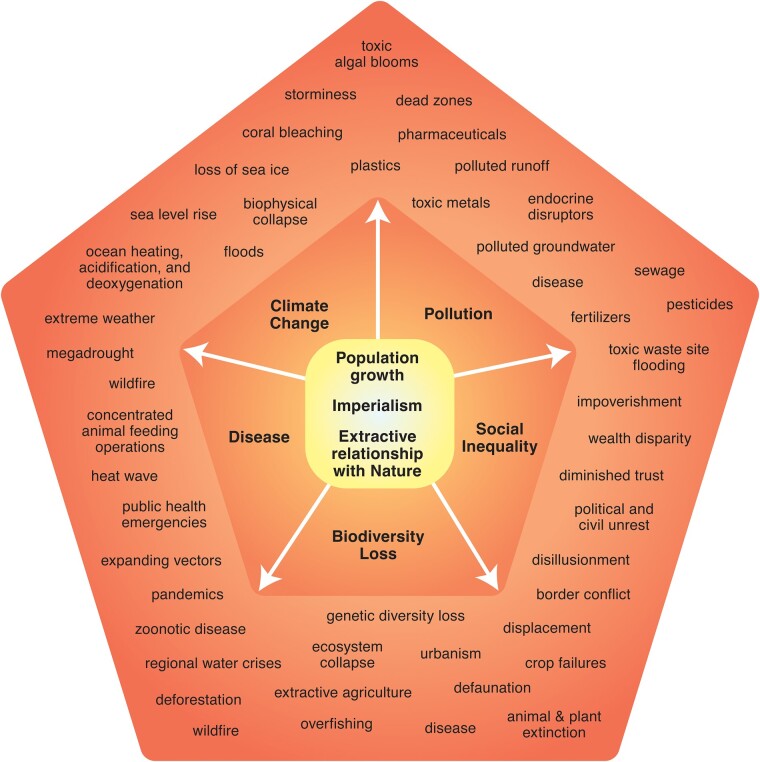
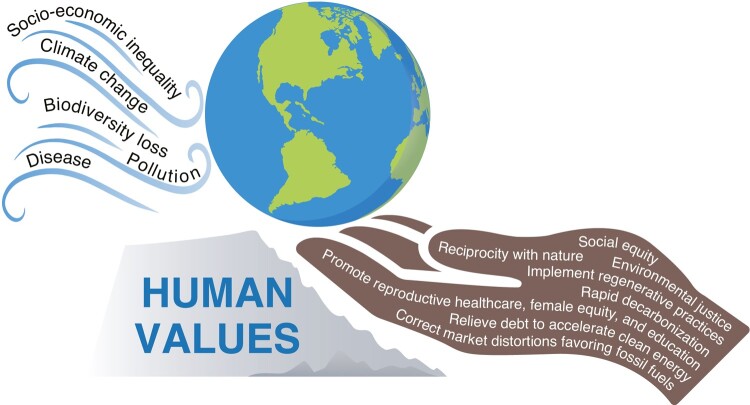
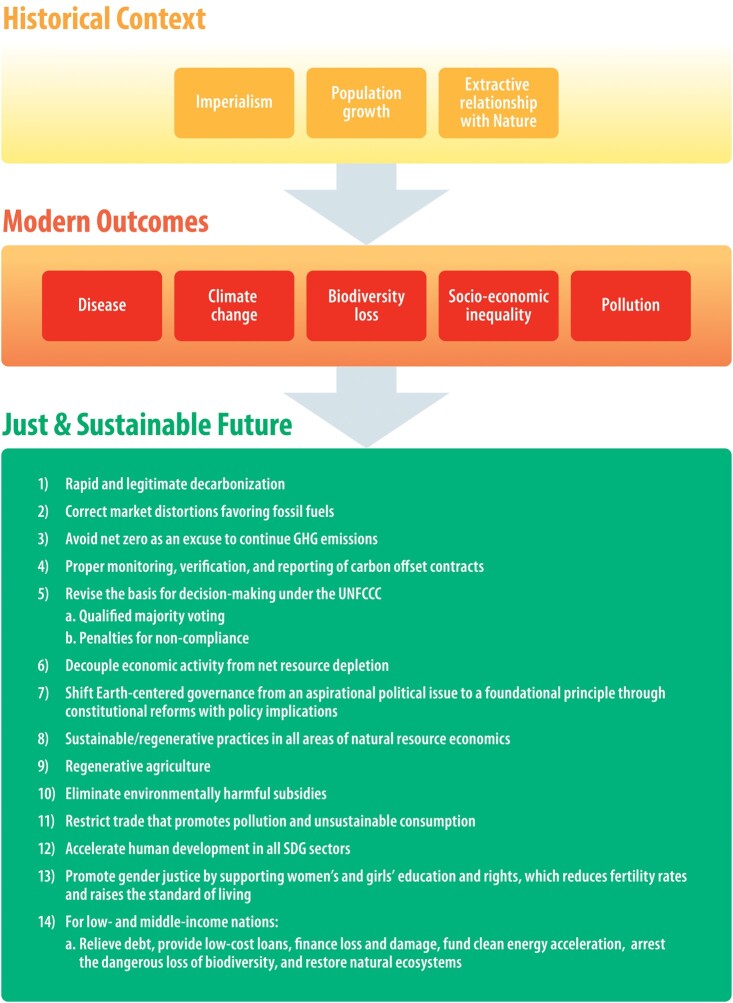
Human development has ushered in an era of converging crises: climate change, ecological destruction, disease, pollution, and socioeconomic inequality. This review synthesizes the breadth of these interwoven emergencies and underscores the urgent need for comprehensive, integrated action. Propelled by imperialism, extractive capitalism, and a surging population, we are speeding past Earth's material limits, destroying critical ecosystems, and triggering irreversible changes in biophysical systems that underpin the Holocene climatic stability which fostered human civilization. The consequences of these actions are disproportionately borne by vulnerable populations, further entrenching global inequities. Marine and terrestrial biomes face critical tipping points, while escalating challenges to food and water access foreshadow a bleak outlook for global security. Against this backdrop of Earth at risk, we call for a global response centered on urgent decarbonization, fostering reciprocity with nature, and implementing regenerative practices in natural resource management. We call for the elimination of detrimental subsidies, promotion of equitable human development, and transformative financial support for lower income nations. A critical paradigm shift must occur that replaces exploitative, wealth-oriented capitalism with an economic model that prioritizes sustainability, resilience, and justice. We advocate a global cultural shift that elevates kinship with nature and communal well-being, underpinned by the recognition of Earth's finite resources and the interconnectedness of its inhabitants. The imperative is clear: to navigate away from this precipice, we must collectively harness political will, economic resources, and societal values to steer toward a future where human progress does not come at the cost of ecological integrity and social equity.
气候变化、生态破坏、疾病、污染以及社会经济不平等。本综述综合了这些相互交织的紧急情况,并强调了采取全面、综合行动的迫切需求。在帝国主义、掠夺性资本主义和人口激增的推动下,我们正迅速超越地球的物质极限,破坏关键生态系统,并引发生物物理系统的不可逆转变化,而这些系统支撑着孕育人类文明的全新世气候稳定性。这些行动的后果由弱势群体不成比例地承担,进一步加剧了全球不平等。海洋和陆地生物群落面临关键的临界点,而获取食物和水的挑战不断升级,预示着全球安全前景黯淡。在地球面临风险的背景下,我们呼吁采取全球应对措施,重点是紧急脱碳、促进与自然的互惠以及在自然资源管理中实施再生实践。我们呼吁消除有害补贴,促进公平的人类发展,并为低收入国家提供变革性的财政支持。必须发生重大的范式转变,用一种优先考虑可持续性、恢复力和正义的经济模式取代剥削性的、以财富为导向的资本主义。我们倡导全球文化转变,提升与自然的亲情和社区福祉,其基础是认识到地球资源的有限性及其居民的相互联系。当务之急很明确:为了从这一悬崖边缘转危为安,我们必须共同利用政治意愿、经济资源和社会价值观,朝着一个人类进步不以生态完整性和社会公平为代价的未来前进。