Zuniga-Moya Julio C, Papadopoulos Benjamin, Mansoor Armaghan-E-Rehman, Mazi Patrick B, Rauseo Adriana M, Spec Andrej
St Louis School of Medicine, Washington University, St Louis, Missouri, USA.
Open Forum Infect Dis. 2024 Apr 2;11(4):ofae108. doi: 10.1093/ofid/ofae108. eCollection 2024 Apr.
An association between coronavirus disease 2019 (COVID-19)-associated invasive fungal infections (CAIFIs) and high mortality among intubated patients has been suggested in previous research. However, some of the current evidence was derived from small case series and multicenter studies conducted during different waves of the COVID-19 pandemic. We examined the incidence of CAIFIs and their associated mortality using a large, multicenter COVID-19 database built throughout the pandemic.
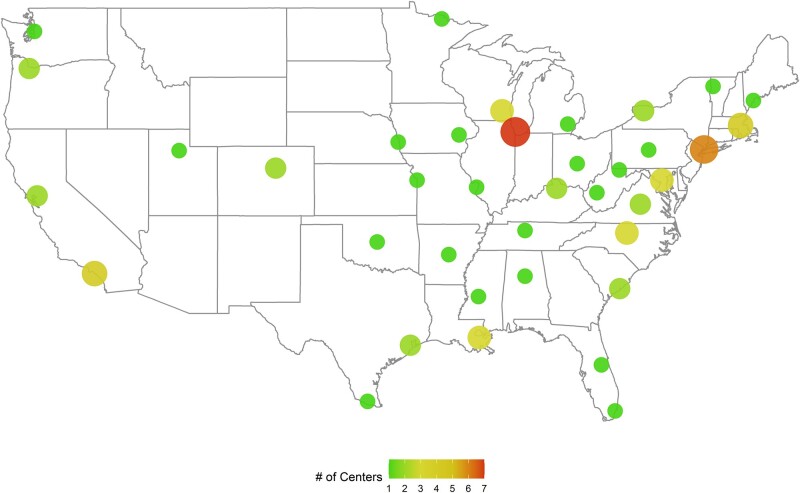
We conducted a retrospective analysis of the National COVID Cohort Collaborative (N3C) database collected from 76 medical centers in the United States between January 2020 and August 2022. Patients were 18 years or older and intubated after severe acute respiratory syndrome coronavirus 2 infection. The primary outcomes were incidence and all-cause mortality at 90 days. To assess all-cause mortality, we fitted Cox proportional hazard models after adjusting for confounders via inverse probability weighting.
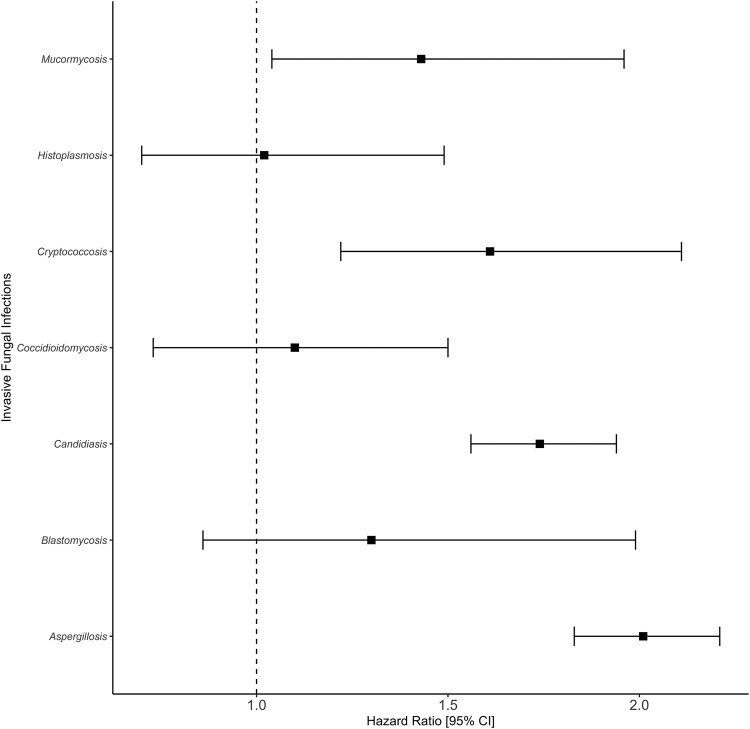
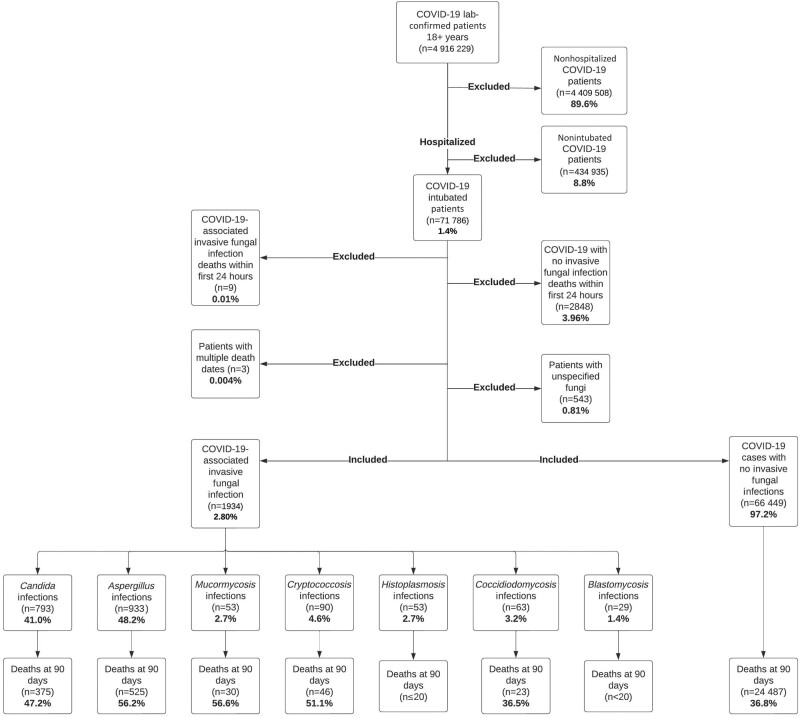
Out of the 4 916 229 patients with COVID-19 diagnosed during the study period, 68 383 (1.4%) met our cohort definition. The overall incidence of CAIFI was 2.80% (n = 1934/68 383). (48.2%; n = 933/1934) and (41.0%; n = 793/1934) were the most common causative organisms. The incidence of CAIFIs associated with among patients who underwent BAL was 6.2% (n = 83/1328). Following inverse probability weighting, CAIFIs caused by (hazard ratio [HR], 2.0; 95% CI, 1.8-2.2) and (HR, 1.7; 95% CI, 1.5-1.9) were associated with increased all-cause mortality. Systemic antifungals reduced mortality in 17% of patients with CAIFI with and 24% of patients with CAIFI with .
The incidence of CAIFI was modest but associated with higher 90-day all-cause mortality among intubated patients. Systemic antifungals modified mortality.
先前的研究表明,2019冠状病毒病(COVID-19)相关的侵袭性真菌感染(CAIFI)与插管患者的高死亡率之间存在关联。然而,目前的一些证据来自于COVID-19大流行不同阶段的小病例系列和多中心研究。我们使用在整个大流行期间建立的一个大型多中心COVID-19数据库,研究了CAIFI的发病率及其相关死亡率。
我们对2020年1月至2022年8月期间从美国76个医疗中心收集的国家COVID队列协作(N3C)数据库进行了回顾性分析。患者年龄在18岁及以上,在感染严重急性呼吸综合征冠状病毒2后进行了插管。主要结局是90天时的发病率和全因死亡率。为了评估全因死亡率,我们通过逆概率加权调整混杂因素后,拟合了Cox比例风险模型。
在研究期间确诊的4916229例COVID-19患者中,68383例(1.4%)符合我们的队列定义。CAIFI的总体发病率为2.80%(n = 1934/68383)。(48.2%;n = 933/1934)和(41.0%;n = 793/1934)是最常见的致病微生物。在接受支气管肺泡灌洗(BAL)的患者中,与BAL相关的CAIFI发病率为6.2%(n = 83/1328)。经过逆概率加权后,由(风险比[HR],2.0;95%置信区间,1.8 - 2.2)和(HR,1.7;95%置信区间,1.5 - 1.9)引起的CAIFI与全因死亡率增加相关。全身性抗真菌药物使17%的曲霉属CAIFI患者和24%的念珠菌属CAIFI患者的死亡率降低。
CAIFI的发病率适中,但与插管患者90天的全因死亡率较高相关。全身性抗真菌药物可改善死亡率。