Department of Gastrointestinal and Pediatric Surgery, Tokyo Medical University, Tokyo, Japan.
J Robot Surg. 2024 Apr 3;18(1):157. doi: 10.1007/s11701-024-01894-x.
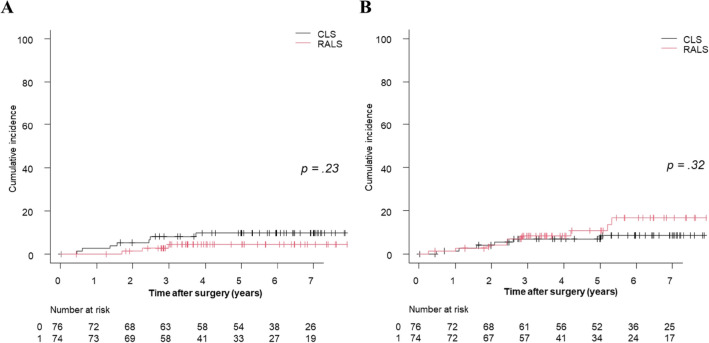
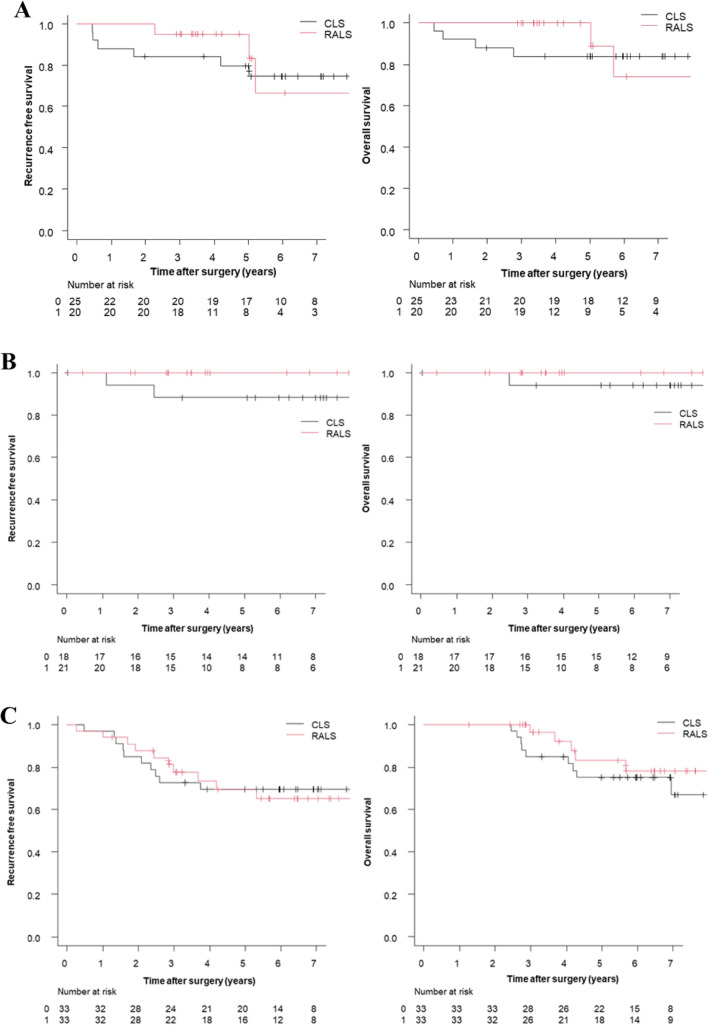
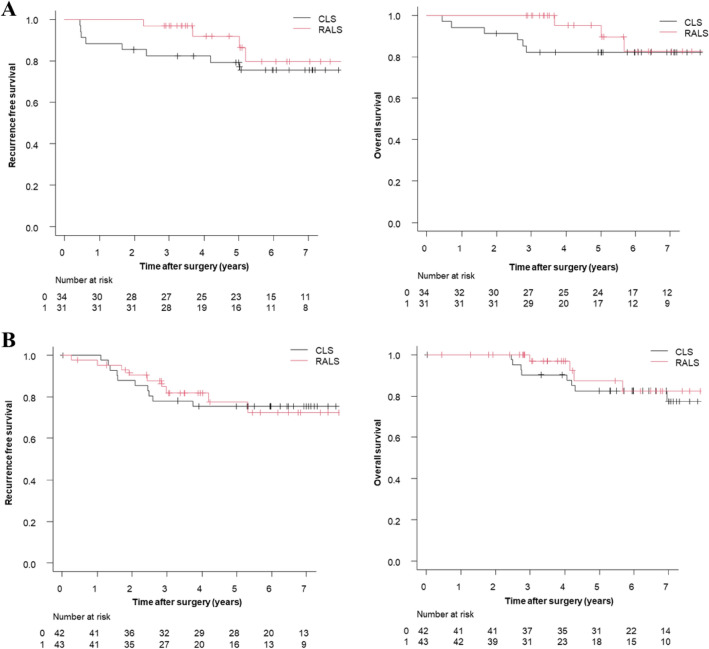
Although the short-term outcomes of robot-assisted laparoscopic surgery (RALS) for rectal cancer are well known, the long-term oncologic outcomes of RALS compared with those of conventional laparoscopic surgery (CLS) are not clear. This study aimed to compare the long-term outcomes of RALS and CLS for rectal cancer using propensity score matching. This retrospective study included 185 patients with stage I-III rectal cancer who underwent radical surgery at our institute between 2010 and 2019. Propensity score analyses were performed with 3-year overall survival (OS) and relapse-free survival (RFS) as the primary endpoints. After case matching, the 3-year OS and 3-year RFS rates were 86.5% and 77.9% in the CLS group and 98.4% and 88.5% in the RALS group, respectively. Although there were no significant differences in OS (p = 0.195) or RFS (p = 0.518) between the groups, the RALS group had slightly better OS and RFS rates. 3-year cumulative (Cum) local recurrence (LR) and 3-year Cum distant metastasis (DM) were 9.7% and 8.7% in the CLS group and 4.5% and 10.8% in the RALS group, respectively. There were no significant differences in Cum-LR (p = 0.225) or Cum-DM (p = 0.318) between the groups. RALS is a reasonable surgical treatment option for patients with rectal cancer, with long-term outcomes similar to those of CLS in such patients.
虽然机器人辅助腹腔镜手术(RALS)治疗直肠癌的短期疗效众所周知,但 RALS 与传统腹腔镜手术(CLS)的长期肿瘤学结果尚不清楚。本研究旨在通过倾向评分匹配比较 RALS 和 CLS 治疗直肠癌的长期疗效。这项回顾性研究纳入了 2010 年至 2019 年期间在我院接受根治性手术的 185 例 I-III 期直肠癌患者。以 3 年总生存率(OS)和无复发生存率(RFS)作为主要终点进行倾向评分分析。经过病例匹配后,CLS 组和 RALS 组的 3 年 OS 率和 3 年 RFS 率分别为 86.5%和 77.9%、98.4%和 88.5%。虽然两组的 OS(p=0.195)或 RFS(p=0.518)无显著差异,但 RALS 组的 OS 和 RFS 率略高。CLS 组 3 年累积局部复发(LR)率和 3 年累积远处转移(DM)率分别为 9.7%和 8.7%,RALS 组分别为 4.5%和 10.8%。两组的累积 LR(p=0.225)或累积 DM(p=0.318)无显著差异。对于直肠癌患者,RALS 是一种合理的手术治疗选择,其长期疗效与 CLS 相似。