Department of Environmental Medicine, University of Rochester Medical Center, Rochester, NY, 14642, USA.
Department of Pediatrics, University of Rochester Medical Center, Rochester, NY, 14642, USA.
J Neuroinflammation. 2024 Apr 3;21(1):82. doi: 10.1186/s12974-024-03073-z.
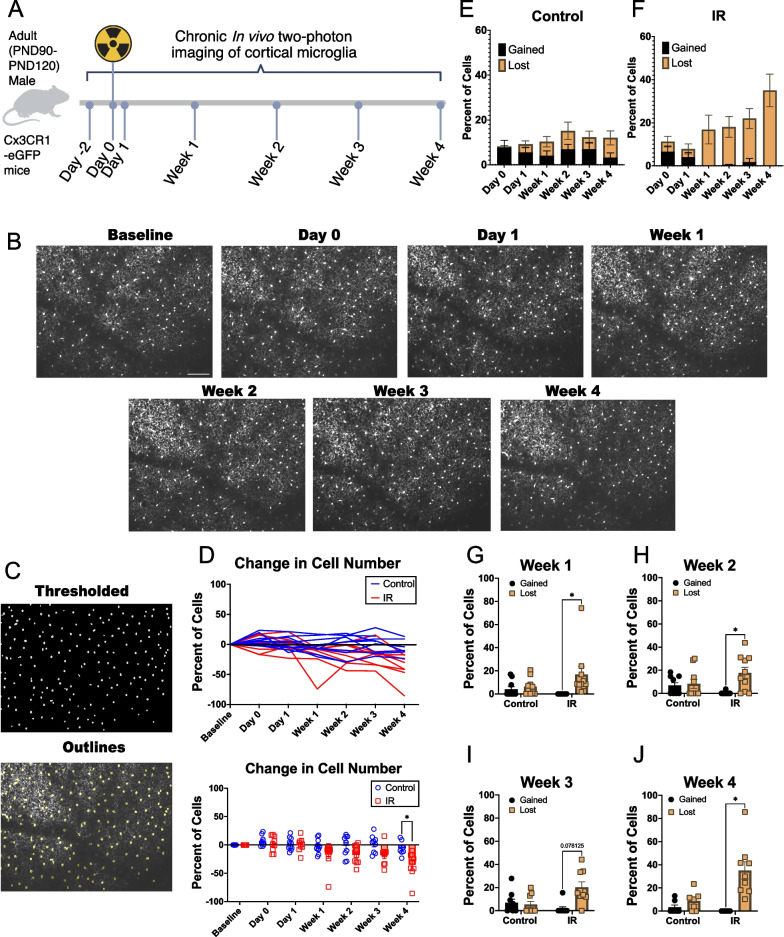
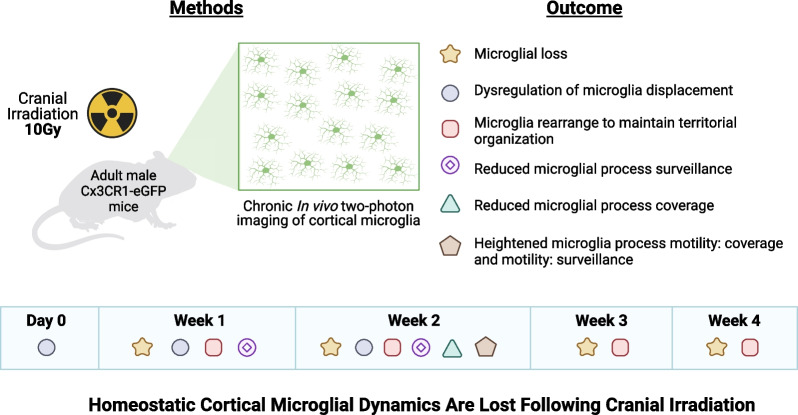
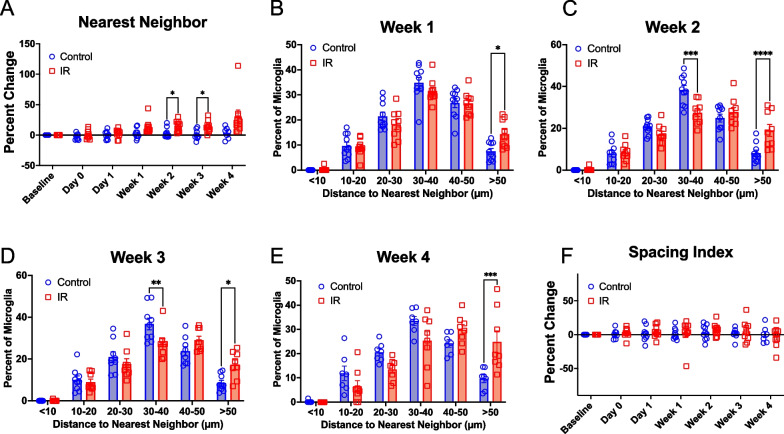
Cranial irradiation causes cognitive deficits that are in part mediated by microglia, the resident immune cells of the brain. Microglia are highly reactive, exhibiting changes in shape and morphology depending on the function they are performing. Additionally, microglia processes make dynamic, physical contacts with different components of their environment to monitor the functional state of the brain and promote plasticity. Though evidence suggests radiation perturbs homeostatic microglia functions, it is unknown how cranial irradiation impacts the dynamic behavior of microglia over time. Here, we paired in vivo two-photon microscopy with a transgenic mouse model that labels cortical microglia to follow these cells and determine how they change over time in cranial irradiated mice and their control littermates. We show that a single dose of 10 Gy cranial irradiation disrupts homeostatic cortical microglia dynamics during a 1-month time course. We found a lasting loss of microglial cells following cranial irradiation, coupled with a modest dysregulation of microglial soma displacement at earlier timepoints. The homogeneous distribution of microglia was maintained, suggesting microglia rearrange themselves to account for cell loss and maintain territorial organization following cranial irradiation. Furthermore, we found cranial irradiation reduced microglia coverage of the parenchyma and their surveillance capacity, without overtly changing morphology. Our results demonstrate that a single dose of radiation can induce changes in microglial behavior and function that could influence neurological health. These results set the foundation for future work examining how cranial irradiation impacts complex cellular dynamics in the brain which could contribute to the manifestation of cognitive deficits.
颅脑照射会导致认知缺陷,部分是由脑内的固有免疫细胞——小胶质细胞介导的。小胶质细胞具有高度反应性,其形态和形态会根据其执行的功能而发生变化。此外,小胶质细胞的突起会与环境的不同成分进行动态、物理接触,以监测大脑的功能状态并促进可塑性。尽管有证据表明辐射会扰乱小胶质细胞的稳态功能,但尚不清楚颅脑照射会如何随着时间的推移影响小胶质细胞的动态行为。在这里,我们将活体双光子显微镜与一种转基因小鼠模型相结合,该模型标记皮质小胶质细胞以跟踪这些细胞,并确定在颅脑照射小鼠及其对照同窝仔鼠中,这些细胞随时间的推移如何发生变化。我们发现,单次 10 Gy 颅脑照射会在 1 个月的时间内破坏稳态皮质小胶质细胞的动力学。我们发现颅脑照射后会持续丧失小胶质细胞,同时小胶质体细胞体位移在早期也出现适度失调。小胶质细胞的均匀分布得以维持,这表明小胶质细胞会重新排列以弥补细胞丢失,并在颅脑照射后维持其区域性组织。此外,我们发现颅脑照射会减少小胶质细胞对实质的覆盖和监测能力,而不会明显改变形态。我们的研究结果表明,单次剂量的辐射会引起小胶质细胞行为和功能的变化,这可能会影响神经健康。这些结果为未来研究颅脑照射如何影响大脑中复杂的细胞动力学奠定了基础,这可能会导致认知缺陷的表现。