
加拿大性工作中“不”的含义变化。
The changing meaning of "no" in Canadian sex work.
机构信息
Sex Work Population Project https://populationproject.ca/, Vancouver, British Columbia, Canada.
出版信息
PLoS One. 2024 Apr 4;19(4):e0301600. doi: 10.1371/journal.pone.0301600. eCollection 2024.
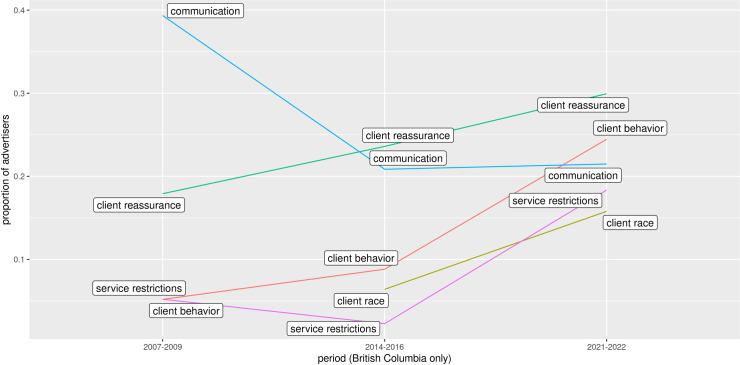
With the migration of sex workers to online advertising in Canada, a substantial body of research has emerged on how they communicate with prospective clients. However, given the enormous quantity of archival material available, finding representative ways to identify what sex workers say is a difficult task. Numerical analysis of commonly used phrases allows for the analysis of large numbers of documents potentially identifying themes that may be missed using other techniques. This study considers how Canadian sex workers communicate by examining how the word "no" was used by online advertisers over a 15-year period. Source materials consisted of three collections of online classified advertising containing over 4.2 million ads collected between 2007 and 2022 representing 214456 advertisers. Advertisers and demographic variables were extracted from ad metadata. Common terms surrounding the word "no" were used to identify themes. The word "no" was used by 115127 advertisers. Five major themes were identified: client reassurance (54084 advertisers), communication (47130 advertisers), client race (32612 advertisers), client behavior (23863 advertisers), and service restrictions (8545 advertisers). The probability of there being an association between an advertiser and a major theme was found to vary in response to several variables, including: time period, region, advertiser gender, and advertiser ethnicity. Results are compared with previous work on race and risk messaging in sex work advertising and factors influencing client race restrictions are considered. Over time, the restriction related themes of client behavior, service restrictions, and client race became more prominent. Collectives, multi-regional, cis-female, and Black or Mixed ancestry advertisers were more likely to use restrictions.
随着性工作者在加拿大向在线广告的迁移,出现了大量关于他们如何与潜在客户沟通的研究。然而,由于存档材料数量巨大,找到有代表性的方法来识别性工作者的言论是一项艰巨的任务。常用短语的数值分析允许对大量文件进行分析,从而可能识别出使用其他技术可能会错过的主题。本研究通过考察在线广告商在 15 年内如何使用“不”这个词来考虑加拿大性工作者的沟通方式。原始材料包括三批在线分类广告,其中包含 2007 年至 2022 年间收集的超过 420 万条广告,代表 214456 名广告商。从广告元数据中提取了广告商和人口统计变量。围绕“不”这个词的常用术语被用来识别主题。有 115127 名广告商使用了“不”这个词。确定了五个主要主题:客户保证(54084 名广告商)、沟通(47130 名广告商)、客户种族(32612 名广告商)、客户行为(23863 名广告商)和服务限制(8545 名广告商)。发现广告商与主要主题之间存在关联的概率因多个变量而异,包括:时间段、地区、广告商性别和广告商种族。结果与以前关于性工作广告中的种族和风险信息传递的工作进行了比较,并考虑了影响客户种族限制的因素。随着时间的推移,与客户行为、服务限制和客户种族相关的限制主题变得更加突出。集体、多地区、顺性别女性和黑人或混合血统的广告商更有可能使用限制。




 Zotero 插件