https://ror.org/01kd65564 Department of Molecular Microbiology and Immunology and STCEID, University of Texas at San Antonio, San Antonio, TX, USA.
https://ror.org/01kd65564 Department of Molecular Microbiology and Immunology and STCEID, University of Texas at San Antonio, San Antonio, TX, USA
Life Sci Alliance. 2024 Apr 4;7(6). doi: 10.26508/lsa.202302540. Print 2024 Jun.
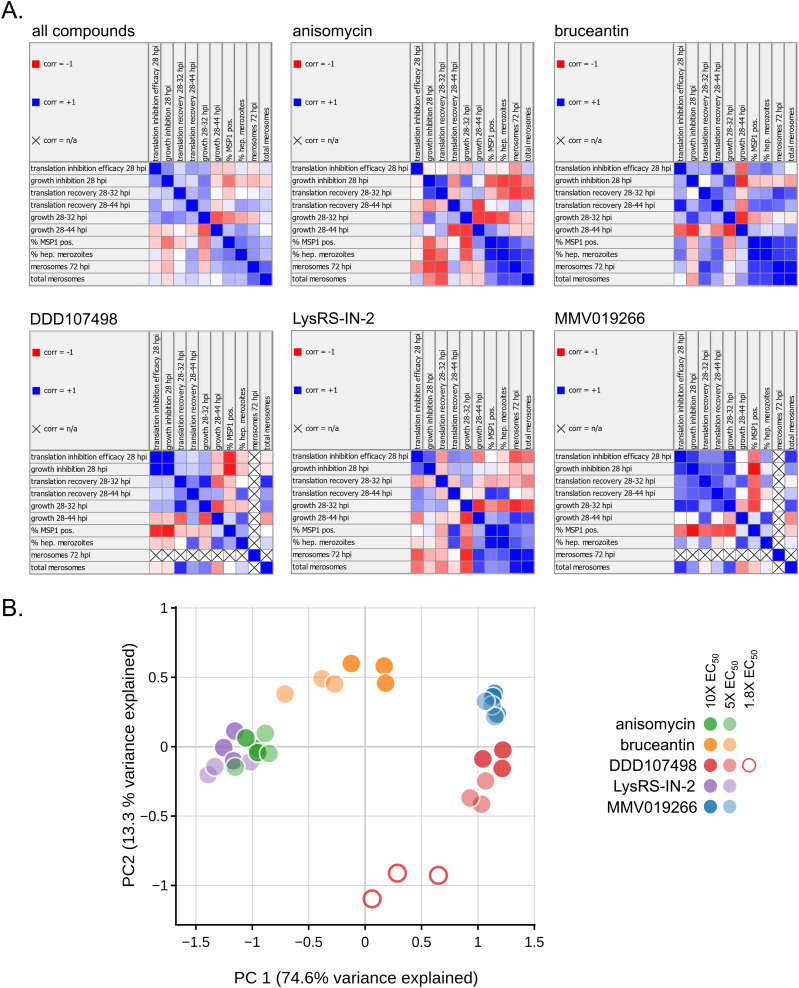
Increasing numbers of antimalarial compounds are being identified that converge mechanistically at inhibition of cytoplasmic translation, regardless of the molecular target or mechanism. A deeper understanding of how their effectiveness as liver stage translation inhibitors relates to their chemoprotective potential could prove useful. Here, we probed that relationship using the -HepG2 liver stage infection model. After determining translation inhibition ECs for five compounds, we tested them at equivalent effective concentrations to compare the parasite response to, and recovery from, a brief period of translation inhibition in early schizogony, followed by parasites to 120 h post-infection to assess antiplasmodial effects of the treatment. We show compound-specific heterogeneity in single parasite and population responses to translation inhibitor treatment, with no single metric strongly correlated to the release of hepatic merozoites for all compounds. We also demonstrate that DDD107498 is capable of exerting antiplasmodial effects on translationally arrested liver stage parasites and uncover unexpected growth dynamics during the liver stage. Our results demonstrate that translation inhibition efficacy does not determine antiplasmodial efficacy for these compounds.
越来越多的抗疟化合物被鉴定出来,它们在细胞质翻译抑制方面具有机制上的趋同,无论其分子靶标或机制如何。更深入地了解它们作为肝期翻译抑制剂的有效性与它们的化学保护潜力之间的关系可能会很有用。在这里,我们使用 -HepG2 肝期感染模型来探究这种关系。在确定了五种化合物的翻译抑制 EC 值后,我们在等效有效浓度下测试了它们,以比较在早期裂殖体中短暂抑制翻译后,寄生虫对翻译抑制剂的反应和恢复情况,然后在感染后 120 小时评估治疗的抗疟效果。我们发现,在单一寄生虫和群体对翻译抑制剂治疗的反应方面存在化合物特异性异质性,对于所有化合物,没有单一指标与肝期裂殖子的释放强烈相关。我们还证明,DDD107498 能够对翻译受阻的肝期寄生虫发挥抗疟作用,并揭示了肝期期间意想不到的生长动态。我们的结果表明,对于这些化合物,翻译抑制效果并不决定抗疟效果。