Department of Clinical Neuroscience, Centre for Psychiatry Research, Karolinska Institutet and Stockholm Health Care Services, Region Stockholm, Stockholm, Sweden.
Theme Inflammation and Aging, Karolinska University Hospital, Stockholm, Sweden.
BMC Neurol. 2024 Apr 4;24(1):111. doi: 10.1186/s12883-024-03596-1.
Rapamycin is an inhibitor of the mechanistic target of rapamycin (mTOR) protein kinase, and preclinical data demonstrate that it is a promising candidate for a general gero- and neuroprotective treatment in humans. Results from mouse models of Alzheimer's disease have shown beneficial effects of rapamycin, including preventing or reversing cognitive deficits, reducing amyloid oligomers and tauopathies and normalizing synaptic plasticity and cerebral glucose uptake. The "Evaluating Rapamycin Treatment in Alzheimer's Disease using Positron Emission Tomography" (ERAP) trial aims to test if these results translate to humans through evaluating the change in cerebral glucose uptake following six months of rapamycin treatment in participants with early-stage Alzheimer's disease.
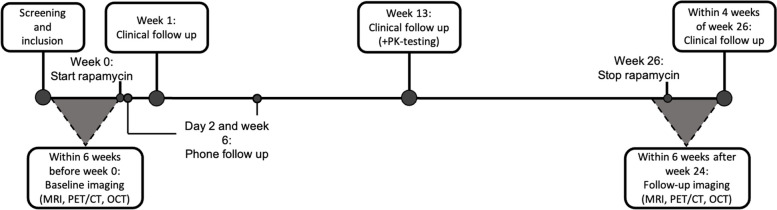
ERAP is a six-month-long, single-arm, open-label, phase IIa biomarker-driven study evaluating if the drug rapamycin can be repurposed to treat Alzheimer's disease. Fifteen patients will be included and treated with a weekly dose of 7 mg rapamycin for six months. The primary endpoint will be change in cerebral glucose uptake, measured using [F]FDG positron emission tomography. Secondary endpoints include changes in cognitive measures, markers in cerebrospinal fluid as well as cerebral blood flow measured using magnetic resonance imaging. As exploratory outcomes, the study will assess change in multiple age-related pathological processes, such as periodontal inflammation, retinal degeneration, bone mineral density loss, atherosclerosis and decreased cardiac function.
The ERAP study is a clinical trial using in vivo imaging biomarkers to assess the repurposing of rapamycin for the treatment of Alzheimer's disease. If successful, the study would provide a strong rationale for large-scale evaluation of mTOR-inhibitors as a potential disease-modifying treatment in Alzheimer's disease.
ClinicalTrials.gov ID NCT06022068, date of registration 2023-08-30.
雷帕霉素是一种机械靶蛋白(mTOR)蛋白激酶抑制剂,临床前数据表明,它是一种有前途的人类通用神经保护和神经退行性疾病治疗候选药物。阿尔茨海默病的小鼠模型研究表明雷帕霉素具有有益作用,包括预防或逆转认知障碍、减少淀粉样寡聚物和tau 病变以及使突触可塑性和大脑葡萄糖摄取正常化。“使用正电子发射断层扫描评估雷帕霉素治疗阿尔茨海默病”(ERAP)试验旨在通过评估在早期阿尔茨海默病患者中接受雷帕霉素治疗六个月后大脑葡萄糖摄取的变化,来测试这些结果是否在人类中转化。
ERAP 是一项为期六个月、单臂、开放性、Ⅱa 期生物标志物驱动的研究,旨在评估雷帕霉素是否可以重新用于治疗阿尔茨海默病。将纳入 15 名患者,每周接受 7 毫克雷帕霉素治疗六个月。主要终点是使用 [F]FDG 正电子发射断层扫描测量大脑葡萄糖摄取的变化。次要终点包括认知测量、脑脊液标志物以及使用磁共振成像测量的脑血流变化。作为探索性结果,该研究将评估多个与年龄相关的病理过程的变化,如牙周炎、视网膜变性、骨密度丧失、动脉粥样硬化和心脏功能下降。
ERAP 研究是一项使用体内成像生物标志物评估雷帕霉素重新用于治疗阿尔茨海默病的临床试验。如果成功,该研究将为大规模评估 mTOR 抑制剂作为阿尔茨海默病潜在的疾病修饰治疗提供强有力的依据。
ClinicalTrials.gov 注册号 NCT06022068,注册日期 2023-08-30。