Ahi Evran Training and Research Hospital Pediatrics Clinic Bagbasi, Kırşehir Ahi Evran University, Kirsehir, Turkey.
BMC Pediatr. 2024 Apr 4;24(1):240. doi: 10.1186/s12887-024-04594-5.
Iron deficiency anemia remains a significant public health issue in developing countries. The regulation of iron metabolism is primarily controlled by hepcidin, a key regulatory protein. During erythropoiesis, erythroferrone (ERFE), a hormone produced by erythroblasts in response to erythropoietin (EPO) synthesis, mediates the suppression of hepcidin. In this study, it was aimed to determine the correlation between erythroferrone (ERFE) and hepcidin levels in children with iron deficiency anemia.
This is a case-control study conducted at Kırşehir Ahi Evran University Training and Research Hospital Pediatrics Clinic between 1 and 31 September 2020. The study included 26 healthy children and 26 children with iron deficiency anemia. In order to evaluate iron status,whole blood count, serum iron, total iron binding capacity (TIBC), and ferritin levels were analyzed. The study measured the levels of hepcidin and erythroferrone in the serum of children diagnosed with iron deficiency before and after one month of iron treatment, as well as in a control group, using the ELISA method. Correlation between whole blood count, initial ferritin, hepcidin, ERFE and ferritin in the iron deficiency group was evaluated.
Compared with healthy controls, the iron-deficient group had significantly lower haemoglobin (p < 0.001), MCV (p = 0.001), MCH (p < 0.001), MCHC (p < 0.001), iron (p < 0.001), ferritin (p < 0.001) and hepcidin (p = 0.001). Ferritin and hepcidin levels increased while erythroferrone levels remained unchanged after iron deficiency treatment. There was no correlation between hepcidin and ferritin levels in treatment group.
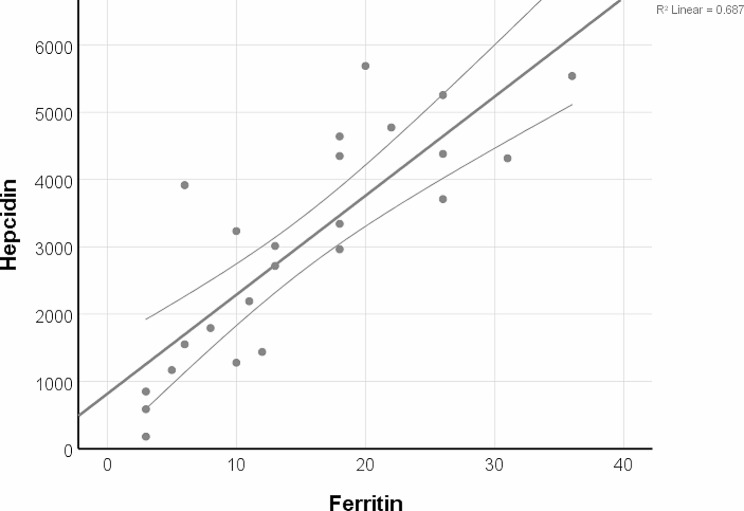
The study found a strong and positive correlation between ferritin and hepcidin levels in iron-deficient children, but not between ERFE levels, suggesting that hepcidin is largely regulated by iron deposition levels. In addition, there was an increase in ferritin and hepcidin levels after iron treatment. The study found no significant difference in erythroferrone levels between the iron-deficient group and the control group. It is thought that this may be due to the short duration of iron treatment given to the patients with iron deficiency anemia included in the study.
缺铁性贫血仍然是发展中国家的一个重大公共卫生问题。铁代谢的调节主要由铁调素(hepcidin)控制,它是一种关键的调节蛋白。在红细胞生成过程中,红系生成素(erythroferrone,ERFE)作为一种激素,由红细胞对促红细胞生成素(erythropoietin,EPO)合成的反应产生,介导铁调素的抑制。本研究旨在确定缺铁性贫血患儿的红细胞生成素(erythroferrone,ERFE)和铁调素水平之间的相关性。
这是一项病例对照研究,于 2020 年 9 月 1 日至 31 日在基尔希埃拉万大学培训和研究医院儿科诊所进行。该研究纳入了 26 名健康儿童和 26 名缺铁性贫血儿童。为了评估铁状态,分析了全血细胞计数、血清铁、总铁结合能力(TIBC)和铁蛋白水平。使用 ELISA 法测定了铁缺乏症患儿在铁治疗前和治疗后一个月以及对照组的血清中铁调素和红细胞生成素的水平。评估了缺铁组全血细胞计数、初始铁蛋白、铁调素、ERFE 与铁蛋白之间的相关性。
与健康对照组相比,缺铁组的血红蛋白(p<0.001)、MCV(p=0.001)、MCH(p<0.001)、MCHC(p<0.001)、铁(p<0.001)、铁蛋白(p<0.001)和铁调素(p=0.001)明显降低。铁缺乏治疗后,铁蛋白和铁调素水平升高,而红细胞生成素水平不变。治疗组铁调素与铁蛋白水平之间无相关性。
本研究发现缺铁性儿童铁蛋白与铁调素水平之间存在强正相关,但 ERFE 水平之间无相关性,提示铁调素主要受铁沉积水平调节。此外,铁治疗后铁蛋白和铁调素水平升高。本研究发现缺铁组与对照组之间红细胞生成素水平无显著差异。这可能是由于纳入研究的缺铁性贫血患者的铁治疗时间较短。