Arif Haad A, LeBrun Gavin, Moore Simon T, Friscia David A
School of Medicine, University of California Riverside, Riverside, CA, USA.
University of Texas at Austin, Austin, TX, USA.
Foot Ankle Orthop. 2024 Apr 3;9(2):24730114241241310. doi: 10.1177/24730114241241310. eCollection 2024 Apr.
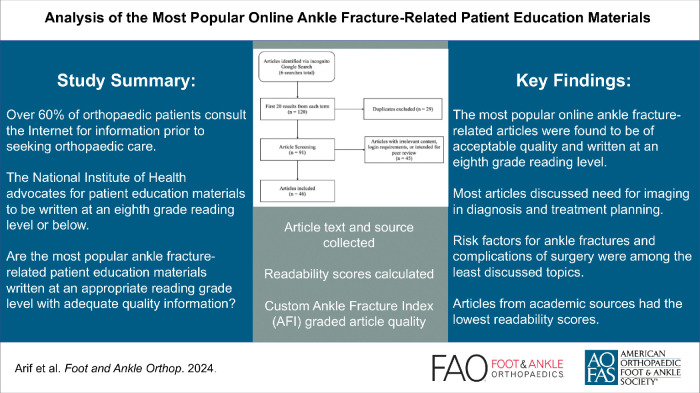
Given the increasing accessibility of Internet access, it is critical to ensure that the informational material available online for patient education is both accurate and readable to promote a greater degree of health literacy. This study sought to investigate the quality and readability of the most popular online resources for ankle fractures.
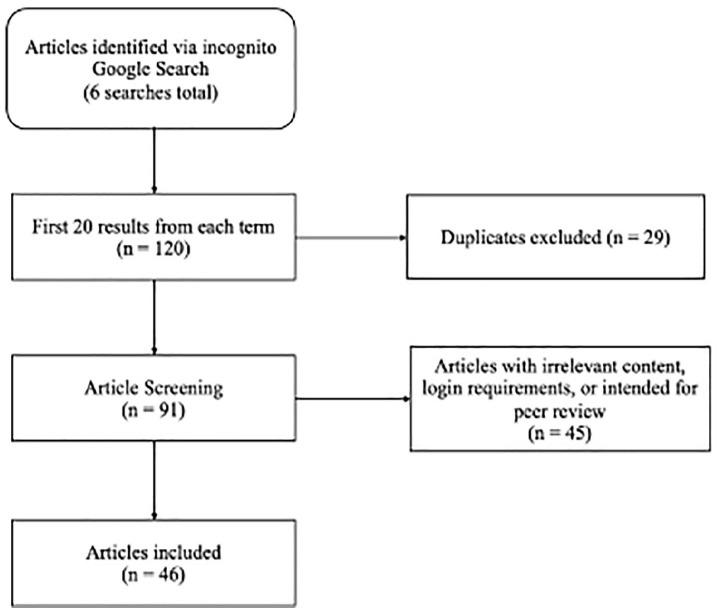
After conducting a Google search using 6 terms related to ankle fractures, we collected the first 20 nonsponsored results for each term. Readability was evaluated using the Flesch Reading Ease (FRE), Flesch-Kincaid Grade Level (FKGL), and Gunning Fog Index (GFI) instruments. Quality was evaluated using custom created Ankle Fracture Index (AFI).
A total of 46 of 120 articles met the inclusion criteria. The mean FKGL, FRE, and GFI scores were 8.4 ± 0.5, 57.5 ± 3.2, and 10.5 ± 0.5, respectively. The average AFI score was 15.4 ± 1.4, corresponding to an "acceptable" quality rating. Almost 70% of articles (n = 32) were written at or below the recommended eighth-grade reading level. Most articles discussed the need for imaging in diagnosis and treatment planning while neglecting to discuss the risks of surgery or potential future operations.
We found that online patient-facing materials on ankle fractures demonstrated an eighth-grade average reading grade level and an acceptable quality on content analysis. Further work should surround increasing information regarding risk factors, complications for surgery, and long-term recovery while ensuring that readability levels remain below at least the eighth-grade level.
鉴于互联网接入的普及程度不断提高,确保在线提供的患者教育信息材料准确且易于阅读,以提高健康素养至关重要。本研究旨在调查最受欢迎的踝关节骨折在线资源的质量和可读性。
使用与踝关节骨折相关的6个术语进行谷歌搜索后,我们收集了每个术语的前20个非赞助结果。使用弗莱什易读性(FRE)、弗莱什-金凯德年级水平(FKGL)和冈宁雾度指数(GFI)工具评估可读性。使用自定义创建的踝关节骨折指数(AFI)评估质量。
120篇文章中有46篇符合纳入标准。平均FKGL、FRE和GFI分数分别为8.4±0.5、57.5±3.2和10.5±0.5。平均AFI分数为15.4±1.4,对应于“可接受”的质量评级。近70%的文章(n = 32)的写作水平在推荐的八年级或以下。大多数文章讨论了诊断和治疗计划中成像的必要性,而忽略了讨论手术风险或潜在的未来手术。
我们发现,面向患者的踝关节骨折在线材料在内容分析中显示出平均八年级的阅读水平和可接受的质量。进一步的工作应围绕增加有关风险因素、手术并发症和长期恢复的信息展开,同时确保可读性水平至少保持在八年级以下。