Graduate School of Biomedical and Health Sciences, Hiroshima University, Hiroshima, Japan.
International Centre for Diarrhoeal Disease Research, Bangladesh, Dhaka, Bangladesh.
J Med Internet Res. 2020 Dec 7;22(12):e19137. doi: 10.2196/19137.
Hypertension (HTN) is a major modifiable risk factor and the leading cause of premature deaths globally. The lack of awareness and knowledge have been identified as risk factors in low- and middle-income countries including Bangladesh. Recently, the use of mobile phone SMS text messaging is found to have an important positive impact on HTN management.
The study aimed to develop awareness and knowledge in order to enhance lifestyle behavior changes among individuals with HTN in a rural community of Bangladesh by using health education and mobile health (mHealth) technology (SMS text messaging).
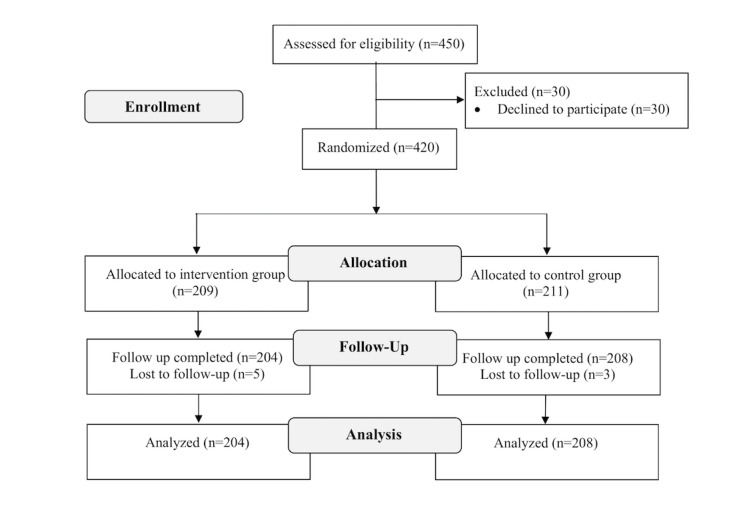
A prospective randomized 5-month intervention, open-label (1:1), parallel-group trial was implemented among the individuals with HTN aged 35 years or older. Both men and women were included. Between August 2018 and July 2019, we enrolled 420 participants, selected from a tertiary level health facility and through door-to-door visits by community health workers. After block randomization, they were assigned to either the intervention group (received SMS text messaging and health education; n=209) or the control group (received only health education; n=211). The primary outcome was the evaluation of self-reported behavior changes (salt intake, fruits and vegetables intake, physical activity, and blood pressure [BP], and body weight monitoring behaviors). The secondary outcomes were measurements of actual salt intake and dietary salt excretion, blood glucose level, BP values, and quality of life (QOL).
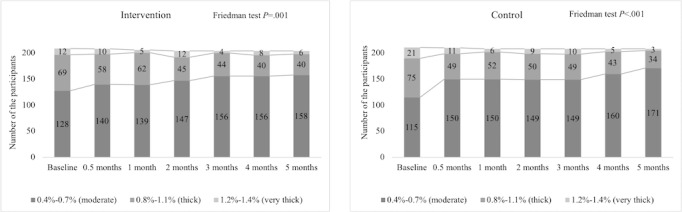
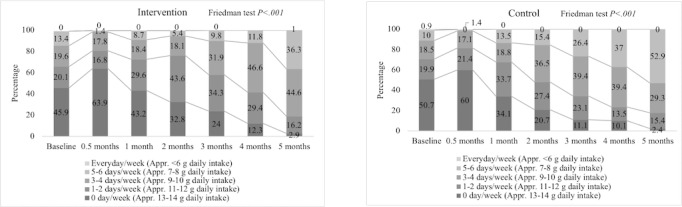
During the study period, a total of 8 participants were dropped, and the completion rate was 98.0% (412/420). The adherence rates were significantly higher (9%) among the control group regarding salt intake (P=.04) and physical activity behaviors (P<.03), and little differences were observed in other behaviors. In primary outcome, the focused behavior, salt intake less than 6 g/day, showed significant chronological improvement in both groups (P<.001). The fruits intake behavior steadily improved in both groups (P<.001). Participants in both groups had a custom of vegetables intake everyday/week. Physical activity suddenly increased and continued until the study end (P<.001 in both groups). Both BP and body weight monitoring status increased from baseline to 1 month but decreased afterward (P<.001). In case of secondary outcomes, significant chronological changes were observed in food salt concentration and urinary salinity between the groups (P=.01). The mean systolic BP and diastolic BP significantly chronologically decreased in both groups (systolic BP, P=.04; diastolic BP, P=.02.P<.05). All of these supported self-reported behavior changes. For the QOL, both groups showed significant improvement over the study periods (P<.001).
Based on these results, we suggest that face-to-face health education requires integration of home health care provision and more relevant and timely interactive SMS text messages to increase the effectiveness of the intervention. Besides, community awareness can be created to encourage "low-salt culture" and educate family members.
Bangladesh Medical Research Council (BMRC) 06025072017; ClinicalTrials.gov NCT03614104; https://clinicaltrials.gov/ct2/show/NCT03614104 and UMIN-CTR R000033736; https://tinyurl.com/y48yfcoo.
INTERNATIONAL REGISTERED REPORT IDENTIFIER (IRRID): RR2-10.2196/15523.
高血压(HTN)是一个主要的可调节风险因素,也是全球导致过早死亡的主要原因。在包括孟加拉国在内的中低收入国家,缺乏意识和知识被认为是风险因素。最近,使用手机短信文本消息已被发现对高血压管理有重要的积极影响。
本研究旨在通过健康教育和移动医疗(mHealth)技术(短信文本消息)提高孟加拉国农村社区高血压患者的意识和知识,从而改变他们的生活方式行为。
2018 年 8 月至 2019 年 7 月期间,我们在一家三级医疗机构和社区卫生工作者挨家挨户走访中,对年龄在 35 岁及以上的高血压患者进行了一项前瞻性随机 5 个月干预、开放标签(1:1)、平行组试验。男女均有纳入。共纳入 420 名参与者,在经过块随机分组后,他们被分配到干预组(接受短信文本消息和健康教育;n=209)或对照组(仅接受健康教育;n=211)。主要结局是评估自我报告的行为变化(盐摄入量、水果和蔬菜摄入量、体力活动、血压[BP]和体重监测行为)。次要结局是测量实际盐摄入量和膳食盐排泄量、血糖水平、BP 值和生活质量(QOL)。
在研究期间,共有 8 名参与者退出,完成率为 98.0%(412/420)。在盐摄入量(P=.04)和体力活动行为(P<.03)方面,对照组的依从率明显更高(9%),而其他行为的差异较小。在主要结局方面,关注的行为,即每天摄入盐少于 6 克,两组均呈现出显著的时间改善(P<.001)。水果摄入行为在两组中均稳步改善(P<.001)。两组参与者都有每天/每周吃蔬菜的习惯。体力活动突然增加,并持续到研究结束(两组均 P<.001)。BP 和体重监测状况从基线开始增加,但随后下降(两组均 P<.001)。在次要结局方面,两组之间的食物盐浓度和尿盐度均呈现出显著的时间变化(P=.01)。两组的平均收缩压和舒张压均呈显著的时间下降(收缩压,P=.04;舒张压,P=.02,P<.05)。所有这些都支持自我报告的行为变化。对于 QOL,两组在整个研究期间均显示出显著的改善(P<.001)。
基于这些结果,我们建议面对面的健康教育需要整合家庭保健服务,并提供更相关和及时的互动短信,以提高干预的效果。此外,可以提高社区意识,鼓励“低盐文化”,并教育家庭成员。
孟加拉国医学研究委员会(BMRC)06025072017;ClinicalTrials.gov NCT03614104;https://clinicaltrials.gov/ct2/show/NCT03614104 和 UMIN-CTR R000033736;https://tinyurl.com/y48yfcoo。
国际注册报告标识符(IRRID):RR2-10.2196/15523。