Department of Urology, Kanagawa Cancer Center, Yokohama, Kanagawa, 241-8515, Japan.
Division of Cancer Immunotherapy, Kanagawa Cancer Center Research Institute, Yokohama, Kanagawa, 241-8515, Japan.
Int J Clin Oncol. 2024 Jun;29(6):832-839. doi: 10.1007/s10147-024-02477-4. Epub 2024 Apr 6.
Few studies have reported reliable prognostic factors for immune checkpoint inhibitors (ICIs) in renal cell carcinoma (RCC). Therefore, we investigated prognostic factors in patients treated with ICIs for unresectable or metastatic RCC.
We included 43 patients who received ICI treatment for RCC between January 2018 and October 2021. Blood samples were drawn before treatment, and 73 soluble factors in the plasma were analyzed using a bead-based multiplex assay. We examined factors associated with progression-free survival (PFS), overall survival (OS), and immune-related adverse events (irAE) using the Chi-squared test, Kaplan-Meier method, and the COX proportional hazards model.
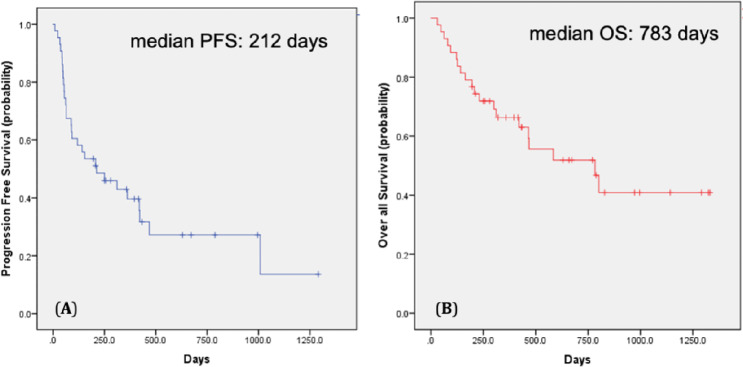
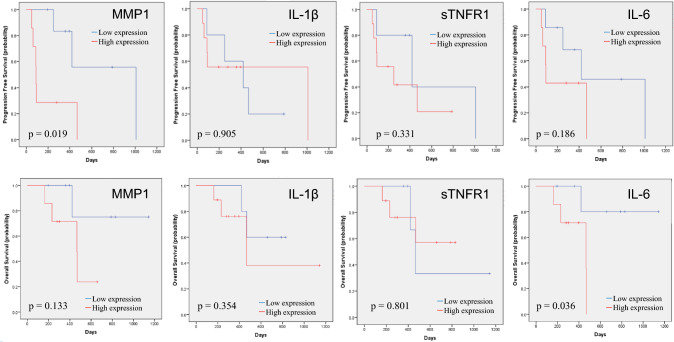
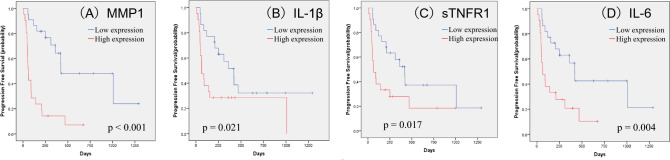
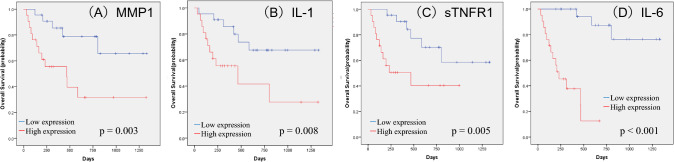
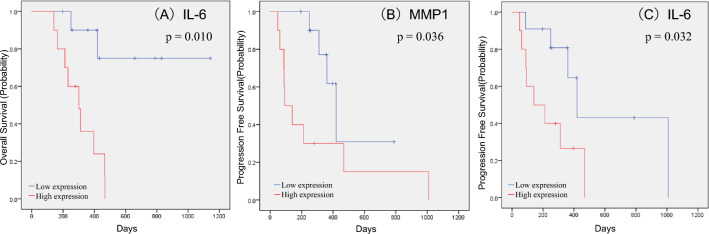
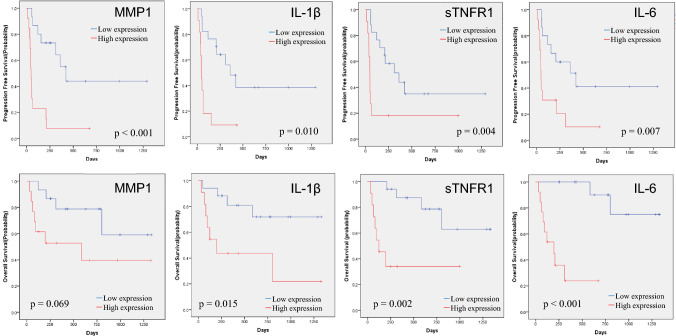
Patients exhibited a median PFS and OS of 212 and 783 days, respectively. Significant differences in both PFS and OS were observed for MMP1 (PFS, p < 0.001; OS, p = 0.003), IL-1β (PFS, p = 0.021; OS, p = 0.008), sTNFR-1 (PFS, p = 0.017; OS, p = 0.005), and IL-6 (PFS, p = 0.004; OS, p < 0.001). Multivariate analysis revealed significant differences in PFS for MMP1 (hazard ratio [HR] 5.305, 95% confidence interval [CI], 1.648-17.082; p = 0.005) and OS for IL-6 (HR 23.876, 95% CI, 3.426-166.386; p = 0.001). Moreover, 26 patients experienced irAE, leading to ICI discontinuation or withdrawal. MMP1 was significantly associated with irAE (p = 0.039).
MMP1 may be associated with severe irAE, and MMP1, IL-1β, sTNFR-1, and IL-6 could serve as prognostic factors in unresectable or metastatic RCC treated with ICIs. MMP1 and IL-6 were independent predictors of PFS and OS, respectively. Thus, inhibiting these soluble factors may be promising for enhancing antitumor responses in patients with RCC treated with ICIs.
鲜有研究报道肾细胞癌(RCC)患者接受免疫检查点抑制剂(ICI)治疗的可靠预后因素。因此,我们研究了接受ICI 治疗不可切除或转移性 RCC 患者的预后因素。
我们纳入了 2018 年 1 月至 2021 年 10 月期间接受 ICI 治疗的 43 例 RCC 患者。在治疗前采集血液样本,并使用基于珠的多重分析检测血浆中的 73 种可溶性因子。我们使用卡方检验、Kaplan-Meier 法和 COX 比例风险模型检查与无进展生存期(PFS)、总生存期(OS)和免疫相关不良事件(irAE)相关的因素。
患者的中位 PFS 和 OS 分别为 212 和 783 天。MMP1(PFS,p<0.001;OS,p=0.003)、IL-1β(PFS,p=0.021;OS,p=0.008)、sTNFR-1(PFS,p=0.017;OS,p=0.005)和 IL-6(PFS,p=0.004;OS,p<0.001)在 PFS 和 OS 方面均存在显著差异。多变量分析显示,MMP1(风险比[HR]5.305,95%置信区间[CI]1.648-17.082;p=0.005)与 PFS 相关,IL-6(HR 23.876,95%CI 3.426-166.386;p=0.001)与 OS 相关。此外,26 例患者发生 irAE,导致 ICI 停药或撤药。MMP1 与 irAE 显著相关(p=0.039)。
MMP1 可能与严重的 irAE 相关,MMP1、IL-1β、sTNFR-1 和 IL-6 可能成为接受 ICI 治疗的不可切除或转移性 RCC 的预后因素。MMP1 和 IL-6 分别是 PFS 和 OS 的独立预测因素。因此,抑制这些可溶性因子可能有助于增强接受 ICI 治疗的 RCC 患者的抗肿瘤反应。