Division of Infections and Molecular Biology, Department of Health Promotion, Kyushu Dental University, 2-6-1 Manazuru, Kokurakita-ku, Kitakyushu, Fukuoka, 803-8580, Japan.
Saki Animal Hospital, 1-19-33, Mukaino, Minami-ku, Fukuoka, 815-0035, Japan.
BMC Vet Res. 2024 Apr 5;20(1):138. doi: 10.1186/s12917-024-03973-5.
Periodontitis is the most common oral disease in dogs, and its progression and severity are influenced by risk factors, such as age and body size. Recent studies have assessed the canine oral microbiota in relation to different stages of periodontitis and niches within the oral cavity. However, knowledge of the bacterial composition at different ages and body sizes, especially in puppies, is limited. This study aimed to characterize the oral microbiota in the healthy gingiva of small breed puppies using next-generation sequencing. Additionally, we assessed the impact of dental care practices and the presence of retained deciduous teeth on the oral microbiota.
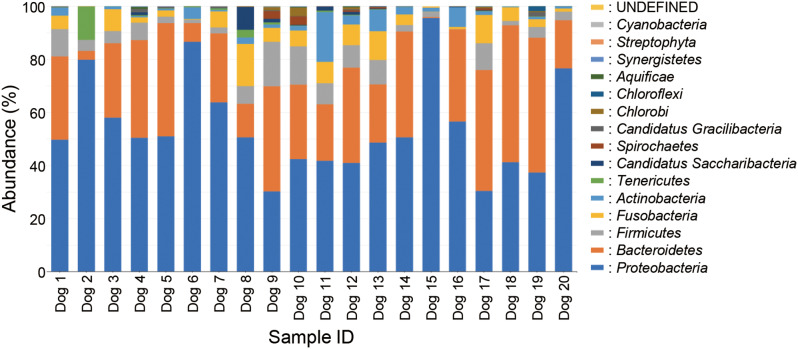
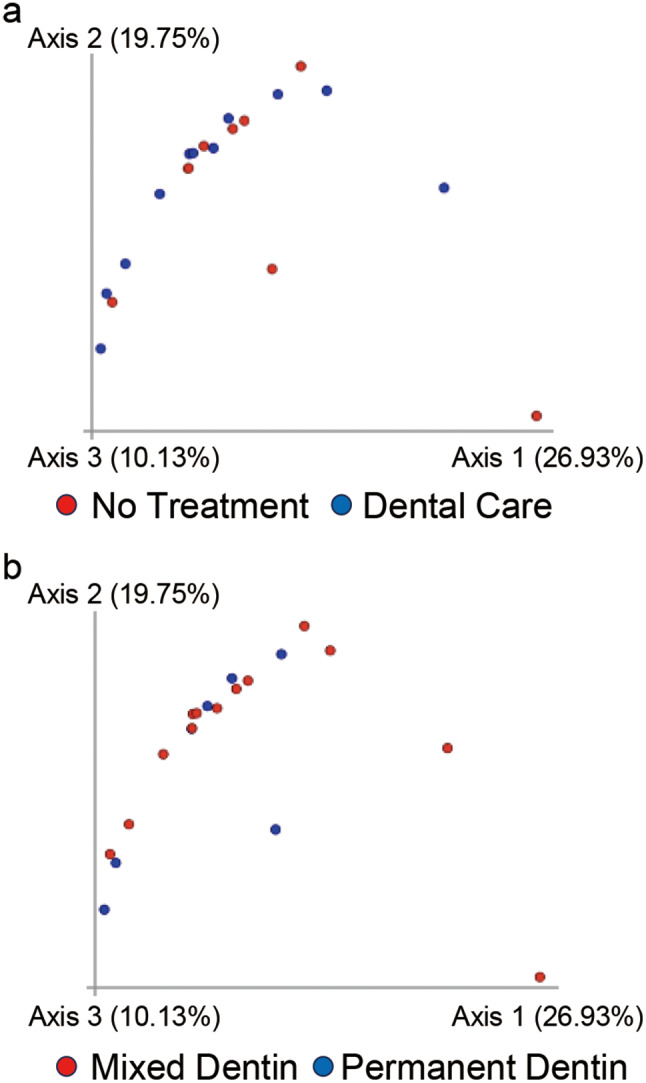
In this study, plaque samples were collected from the gingival margin of 20 small breed puppies (age, 6.9 ± 0.6 months). The plaque samples were subjected to next-generation sequencing targeting the V3-V4 region of the 16 S rRNA. The microbiota of the plaque samples was composed mostly of gram-negative bacteria, primarily Proteobacteria (54.12%), Bacteroidetes (28.79%), and Fusobacteria (5.11%). Moraxella sp. COT-017, Capnocytophaga cynodegmi COT-254, and Bergeyella zoohelcum COT-186 were abundant in the oral cavity of the puppies. In contrast, Neisseria animaloris were not detected. The high abundance of Pasteurellaceae suggests that this genus is characteristic of the oral microbiota in puppies. Dental care practices and the presence of retained deciduous teeth showed no effects on the oral microbiota.
In this study, many bacterial species previously reported to be detected in the normal oral cavity of adult dogs were also detected in 6-8-month-old small breed dogs. On the other hand, some bacterial species were not detected at all, while others were detected in high abundance. These data indicate that the oral microbiota of 6-8-month-old small breed dogs is in the process of maturating in to the adult microbiota and may also have characteristics of the small dog oral microbiota.
牙周炎是犬最常见的口腔疾病,其进展和严重程度受年龄和体型等危险因素的影响。最近的研究评估了犬口腔微生物群与牙周炎的不同阶段和口腔内不同部位的关系。然而,关于不同年龄和体型,特别是在幼犬中,细菌组成的知识有限。本研究旨在使用下一代测序技术描述小型犬健康牙龈的口腔微生物群。此外,我们评估了牙齿护理实践和滞留乳牙的存在对口腔微生物群的影响。
在这项研究中,从 20 只小型犬(年龄 6.9±0.6 个月)的牙龈边缘采集菌斑样本。将菌斑样本进行下一代测序,靶向 16S rRNA 的 V3-V4 区。菌斑样本的微生物群主要由革兰氏阴性菌组成,主要为变形菌门(54.12%)、拟杆菌门(28.79%)和梭杆菌门(5.11%)。莫拉氏菌属 COT-017、嗜沫卡他菌 COT-254 和伯格氏菌 COT-186 在幼犬口腔中大量存在。相反,未检测到奈瑟氏球菌属。巴斯德氏菌科的高丰度表明该属是幼犬口腔微生物群的特征。牙齿护理实践和滞留乳牙对口腔微生物群没有影响。
在本研究中,许多以前报道在成年犬正常口腔中检测到的细菌种类也在 6-8 月龄的小型犬中检测到。另一方面,有些细菌种类根本没有检测到,而有些细菌种类则大量存在。这些数据表明,6-8 月龄小型犬的口腔微生物群正在向成年微生物群成熟,并可能具有小型犬口腔微生物群的特征。