Sugiyama Yu, Kuramitsu Shunichiro, Eguchi Kaoru, Ito Masashi, Ando Ryo, Matsuno Hiroki, Suzaki Noriyuki, Maesawa Satoshi
J Neurosurg Case Lessons. 2024 Apr 8;7(15). doi: 10.3171/CASE23757.
von Hippel-Lindau disease-associated hemangioblastomas (HBs) account for 20%-30% of all HB cases, with the appearance of new lesions often observed in the natural course of the disease. By comparison, the development of new lesions is rare in patients with sporadic HB.
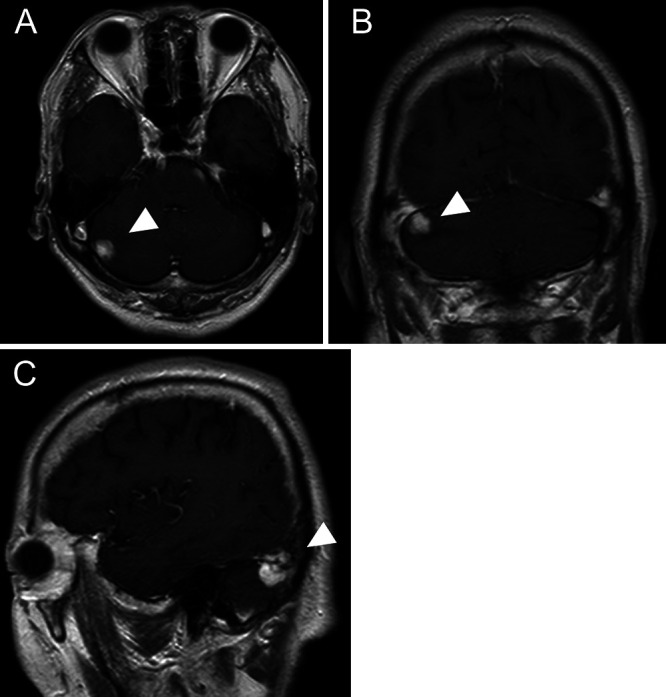
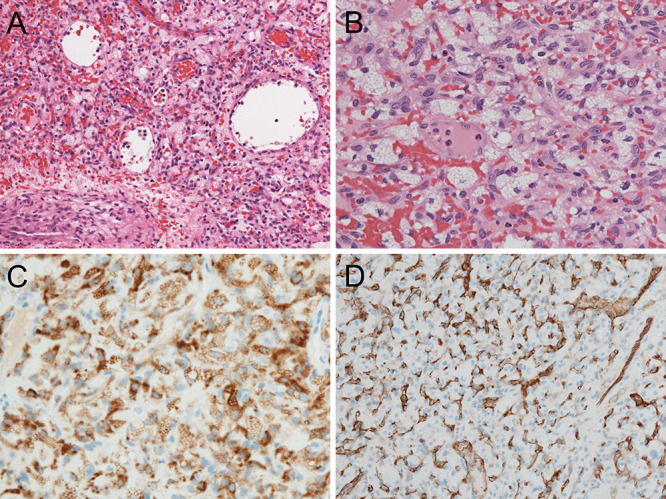
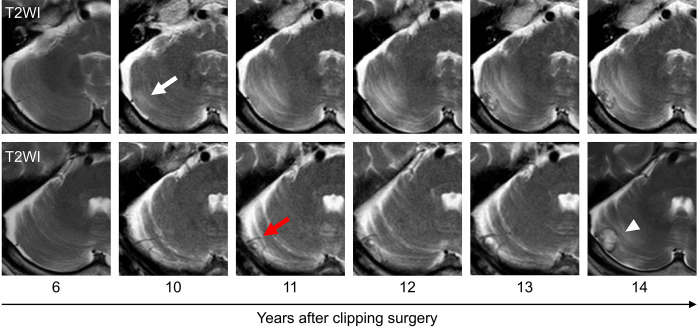
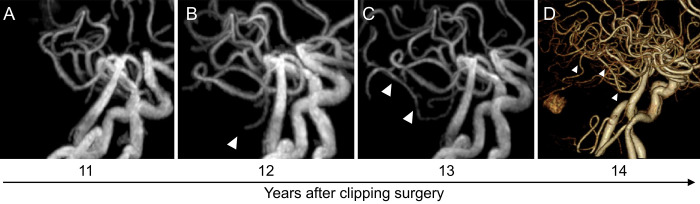
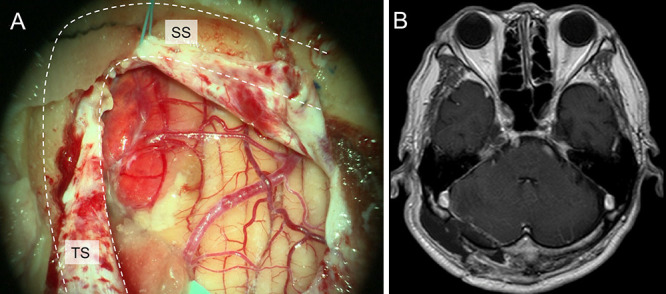
A 65-year-old man underwent clipping for an unruptured aneurysm of the anterior communicating artery. Fourteen years later, follow-up magnetic resonance imaging (MRI) revealed a strongly enhanced mass in the right cerebellar hemisphere, diagnosed as a sporadic HB. A retrospective review of MRI studies obtained over the follow-up period revealed the gradual development of peritumoral edema and vascularization before mass formation.
Newly appearing high-intensity T2 lesions in the cerebellum may represent a preliminary stage of tumorigenesis. Careful monitoring of these patients would be indicated, which could provide options for early treatment to improve patient outcomes.
与冯·希佩尔-林道病相关的血管母细胞瘤(HBs)占所有HB病例的20%-30%,在疾病自然进程中常可见新病灶出现。相比之下,散发性HB患者中新病灶的发生较为罕见。
一名65岁男性因前交通动脉未破裂动脉瘤接受夹闭术。14年后,随访磁共振成像(MRI)显示右侧小脑半球有一强化明显的肿块,诊断为散发性HB。对随访期间获得的MRI研究进行回顾性分析发现,在肿块形成前瘤周水肿和血管化逐渐发展。
小脑新出现的T2高信号病灶可能代表肿瘤发生的早期阶段。应对这些患者进行密切监测,这可为早期治疗提供选择,以改善患者预后。