Yin Xiangdong, Duan Hongzhou, Yi Zhiqiang, Li Chunwei, Lu Runchun, Li Liang
Department of Neurosurgery, Peking University First Hospital, Beijing, China.
Front Oncol. 2020 Sep 9;10:570103. doi: 10.3389/fonc.2020.570103. eCollection 2020.
Hemangioblastomas are uncommon, benign neoplasms of the central nervous system (CNS). This study aims to evaluate the incidence, demographics, clinical characteristics, and prognosis of CNS hemangioblastomas using the data from the Surveillance, Epidemiology, and End Results (SEER) Program.
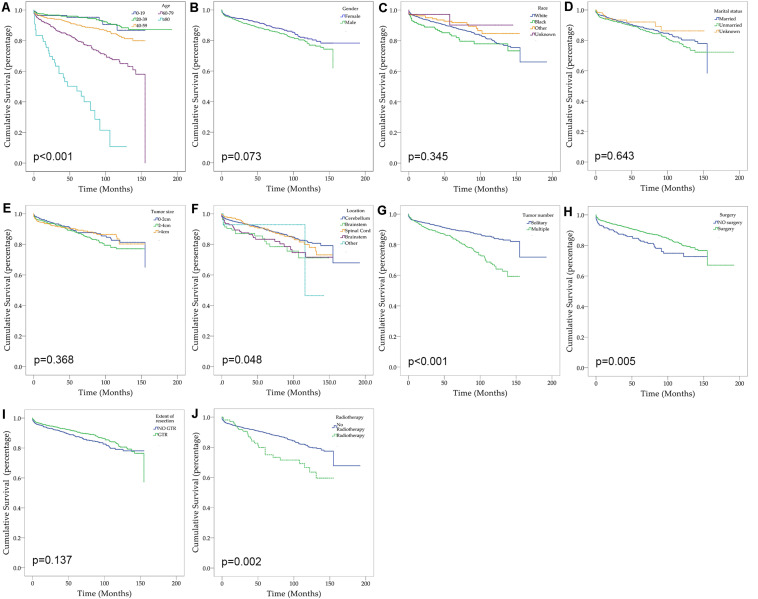
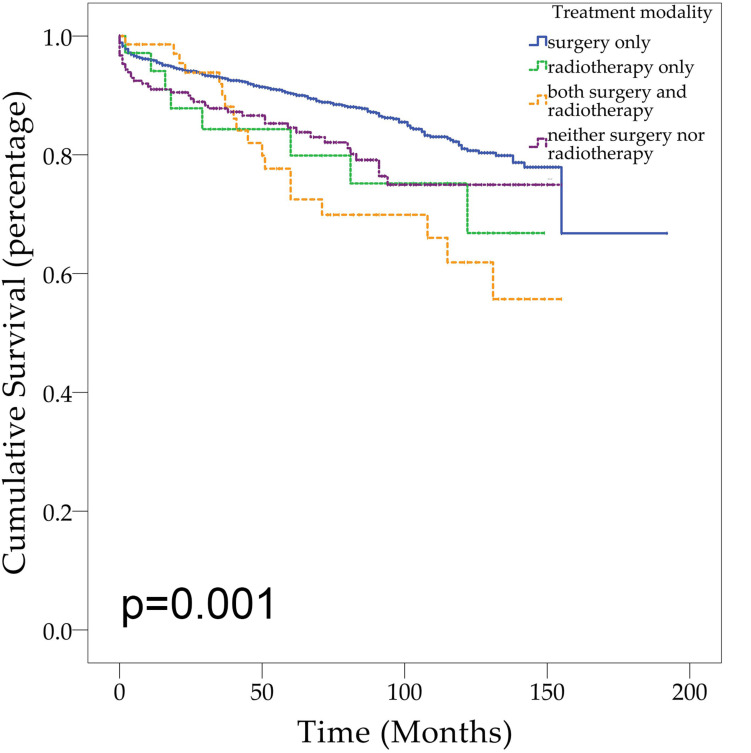
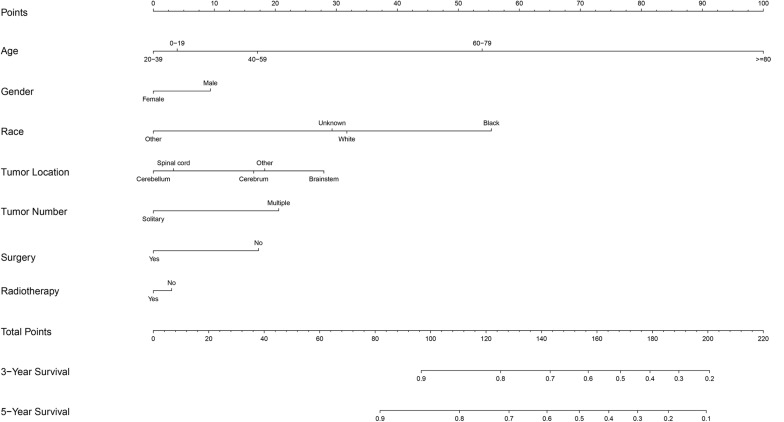
Univariate and multivariate analyses using the Cox proportional hazards model were employed to identify prognostic factors of overall survival. The Kaplan-Meier method was utilized to evaluate overall survival distribution by treatment modality. A nomogram was further built to predict survival at 3 and 5 years.
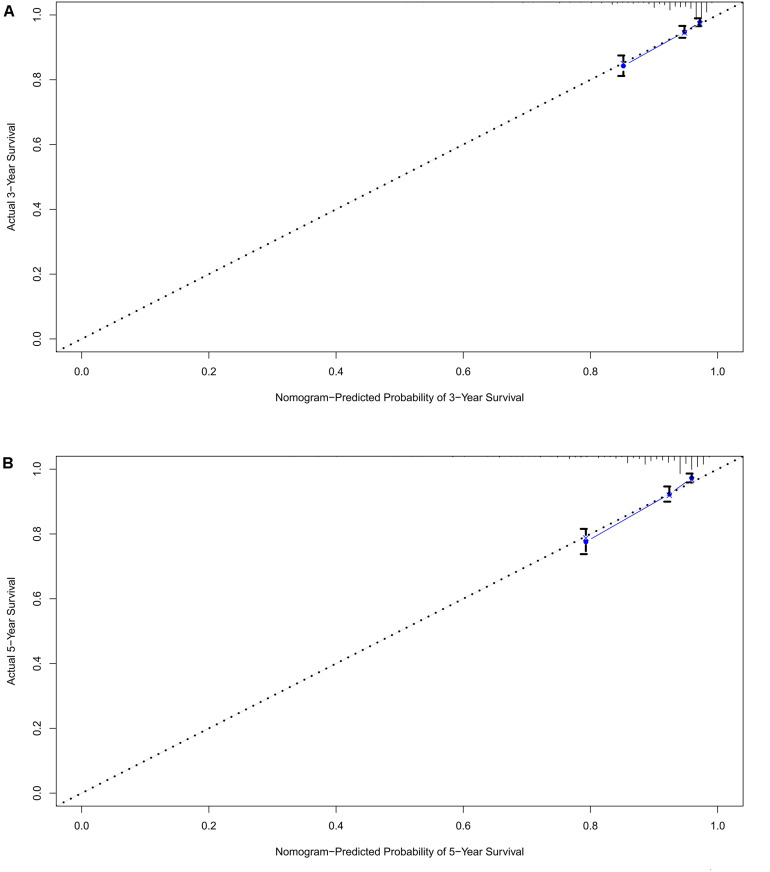
The overall incidence rate of CNS hemangioblastomas was 0.141 per 100,000 person-years. Through univariate analysis and multivariate analyses, age between 60 and 79 years (HR = 3.697, < 0.001), age greater than 80 years (HR = 12.318, < 0.001), African American race (HR = 1.857, = 0.003), multiple tumors (HR = 1.715, < 0.001), and prior surgery (HR = 0.638, = 0.013) were significantly associated with overall survival. Patients receiving surgery alone had better overall survival compared with patients receiving no treatment ( = 0.008) and patients receiving both surgery and radiotherapy ( = 0.002). The calibration plots demonstrated an excellent agreement between nomogram-predicted and actual survival.
In conclusion, age, race, tumor location, number of tumors, and prior surgery are prognostic factors for survival. Surgery was the most common modality and was suggested as an effective and optimal treatment. The proposed nomogram can predict the prognosis of patients with CNS hemangioblastomas and help clinicians in making decisions.
血管母细胞瘤是中枢神经系统(CNS)罕见的良性肿瘤。本研究旨在利用监测、流行病学和最终结果(SEER)计划的数据评估CNS血管母细胞瘤的发病率、人口统计学特征、临床特征和预后。
采用Cox比例风险模型进行单因素和多因素分析,以确定总生存的预后因素。采用Kaplan-Meier法按治疗方式评估总生存分布。进一步构建列线图以预测3年和5年生存率。
CNS血管母细胞瘤的总发病率为每10万人年0.141例。通过单因素分析和多因素分析,60至79岁(HR = 3.697,P < 0.001)、80岁以上(HR = 12.318,P < 0.001)、非裔美国人种族(HR = 1.857,P = 0.003)、多发肿瘤(HR = 1.715,P < 0.001)和既往手术史(HR = 0.638,P = 0.013)与总生存显著相关。单纯接受手术的患者与未接受治疗的患者(P = 0.008)及接受手术和放疗的患者(P = 0.002)相比,总生存情况更好。校准图显示列线图预测的生存率与实际生存率之间具有良好的一致性。
总之,年龄、种族、肿瘤位置、肿瘤数量和既往手术史是生存的预后因素。手术是最常见治疗方式,被认为是一种有效且最佳的治疗方法。所提出的列线图可预测CNS血管母细胞瘤患者的预后,并帮助临床医生做出决策。