Machine Learning and Data Analytics Lab (MaD Lab), Department Artificial Intelligence in Biomedical Engineering (AIBE), Friedrich-Alexander-Universität Erlangen-Nürnberg (FAU), 91052, Erlangen, Germany.
Fraunhofer Institute for Integrated Circuits IIS, 91058, Erlangen, Germany.
Sci Rep. 2024 Apr 8;14(1):8251. doi: 10.1038/s41598-024-59043-1.
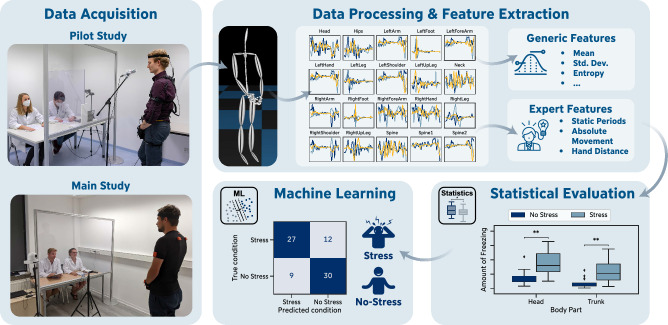
Investigating acute stress responses is crucial to understanding the underlying mechanisms of stress. Current stress assessment methods include self-reports that can be biased and biomarkers that are often based on complex laboratory procedures. A promising additional modality for stress assessment might be the observation of body movements, which are affected by negative emotions and threatening situations. In this paper, we investigated the relationship between acute psychosocial stress induction and body posture and movements. We collected motion data from N = 59 individuals over two studies (Pilot Study: N = 20, Main Study: N = 39) using inertial measurement unit (IMU)-based motion capture suits. In both studies, individuals underwent the Trier Social Stress Test (TSST) and a stress-free control condition (friendly-TSST; f-TSST) in randomized order. Our results show that acute stress induction leads to a reproducible freezing behavior, characterized by less overall motion as well as more and longer periods of no movement. Based on these data, we trained machine learning pipelines to detect acute stress solely from movement information, achieving an accuracy of (Pilot Study) and (Main Study). This, for the first time, suggests that body posture and movements can be used to detect whether individuals are exposed to acute psychosocial stress. While more studies are needed to further validate our approach, we are convinced that motion information can be a valuable extension to the existing biomarkers and can help to obtain a more holistic picture of the human stress response. Our work is the first to systematically explore the use of full-body body posture and movement to gain novel insights into the human stress response and its effects on the body and mind.
研究急性应激反应对于理解应激的潜在机制至关重要。目前的应激评估方法包括可能存在偏差的自我报告和通常基于复杂实验室程序的生物标志物。评估应激的另一种有前途的方法可能是观察身体运动,身体运动受负面情绪和威胁性情况的影响。在本文中,我们研究了急性心理社会应激诱导与身体姿势和运动之间的关系。我们通过基于惯性测量单元 (IMU) 的运动捕捉套装,在两项研究中(初步研究:N=20,主要研究:N=39)从 N=59 个人中收集了运动数据。在两项研究中,个体随机接受特里尔社会应激测试(TSST)和无压力对照条件(友好 TSST;f-TSST)。我们的结果表明,急性应激诱导导致可重复的冻结行为,其特征是整体运动减少以及更多和更长时间的无运动期。基于这些数据,我们训练了机器学习管道,仅从运动信息中检测急性应激,在初步研究中达到了 (准确性)和在主要研究中达到了 (准确性)。这首次表明,身体姿势和运动可用于检测个体是否暴露于急性心理社会应激。虽然需要更多的研究来进一步验证我们的方法,但我们坚信运动信息可以作为现有生物标志物的有价值的补充,并有助于更全面地了解人类应激反应。我们的工作首次系统地探索了全身姿势和运动的使用,以深入了解人类应激反应及其对身心的影响。