Chamlagain Manoj, Hu Jieni, Sionov Ronit Vogt, Steinberg Doron
Institute of Biomedical and Oral Research (IBOR), The Faculty of Dental Medicine, The Hebrew University of Jerusalem, Jerusalem, Israel.
Department of Biology, Hong Kong Baptist University, Kowloon, Hong Kong SAR, China.
Front Microbiol. 2024 Feb 26;15:1333274. doi: 10.3389/fmicb.2024.1333274. eCollection 2024.
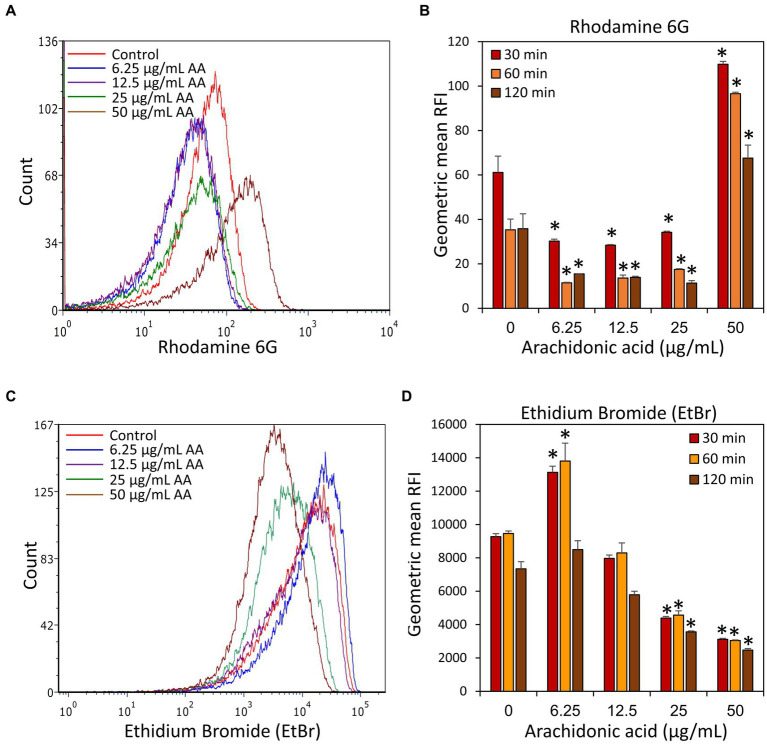
is a Gram-positive, facultative anaerobic bacterium, which causes dental caries after forming biofilms on the tooth surface while producing organic acids that demineralize enamel and dentin. We observed that the polyunsaturated arachidonic acid (AA) (ω-6; 20:4) had an anti-bacterial activity against , which prompted us to investigate its mechanism of action. The minimum inhibitory concentration (MIC) of AA on was 25 μg/ml in the presence of 5% CO, while it was reduced to 6.25-12.5 μg/ml in the absence of CO supplementation. The anti-bacterial action was due to a combination of bactericidal and bacteriostatic effects. The minimum biofilm inhibitory concentration (MBIC) was the same as the MIC, suggesting that part of the anti-biofilm effect was due to the anti-bacterial activity. Gene expression studies showed decreased expression of biofilm-related genes, suggesting that AA also has a specific anti-biofilm effect. Flow cytometric analyses using potentiometric DiOC2(3) dye, fluorescent efflux pump substrates, and live/dead SYTO 9/propidium iodide staining showed that AA leads to immediate membrane hyperpolarization, altered membrane transport and efflux pump activities, and increased membrane permeability with subsequent membrane perforation. High-resolution scanning electron microscopy (HR-SEM) showed remnants of burst bacteria. Furthermore, flow cytometric analysis using the redox probe 2',7'-dichlorofluorescein diacetate (DCFHDA) showed that AA acts as an antioxidant in a dose-dependent manner. α-Tocopherol, an antioxidant that terminates the radical chain, counteracted the anti-bacterial activity of AA, suggesting that oxidation of AA in bacteria leads to the production of cytotoxic radicals that contribute to bacterial growth arrest and death. Importantly, AA was not toxic to normal Vero epithelial cells even at 100 μg/ml, and it did not cause hemolysis of erythrocytes. In conclusion, our study shows that AA is a potentially safe drug that can be used to reduce the bacterial burden of cariogenic .
是一种革兰氏阳性兼性厌氧菌,它在牙齿表面形成生物膜后会导致龋齿,同时产生使牙釉质和牙本质脱矿的有机酸。我们观察到多不饱和花生四烯酸(AA)(ω-6;20:4)对具有抗菌活性,这促使我们研究其作用机制。在5% CO存在的情况下,AA对的最低抑菌浓度(MIC)为25μg/ml,而在不补充CO的情况下,该浓度降至6.25 - 12.5μg/ml。抗菌作用是杀菌和抑菌作用共同作用的结果。最低生物膜抑制浓度(MBIC)与MIC相同,这表明部分抗生物膜作用归因于抗菌活性。基因表达研究表明生物膜相关基因的表达降低,这表明AA也具有特定的抗生物膜作用。使用电位DiOC2(3)染料、荧光外排泵底物以及活/死SYTO 9/碘化丙啶染色的流式细胞术分析表明,AA会导致膜立即超极化、膜转运和外排泵活性改变,以及膜通透性增加,随后膜穿孔。高分辨率扫描电子显微镜(HR-SEM)显示有破裂细菌的残余物。此外,使用氧化还原探针2',7'-二氯荧光素二乙酸酯(DCFHDA)的流式细胞术分析表明,AA以剂量依赖的方式作为抗氧化剂发挥作用。α-生育酚是一种终止自由基链的抗氧化剂,它抵消了AA的抗菌活性,这表明细菌中AA的氧化会导致细胞毒性自由基的产生,从而导致细菌生长停滞和死亡。重要的是,即使在100μg/ml时,AA对正常的Vero上皮细胞也没有毒性,并且它不会导致红细胞溶血。总之,我们的研究表明AA是一种潜在安全的药物,可用于减轻致龋菌的细菌负荷。