Carnegie Institution for Science, Pasadena, CA 91101.
Pacific Biosciences Research Center, University of Hawaii at Manoa, Honolulu, HI 96848.
Mol Biol Cell. 2024 Jun 1;35(6):ar79. doi: 10.1091/mbc.E24-01-0044. Epub 2024 Apr 10.
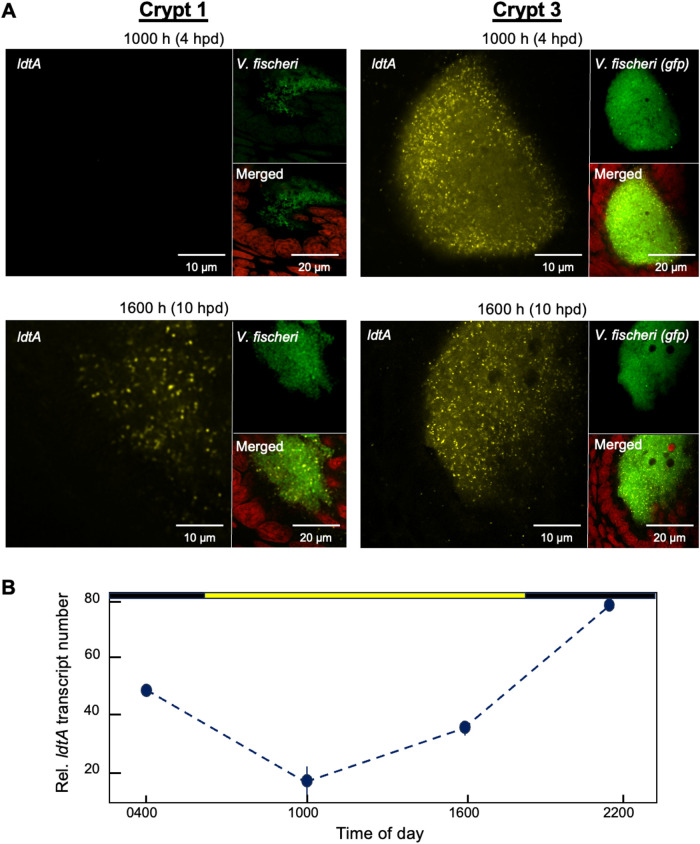
The symbiotic relationship between the bioluminescent bacterium and the bobtail squid serves as a valuable system to investigate bacterial growth and peptidoglycan (PG) synthesis within animal tissues. To better understand the growth dynamics of in the crypts of the light-emitting organ of its juvenile host, we showed that, after the daily dawn-triggered expulsion of most of the population, the remaining symbionts rapidly proliferate for ∼6 h. At that point the population enters a period of extremely slow growth that continues throughout the night until the next dawn. Further, we found that PG synthesis by the symbionts decreases as they enter the slow-growing stage. Surprisingly, in contrast to the most mature crypts (i.e., Crypt 1) of juvenile animals, most of the symbiont cells in the least mature crypts (i.e., Crypt 3) were not expelled and, instead, remained in the slow-growing state throughout the day, with almost no cell division. Consistent with this observation, the expression of the gene encoding the PG-remodeling enzyme, L,D-transpeptidase (LdtA), was greatest during the slowly growing stage of Crypt 1 but, in contrast, remained continuously high in Crypt 3. Finally, deletion of the gene resulted in a symbiont that grew and survived normally in culture, but was increasingly defective in competing against its parent strain in the crypts. This result suggests that remodeling of the PG to generate additional 3-3 linkages contributes to the bacterium's fitness in the symbiosis, possibly in response to stresses encountered during the very slow-growing stage.
发光细菌和短尾鱿鱼之间的共生关系是一个很有价值的系统,可以用来研究细菌在动物组织内的生长和肽聚糖(PG)合成。为了更好地了解 在其幼年宿主发光器官的隐窝内的生长动态,我们发现,在每天黎明触发的大部分种群排出之后,剩余的共生体在大约 6 小时内迅速增殖。此时,种群进入一个极其缓慢的生长阶段,一直持续到夜间,直到下一个黎明。此外,我们发现共生体的 PG 合成随着它们进入缓慢生长阶段而减少。令人惊讶的是,与幼年动物最成熟的隐窝(即 Crypt 1)相比,大多数共生体细胞在最不成熟的隐窝(即 Crypt 3)中没有被排出,而是在整个白天保持在缓慢生长状态,几乎没有细胞分裂。与这一观察结果一致的是,编码 PG 重塑酶 L,D-转肽酶(LdtA)的基因的表达在 Crypt 1 的缓慢生长阶段最大,但与此相反,在 Crypt 3 中保持持续高水平。最后, 基因的缺失导致共生体在培养中正常生长和存活,但在隐窝中与亲株竞争时越来越有缺陷。这一结果表明,PG 的重塑以产生额外的 3-3 键合有助于细菌在共生中的适应性,可能是对在非常缓慢生长阶段遇到的压力的反应。